











 Secure payments
Standard refund policy
Trade Assurance
Secure payments
Standard refund policy
Trade Assurance
| Model | M391A5143EB1-CRC |
|---|---|
| Product Type | Memory Module |
| Compliance Standards | EU RoHS,FCC |
| Memory Capacity | 4 GB |
| Memory Technology | DDR4 |
| Product Voltage | 1.2V |
| RAM Speed | 2400MHz |
| RAM Standard | DDR4-2400/PC4-19200 |
| Error Identifying | ECC |
| Signal Type | Unbuffered |
| Column Access Strobe (CAS) | CL17 |
| Rank | Single Rank x8 |
| Quantity of Pins | 288-pin |
| RAM Genre | UDIMM |
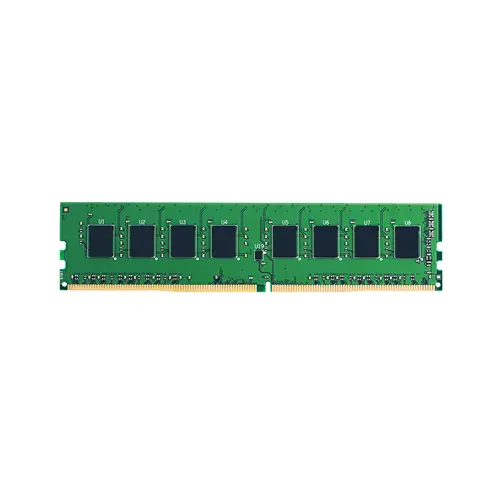
This Samsung 4GB DDR4-2400 Unbuffered ECC UDIMM (PC4-19200, CL17) targets entry-level servers and workstations where data integrity is non-negotiable, excelling in light virtualization, file serving, and small-scale database workloads. Its single-rank x8 design minimizes bus loading and improves signal integrity at 2400MHz, while the integrated ECC and unbuffered architecture deliver reliable error correction and low latency for always-on stability.
1. Error-correcting code consistently detects and corrects single-bit memory errors, preserving long-term data integrity for always-on services and mission-critical server environments.
2. The 4GB capacity provides precisely provisioned memory for lightweight server instances, edge computing nodes, or dedicated appliances where stable operation takes priority over raw density.
3. 2400MT/s data rate supplies ample throughput to handle concurrent network requests and moderate virtualization loads without becoming a bottleneck in small-business server platforms.
4. Operating at just 1.2 volts drives down power consumption and waste heat generation, directly lowering electricity costs and improving thermal headroom inside densely packed server chassis.
5. A CAS latency of 17 cycles reduces memory access delays, helping database queries and latency-sensitive enterprise microservices respond faster under constant client pressure.
When you select the Samsung M391A5143EB1-CRC for your entry-level server or critical workstation, you are investing in a memory module engineered to eliminate silent data corruption. In a 24/7 TrueNAS environment storing irreplaceable business records, the integrated ECC technology actively detects and corrects single-bit errors caused by background radiation, turning a potential backup failure into an invisible, self-healed event. That same reliability extends to a lightweight ESXi virtualization host, where a flipped bit in a running virtual machine can mean unbudgeted downtime; here, ECC gives you transactional consistency you can bank on. The module’s single-rank x8 design and unbuffered architecture, clocked at a responsive 2400MHz with a CL17 latency, keep your single-socket platform agile without the added complexity of registered buffers, while the frugal 1.2V DDR4 standard lowers thermal stress and energy bills in your cramped networking closet. RoHS and FCC compliance assure that this 4GB investment meets strict environmental and electromagnetic interference standards, so your pfSense firewall runs quietly and consistently. Ultimately, this memory transforms unpredictable hardware faults into predictable stability for the small-scale services your organization depends on.
Memory Type Assessment: The M391A5143EB1-CRC is a DDR4-2400 ECC Unbuffered DIMM (UDIMM) with a 4GB capacity. Its ECC support and 288-pin form factor identify it as server-grade memory, typically used in entry-level servers, small NAS systems, and single-socket workstations requiring data integrity.
Capacity Planning for Server Deployments
General Virtualization
For light to moderate VM densities, populate all available memory channels with identical modules to maximize bandwidth. A typical dual-socket platform with 8 DIMM slots can be filled with 8×4GB UDIMMs, delivering 32GB total. This balanced configuration avoids performance penalties from asymmetric channel loading and supports common hypervisors comfortably.
In-Memory Database
In-memory databases thrive on capacity and low latency, but 4GB modules limit per-server footprint. Install the maximum supported UDIMMs—often 16×4GB for 64GB in a single-socket platform—to store larger working sets. ECC protection is critical here, preventing silent data corruption during intensive transactional processing.
High-Performance Computing
HPC workloads favor bandwidth over density. Deploy one DIMM per channel across all memory controllers to achieve full interleaving, e.g., 6×4GB (24GB) on a six-channel server. This arrangement optimizes aggregate throughput for parallel floating-point and simulation codes; a second set of identical modules can be added if total capacity needs scaling without breaking channel symmetry.
Rigorously tested, this server memory is compatible with Dell PowerEdge T140, HPE ProLiant ML30 Gen10, Lenovo ThinkSystem ST250, and similar systems.
Q: Can I mix this M391A5143EB1-CRC with other memory modules of different brands or speeds?
A: Mixing is not recommended for server environments. ECC UDIMMs require matched ranks, timings, and voltage to maintain data integrity. For stable operation, use identical Samsung M391A5143EB1-CRC modules across all channels.
Q: Is this memory compatible with my Intel or AMD server platform?
A: This DDR4-2400 ECC UDIMM is validated for Intel Xeon E3-1200 v5/v6 and select Core i3/Pentium processors, as well as AMD AM4 platforms with ECC support. Verify your board supports unbuffered ECC DDR4 at 2400MT/s.
Q: What is the recommended DIMM population order for optimal performance?
A: Populate identical modules symmetrically across memory channels following the server board manual—typically starting with the farthest slots from the CPU per channel. Balanced loading ensures dual-channel performance and full ECC protection.
Q: Does this module support overclocking or XMP profiles?
A: No. As an enterprise-grade ECC UDIMM, the M391A5143EB1-CRC runs strictly at JEDEC-standard DDR4-2400 CL17. Overclocking and XMP are disabled to preserve signal integrity and error correction capability.
Q: What warranty and typical failure rate can I expect?
A: This Samsung module includes a 1-year warranty. Built with first-tier DRAM chips, it delivers an exceptionally low annualized failure rate (typically <0.1%), ensuring reliable 24/7 server operation within specified conditions.