











 Secure payments
Standard refund policy
Trade Assurance
Secure payments
Standard refund policy
Trade Assurance
| Product Type | Memory Module |
|---|---|
| Compliance Standards | EU RoHS,FCC |
| Memory Capacity | 4 GB |
| Memory Technology | DDR4 |
| Product Voltage | 1.2V |
| RAM Speed | 2400MHz |
| RAM Standard | DDR4-2400/PC4-19200 |
| Error Identifying | Non-ECC |
| Signal Type | Unbuffered |
| Column Access Strobe (CAS) | CL17 |
| Rank | Single Rank x16 |
| Quantity of Pins | 288-pin |
| RAM Genre | UDIMM |
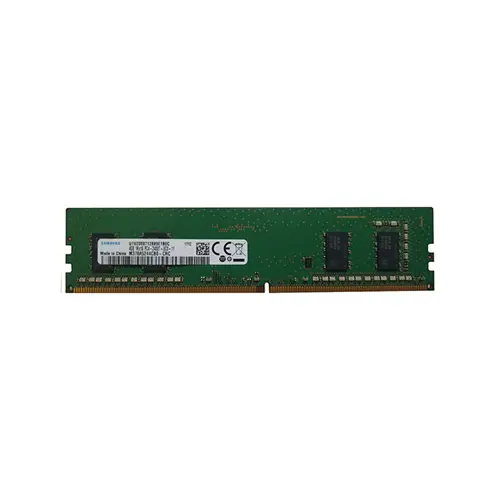
This DDR4 UDIMM is tailored for mainstream desktop platforms, delivering reliable 2400MHz performance at a low CL17 latency that readily supports gaming, content creation, and general productivity workloads. Its single-rank x16 configuration and unbuffered signal topology reduce the electrical load on the memory controller, ensuring stable operation and broad compatibility with consumer processors without the need for complex tuning.
1. Single Rank x16 organization streamlines the signal path for lower electrical loading, helping overclockers achieve higher stable frequencies on desktop platforms.
2. CL17 latency balances response time with clock cycle efficiency, delivering snappy application launches and smoother multitasking in everyday productivity and content creation.
3. 2400MHz data rate provides ample bandwidth for consistent frame pacing in mainstream gaming rigs without taxing the memory controller.
4. 4GB module capacity serves as an ideal baseline for building cost-effective office desktops or light-duty home PCs running essential applications.
5. Unbuffered design eliminates register delays, offering plug-and-play compatibility and instant responsiveness for users upgrading standard desktop motherboards.
The M378A5244CB0-CRC is a DDR4 Unbuffered DIMM built specifically for desktop platforms, where responsiveness directly shapes the user experience. Its 2400 MHz speed and PC4‑19200 bandwidth mean that when you are battling through a triple‑A game or scrubbing a 4K video timeline, textures and footage load with minimal wait, keeping the CPU fed and frame rates consistent. The CL17 CAS latency sharpens that advantage further — a lower cycle delay between a command and the data burst makes every interaction feel snappier, reducing the micro‑stutters that can ruin immersion during intensive rendering or competitive play. As a non‑ECC, unbuffered UDIMM, this module slots directly into mainstream consumer motherboards without the cost or compatibility hurdles of registered memory, giving you a simple, reliable upgrade path. The single‑rank x16 design and 1.2 V ultra‑low operating voltage collaborate behind the scenes: less electrical load on the memory controller improves stability, while reduced power draw cuts heat generation over hours of video encoding or gaming marathons. For a content creator balancing a demanding project or a gamer seeking fluid visuals, this memory translates technical precision into real‑world, uninterrupted performance.
Gaming Build
A single 4GB UDIMM is insufficient for modern titles; always install matched pairs for dual‑channel. For entry-level 1080p gaming, populate two or four identical modules to reach 16GB (4×4GB) and unlock the 128‑bit memory bus. Mid‑range builds should migrate to 32GB via eight modules if the motherboard supports it, though a 2×16GB kit is more electrically efficient.
Content Creation
Video editing and 3D rendering demand capacity over raw frequency, but DDR4‑2400 at CL17 still provides a stable baseline. Assemble the maximum number of identical 4GB sticks supported by the platform—commonly 8×4GB for 32GB. For 4K timelines or large texture projects, pursue a 64GB configuration using alternative 16GB modules, as populating 16 single‑rank 4GB DIMMs may exceed desktop board limits.
General Productivity
Office multitasking and web workflows benefit from dual‑channel even at modest capacities. Pair two 4GB modules for an 8GB configuration; this balances cost and responsiveness. Users with many browser tabs or spreadsheets can step to 4×4GB (16GB), leveraging the affordable per‑module price. Avoid single‑stick setups to prevent leaving half the memory controller bandwidth unutilized.
Rigorously tested UDIMM for desktops; compatible with Dell OptiPlex 7050, HP EliteDesk 800 G3, Lenovo ThinkCentre M910.
Q: Can I mix this M378A5244CB0-CRC with other memory modules of different brands or speeds?
A: Mixing is possible, but the system will operate at the slowest module's speed and timings. For guaranteed stability, matched kits with identical specifications are strongly recommended.
Q: Is this memory compatible with my system? It's for a desktop with an Intel 300-series chipset.
A: Yes, this DDR4-2400 UDIMM is compatible with Intel 300-series and most DDR4 desktop chipsets. Please verify your motherboard supports 4GB single-rank modules and check the QVL list.
Q: What is the recommended DIMM population order for optimal performance with this module?
A: For a single module, use the slot recommended by your motherboard manual, typically DIMM_A2. For dual-channel, install two identical modules in the same-colored slots (A2/B2).
Q: Does this module support overclocking or XMP profiles?
A: No, this Samsung module operates at standard JEDEC DDR4-2400 CL17 timings. It does not feature an XMP profile and is not designed for overclocking.
Q: What warranty and typical failure rate can I expect for this memory?
A: This module includes a 1-year warranty. DRAM failure rates are inherently very low, typically under 0.5% annually when operated within standard specifications.