











 Secure payments
Standard refund policy
Trade Assurance
Secure payments
Standard refund policy
Trade Assurance
| Product Type | Memory Module |
|---|---|
| Memory Capacity | 4 GB |
| Memory Technology | DDR4 |
| Product Voltage | 1.2V |
| RAM Speed | 3200MHz |
| RAM Standard | DDR4-3200/PC4-25600 |
| Error Identifying | Non-ECC |
| Signal Type | Unbuffered |
| Column Access Strobe (CAS) | CL22 |
| Rank | Single Rank x16 |
| Quantity of Pins | 288-pin |
| RAM Genre | UDIMM |
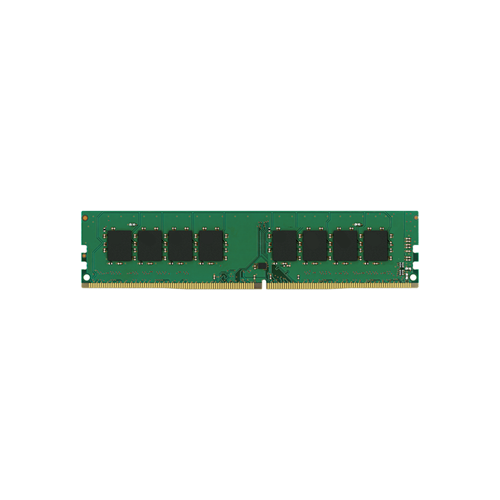
This is a standard DDR4-3200 UDIMM designed for mainstream desktop platforms, ideal for productivity workloads, content creation, and gaming builds that demand reliable, high-bandwidth memory. Its single-rank x16 organization reduces the load on the memory controller for improved compatibility and stability, while the 1.2V operating voltage and unbuffered signal path deliver efficient, low-latency performance at the default CL22 timing.
1. High memory bandwidth keeps frame delivery smooth in GPU-bound gaming and dramatically cuts down project export times during 4K video editing sessions.
2. Tight-latency timings translate directly into snappier desktop responsiveness, giving competitive gamers a crucial reaction advantage in high-refresh-rate environments.
3. Standard DDR4 voltage drives cooler, whisper-quiet operation inside confined desktop chassis, preserving Turbo Boost headroom during prolonged creative workloads.
4. Single Rank topology lightens the load on the CPU’s memory controller, ensuring rock-solid stability even when all DIMM slots are populated for maximum capacity.
5. Unbuffered, non-ECC architecture provides effortless plug-and-play compatibility on mainstream consumer boards, simplifying DIY upgrades for home workstations and gaming rigs.
M378A5244CB0-CWE is a standard desktop UDIMM, verified by its 288-pin, unbuffered, non-ECC layout. Four characteristics directly address real-world needs. First, the 3200 MT/s data rate delivers 25.6 GB/s bandwidth; for users juggling countless browser tabs, office documents, and HD video playback, this translates into lag-free switching. In esports titles like Valorant, it minimizes micro-stutters by feeding textures to the GPU faster. Second, the 1.2V operating voltage drastically reduces thermal output and power consumption compared to older DDR3, enabling a cooler, quieter desktop during long work or entertainment sessions. Third, the Single Rank x16 construction lessens the load on the CPU memory controller, ensuring instant POST and rock-steady compatibility with mainstream Intel and AMD chipsets without manual voltage or timing adjustments—a huge relief for DIY builders. Fourth, the unbuffered, non-ECC architecture eliminates buffer delays, giving the processor a direct, low-latency link essential for real-time audio processing in a DAW or fluid photo culling in Lightroom. For a cost-effective home-office enhancement or a snappy media center, this module delivers exactly that.
Gaming Build
For a responsive gaming system, dual-channel operation is critical. Pair two of these 4 GB modules as a 2×4 GB kit to establish 8 GB of bandwidth-optimized memory. If your budget permits and the motherboard has four DIMM slots, a 4×4 GB configuration delivers 16 GB, comfortably meeting modern AAA title requirements while maintaining dual-channel interleaving. Avoid a single 4 GB stick, as single-channel mode will noticeably throttle frame rates.
Content Creation
Video editing and 3D rendering thrive on high capacity, but relying solely on 4 GB modules limits scalability. The recommended 64 GB for 4K workflows would demand an impractical 16 modules, surpassing consumer desktop capabilities. Populate all four slots with these DIMMs for a maximum 16 GB as a stopgap, then prioritize migrating to 32 GB UDIMMs. If you must use these modules immediately, a 2×4 GB start is functional only for light 1080p projects; upgrade urgently to avoid constant disk swapping.
General Productivity
The most cost-effective configuration for office multitasking and web-heavy workloads is a dual-channel 2×4 GB setup, providing 8 GB of energetic DDR4-3200 at a low voltage of 1.2V. This avoids the performance penalty of single-channel single-rank operation and handles dozens of browser tabs plus productivity suites smoothly. For heavier simultaneous tasks, moving to a 4×4 GB layout for 16 GB offers strong headroom without replacing existing modules, making it a sensible step-up strategy.
Rigorously tested desktop DDR4 memory, compatible with Dell OptiPlex 7080, HP EliteDesk 800 G6, Lenovo ThinkCentre M80s.
Q: Can I mix this M378A5244CB0-CWE with other memory modules of different brands or speeds?
A: Mixing is not recommended. Even identical specs can cause instability. If mixed, the system downclocks to the slowest module’s speed and JEDEC profile. For stability, use identical modules.
Q: Is this memory compatible with my desktop system? How do I check motherboard support?
A: It is a standard DDR4 UDIMM for desktops. Verify your motherboard supports DDR4-3200 and check the QVL list for this Samsung module. Ensure the chipset and CPU support DDR4.
Q: What is the recommended DIMM population order for optimal performance on a desktop board?
A: For dual-channel, install identical modules in slots of the same color (typically A2 and B2 first). Always insert matching pairs to enable full memory bandwidth. Single module limits performance.
Q: Does this module support overclocking or XMP profiles?
A: No, this is a JEDEC-standard DDR4-3200 module running at 1.2V with CL22. It does not feature XMP profiles and is not designed for overclocking. It operates at default SPD settings.
Q: What warranty and typical failure rate can I expect with this Samsung module?
A: It carries a 1-year warranty. Samsung original modules exhibit a typical annualized failure rate well below 0.5%, ensuring high reliability under standard desktop operating conditions.