











 Secure payments
Standard refund policy
Trade Assurance
Secure payments
Standard refund policy
Trade Assurance
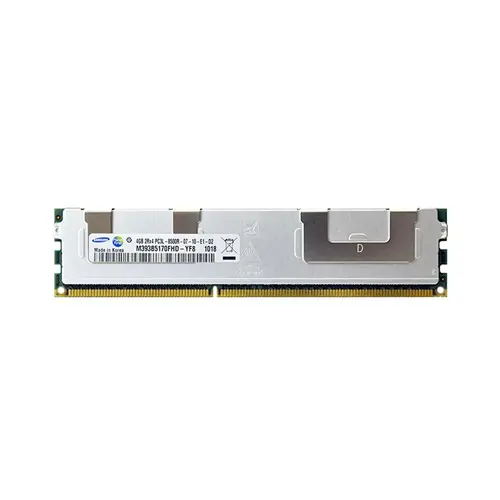
| Model | M393B5170FHD-YF8 |
|---|---|
| Product Type | Memory Module |
| Compliance Standards | EU RoHS,FCC |
| Memory Capacity | 4 GB |
| Memory Technology | DDR3 |
| Product Voltage | 1.35V |
| RAM Speed | 1066MHz |
| RAM Standard | DDR3-1066/PC3-8500 |
| Error Identifying | ECC |
| Signal Type | Registered |
| Column Access Strobe (CAS) | CL7 |
| Rank | Dual Rank x4 |
| Quantity of Pins | 240-pin |
| RAM Genre | RDIMM |
This DDR3-1066 Registered ECC RDIMM is purpose-built for legacy server platforms and excels in virtualization, in-memory databases, and other mission-critical workloads requiring absolute data integrity. Its dual-rank x4 design combined with a low CAS latency of CL7 and 1.35V low-voltage operation delivers reliable throughput and signal stability, while the registered interface ensures clean command/address signaling across fully populated memory channels.
1. ECC memory detects and corrects single-bit errors in real time, shielding virtualized databases from silent data corruption that could otherwise cascade into costly downtime.
2. Registered signal buffering stabilizes command and address lines, allowing dense server memory populations to scale without signal integrity penalties during heavy multi-VM consolidation.
3. 1.35V low-voltage operation trims overall server power draw and cooling demands, helping colocation cages and on-premise racks meet strict energy budgets while maintaining enterprise uptime.
4. Dual Rank organization activates rank interleaving to amplify sustained bandwidth, keeping throughput consistent under the concurrent read/write storms of real-time analytics platforms.
5. A 4GB capacity aligns with dedicated lightweight services such as DNS resolvers, monitoring probes, or edge-caching nodes, offering precise resource provisioning without overinvestment.
Based on the RDIMM form factor, registered signal type, and ECC error correction, the M393B5170FHD-YF8 is a server-class memory module engineered for mission-critical environments. Its four defining characteristics directly address the real-world pains of data centers and enterprise IT.
The ECC capability means every bit of data in a virtualized cluster is protected against single-bit errors caused by cosmic radiation or electrical noise—without it, a silent corruption in a hypervisor could crash dozens of virtual machines overnight. The registered buffer stabilizes signal integrity when populating multiple DIMMs per channel, enabling dense memory configurations essential for in-memory databases like SAP HANA or Redis; you avoid boot failures and unexplained crashes that plague unbuffered designs under heavy load. Operating at a low 1.35V, this DDR3L module cuts power consumption significantly across a fleet of servers, reducing cooling costs in a 24/7 data hall while still delivering reliable 1066MT/s throughput. Finally, the dual-rank x4 organization improves bank-level parallelism, giving database engines faster page access during large table scans. For you, this translates into fewer service interruptions, lower operational expense, and consistent latency under concurrent transactional workloads.
General Virtualization
For dual-socket servers, install one 4 GB RDIMM per memory channel to create balanced, symmetric configurations. A platform with four channels per CPU benefits from eight identical modules (32 GB total), delivering reliable performance for hypervisors. To scale capacity, add a second DIMM per channel, noting that speeds may downclock to 800 MHz; always keep channels equally populated to preserve NUMA stability.
In-Memory Database
Populate every DIMM slot with these 4 GB DDR3L RDIMMs, distributing modules evenly across all memory channels to maximize total capacity. The CL7 latency and 1.35 V low-voltage operation reduce power draw and heat, sustaining consistent performance for data-critical workloads. Matched ECC Registered DIMMs are essential to guarantee data integrity for in-memory engines like Redis or SAP HANA.
High-Performance Computing (HPC)
For maximum memory bandwidth, apply a one-DIMM-per-channel (1DPC) policy, allowing these 4 GB modules to run at the full 1066 MHz speed with CL7 timings. In a quad-channel system, use four modules per processor (16 GB per socket) to deliver optimized throughput for compute-bound tasks. Maintain strictly symmetric populations across sockets to avoid NUMA imbalances and maximize parallel memory access.
Validated for servers: compatible with Dell R710, HP DL380 G7, IBM x3650 M3 after rigorous testing.
Q: Can I mix this M393B5170FHD-YF8 with other memory modules of different brands or speeds?
A: Mixing registered ECC modules of different brands or speeds is not recommended. It may cause signal integrity issues, POST failures, or silent data corruption. Always install identical modules with the same Samsung part number to ensure reliable interoperability.
Q: Is this memory compatible with my server? Which Intel or AMD platforms support it?
A: This DDR3 Registered ECC RDIMM is designed for dual/quad-socket servers. It is validated on Intel Xeon 5500/5600 series and AMD Opteron 6100/6200 platforms. Please confirm your board supports 1.35V low-voltage DDR3-1066R and 4 GB dual-rank x4 modules via its QVL.
Q: What is the recommended DIMM population order for optimal performance?
A: To maximize memory bandwidth, populate the first slot of each memory channel identically (e.g., DIMM_A1, DIMM_B1, DIMM_C1) before filling second slots. Maintain balanced configuration across CPU sockets and follow your server board’s specific population recommendations for dual‑rank registered DIMMs.
Q: Does this module support overclocking or XMP profiles?
A: No. As a server-grade registered ECC DIMM, it strictly adheres to JEDEC DDR3-1066 (PC3-8500) standards with fixed CL7 timings. It does not support overclocking, XMP, or any performance profiles that could compromise data integrity in mission-critical environments.
Q: What warranty and typical failure rate can I expect?
A: The module comes with a 1-year warranty. Samsung enterprise DRAM typically exhibits an annualized failure rate (AFR) well below 0.5% under specified operating conditions, reflecting high reliability when properly installed in compliant server systems.