











 Secure payments
Standard refund policy
Trade Assurance
Secure payments
Standard refund policy
Trade Assurance
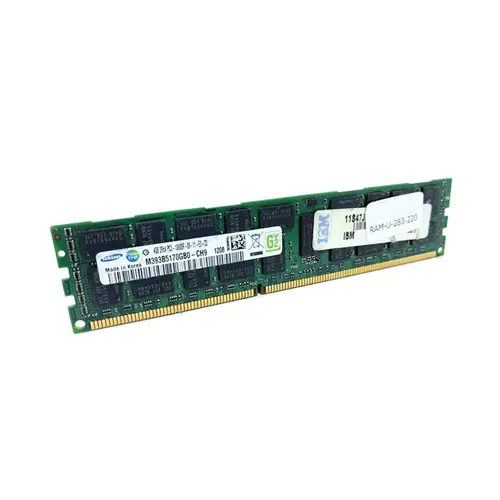
| Model | M393B5170GB0-CH9 |
|---|---|
| Product Type | Memory Module |
| Compliance Standards | EU RoHS,FCC |
| Memory Capacity | 4 GB |
| Memory Technology | DDR3 |
| Product Voltage | 1.5V |
| RAM Speed | 1333MHz |
| RAM Standard | DDR3-1333/PC3-10600 |
| Error Identifying | ECC |
| Signal Type | Registered |
| Column Access Strobe (CAS) | CL9 |
| Rank | Dual Rank x4 |
| Quantity of Pins | 240-pin |
| RAM Genre | RDIMM |
This DDR3-1333 registered ECC module (M393B5170GB0-CH9) is a server-grade component optimized for legacy platforms running virtualized environments or in-memory databases where data integrity is paramount. Its dual-rank x4 organization and registered signaling enhance signal stability and capacity scaling, while ECC protection reliably detects and corrects single-bit errors in mission-critical workloads.
1. ECC protection detects and corrects single-bit errors in real time, preserving data integrity for mission-critical database and virtualization workloads.
2. Registered signal buffering stabilizes command and address lines, enabling dense memory populations essential for large-scale server consolidation.
3. Dual Rank x4 structure fully interleaves memory banks, maximizing sustained bandwidth when multiple VMs compete for shared resources.
4. Low CAS latency shrinks the gap between data request and delivery, boosting transaction throughput in latency-sensitive enterprise applications.
5. Mainstream DDR3 frequency supplies ample throughput for legacy server fleets while maintaining compatibility with older infrastructure investments.
In a server environment, the Samsung M393B5170GB0-CH9 RDIMM is purpose-built to eliminate the kinds of failures that directly threaten business continuity. Its registered architecture buffers the command and address signals, which means your server can support far denser memory populations without the electrical loading that causes signal degradation. When you deploy this module across a virtualization cluster running dozens of VMs, that signal integrity is the difference between stable multi-socket scalability and random crashes under load.
Equally critical is the integrated ECC, which continuously corrects single-bit errors before they corrupt transactional data or trigger hypervisor faults. For an in-memory database like Redis or a write-intensive SQL instance, a single flipped bit in cache can silently propagate into financial records or user sessions. The dual-rank x4 organization of this 4 GB DDR3-1333 module also improves command and data bus utilization through rank interleaving, allowing the memory controller to mask latency during concurrent read and write operations. The result is smoother throughput during peak OLTP bursts, keeping query response times predictable rather than jittery. For IT operators who measure downtime in revenue per second, these design choices convert raw specifications into real-world resilience.
General Virtualization
For general virtualization hosts, balance capacity and memory bandwidth by populating all available memory channels symmetrically. Using this 4 GB RDIMM, install a minimum of 12 identical modules across a dual-socket platform with triple-channel architecture (36 GB) or 16 modules on a quad-channel system (64 GB). This allows moderate VM density while maintaining consistent ECC protection and low latency for mixed workloads.
In-Memory Database
In-memory databases demand maximum capacity and fault tolerance. Configure the server with fully populated memory slots, often 24 modules per dual-socket node to reach 96 GB or more. The registered ECC design supports stable operation with high-rank counts, and dual‑rank x4 organization helps reduce electrical loading, allowing a large, reliable footprint for datasets held entirely in RAM.
High-Performance Computing
HPC environments prioritize memory bandwidth over raw capacity. Install this DDR3-1333 RDIMM in a balanced configuration matching the CPU memory channels, such as one module per channel on each socket. This ensures optimal interleaving and peak sustained throughput. A typical compute node using 16 modules (64 GB) per node delivers sufficient capacity for simulation checkpoints while keeping dual‑rank access parallelism high.
Stringently tested, this RDIMM ensures proven compatibility with Dell PowerEdge R720, HP ProLiant DL380p Gen8, and Lenovo ThinkServer RD530.
Q: Can I mix this M393B5170GB0-CH9 with other memory modules of different brands or speeds?
A: Mixing brands or speeds is not recommended for registered server memory. The system will downclock all modules to the lowest common speed, potentially causing stability issues and invalidating memory interleaving optimizations.
Q: Is this memory compatible with my Intel Xeon or AMD Opteron server platform?
A: This DDR3-1333 Registered ECC RDIMM with 1.5V and 240-pin is designed for dual-processor Intel Xeon 5500/5600 series and AMD Opteron 6100/6200 series platforms using corresponding chipsets. Verify your server’s qualified vendor list for M393B5170GB0-CH9.
Q: What is the recommended DIMM population order for optimal performance with this module?
A: Populate identical DIMMs per memory channel, starting with the slot farthest from the CPU. For dual-rank x4 RDIMMs like this, balance channels evenly. Consult your server board manual for specific numbering, typically populating slots in pairs for dual-channel mode.
Q: Does this module support overclocking or XMP profiles?
A: No. As a server-grade Registered ECC DIMM, this module operates exclusively at JEDEC standard DDR3-1333 with CL9 timings. Overclocking, XMP, or voltage adjustments are not supported and could compromise data integrity and system stability.
Q: What warranty and typical failure rate can I expect for this M393B5170GB0-CH9 memory?
A: This Samsung server memory comes with a one-year warranty. With proper handling, the annualized failure rate is typically below 0.1%, reflecting enterprise-grade reliability. ECC functionality further mitigates soft error risk in 24/7 operation.