











 Secure payments
Standard refund policy
Trade Assurance
Secure payments
Standard refund policy
Trade Assurance
| Model | M393B5173BH0-YK0 |
|---|---|
| Product Type | Memory Module |
| Compliance Standards | EU RoHS,FCC |
| Memory Capacity | 4 GB |
| Memory Technology | DDR3 |
| Product Voltage | 1.35V |
| RAM Speed | 1600MHz |
| RAM Standard | DDR3-1600/PC3-12800 |
| Error Identifying | ECC |
| Signal Type | Registered |
| Column Access Strobe (CAS) | CL11 |
| Rank | Single Rank x8 |
| Quantity of Pins | 240-pin |
| RAM Genre | RDIMM |
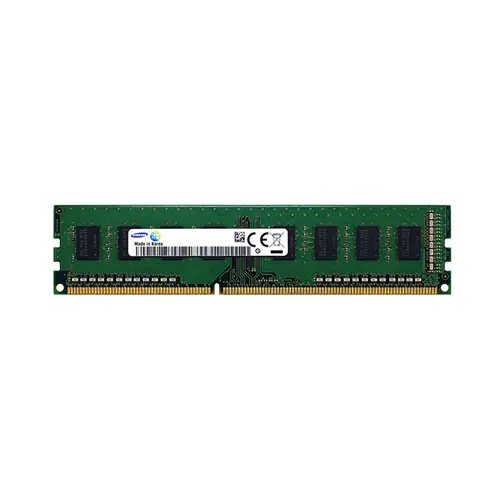
This DDR3-1600 RDIMM with ECC and a registered signal path is purpose-built for server platforms, delivering critical data integrity for virtualized environments, in-memory databases, and enterprise workloads that demand absolute reliability. Its single-rank x8 configuration combined with a low 1.35V operating voltage reduces electrical loading and power consumption, enabling higher memory density per channel while maintaining the stable clock and command distribution essential for 24/7 operation.
1. End-to-end error correction ensures data accuracy in continuous operation, critical for safeguarding long-running database transactions from silent bit flips.
2. The register chip redrives address and command signals, allowing dozens of DIMMs per server to coexist without signal degradation for massive virtualization hosts.
3. Ultra-low voltage operation curbs power draw and waste heat in dense rack deployments, contributing directly to a lower total cost of ownership for the data center.
4. High clock frequency delivers responsive throughput for latency-sensitive enterprise applications, minimizing CPU idle cycles under concurrent user loads.
5. This modest capacity suits targeted roles such as dedicated network appliances or lightweight microservice nodes, where per-socket memory overhead is kept intentionally lean.
The M393B5173BH0-YK0 is a server-grade DDR3 Registered DIMM, purpose-built for enterprise workloads where downtime is measured in dollars per second. Its combination of ECC, registered buffering, low-voltage operation, and single-rank design directly addresses the pain points of IT managers running virtualized clusters or in-memory databases.
First, ECC error correction actively detects and corrects single-bit memory errors caused by cosmic radiation or electrical noise. In a hypervisor hosting dozens of virtual machines, a silent bit flip in the wrong place can corrupt hypervisor structures or guest data, causing cascading failures; ECC prevents these insidious corruptions, delivering the data integrity that financial transactions and database records demand. Second, the registered buffer isolates the memory controller from the electrical load of multiple DIMMs, enabling you to populate all channels with high-capacity modules without signal degradation. This is essential when consolidating an entire rack of servers into a few high-memory-footprint virtualization hosts. Meanwhile, the 1.35V low-voltage specification cuts thermal dissipation and power bills across a data center floor—a few watts saved per module compounds into thousands in annual cooling and electricity costs. Finally, the single-rank x8 organization enhances signal timing and compatibility, allowing the module to reach its rated 1600MHz speed reliably under dense loads. For an in-memory database like Redis, this means consistently low latency and predictable throughput under heavy query pressure. In short, this RDIMM transforms raw capacity into resilient, power-efficient real-world performance that keeps mission-critical services online and responsive.
General Virtualization
For general virtualization hosts, populate all memory channels evenly with identical 4GB Registered DIMMs to maximize bandwidth and avoid NUMA bottlenecks. Six to twelve modules (24–48GB total) strike a strong balance between density and cost, comfortably supporting dozens of light to moderate VMs. Scale by adding matched sets across empty slots as workload density grows.
In-Memory Database
In-memory databases demand strict data integrity and low latency, making ECC Registered memory mandatory. Fill every available slot with these 4GB RDIMMs—32 modules deliver 128GB—to provide the large, reliable capacity that platforms like Redis or SAP HANA require. Distribute ranks evenly across all channels to maintain deterministic access times and high transactional throughput.
High-Performance Computing (HPC)
HPC clusters benefit from the power efficiency of 1.35V low-voltage DIMMs. Symmetrically populate all memory channels per socket (typically three or four modules) to maximize bandwidth, targeting 12–24GB per node for moderately parallel workloads. Prioritize full channel utilization over raw capacity, which minimizes thermal load and accelerates tightly coupled inter-process communication.
Strictly tested server memory, compatible with Dell PowerEdge R720, R620, HP ProLiant DL380p Gen8, and more.
Q: Can I mix this M393B5173BH0-YK0 with other memory modules of different brands or speeds?
A: Mixing is not recommended in server environments. Unmatched brands, speeds, or timings risk instability and memory errors. For reliable operation, use identical part numbers and specs across all channels.
Q: Is this memory compatible with my system?
A: This DDR3-1600 Registered ECC RDIMM targets server platforms like Intel Xeon E5-2600 v2 or AMD Opteron 6300 series. Always verify compatibility against your motherboard’s qualified vendor list (QVL).
Q: What is the recommended DIMM population order for optimal performance?
A: Populate identical DIMMs per channel, starting with the primary slots (often blue). Balance capacity across memory channels and follow your server board’s specific population guide to enable optimal interleaving and bandwidth.
Q: Does this module support overclocking or XMP profiles?
A: No. This is a server-grade registered DIMM strictly adhering to JEDEC standards. Overclocking and XMP are disabled to guarantee 24/7 data integrity and mission-critical stability.
Q: What warranty and typical failure rate can I expect?
A: It includes a one-year warranty. Enterprise-class memory like this is highly reliable, typically exhibiting an annualized failure rate (AFR) well below 0.5% under normal operating conditions.