











 Secure payments
Standard refund policy
Trade Assurance
Secure payments
Standard refund policy
Trade Assurance
| Model | M393B5270DH0-YH9Q9 |
|---|---|
| Product Type | Memory Module |
| Compliance Standards | EU RoHS,FCC |
| Memory Capacity | 4 GB |
| Memory Technology | DDR3 |
| Product Voltage | 1.35V |
| RAM Speed | 1333MHz |
| RAM Standard | DDR3-1333/PC3-10600 |
| Error Identifying | ECC |
| Signal Type | Registered |
| Column Access Strobe (CAS) | CL9 |
| Rank | Single Rank x4 |
| Quantity of Pins | 240-pin |
| RAM Genre | RDIMM |
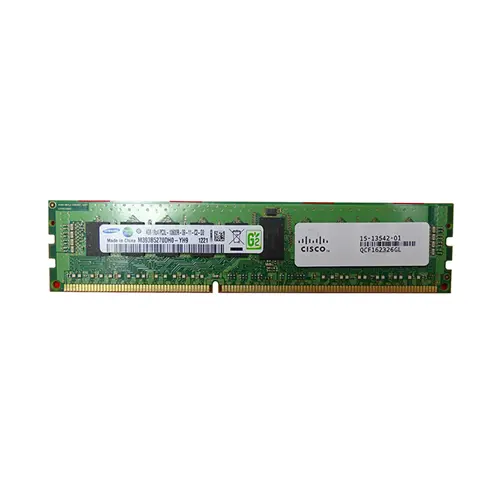
This Samsung DDR3-1333 Registered ECC DIMM (M393B5270DH0-YH9Q9) is optimized for entry-level servers and storage appliances, reliably supporting virtualization, light in-memory databases, and other data-integrity-critical workloads. Its single-rank x4 organization and 1.35V low-voltage operation reduce memory bus loading and power draw, while the registered ECC architecture ensures signal stability and hardware error correction in always-on deployments.
1. ECC error correction safeguards transactional data integrity, preventing silent memory corruption that could crash virtualized workloads in always-on server environments.
2. Registered buffering isolates the memory controller from heavy load, enabling large DIMM populations per channel for maximum virtualization density without signal loss.
3. 1.35V low-voltage operation slashes server power budgets and cooling demands, translating into measurable OpEx savings across hyperscale data center fleets.
4. 1333MHz frequency delivers consistent 10.6 GB/s throughput per channel, keeping latency-sensitive enterprise applications responsive under multi-tenant pressures.
5. Single Rank x4 device topology boosts inherent chip-level error resilience while reducing bus loading, ideal for sustaining predictable performance in dense rack configurations.
The Samsung M393B5270DH0-YH9Q9 is a server-grade DDR3 Registered DIMM whose features are engineered for always-on enterprise infrastructure. Its ECC technology autonomously detects and corrects single-bit errors, which is non-negotiable in virtualization clusters—a single uncaught bit flip during live migration can corrupt hypervisor memory, bringing down dozens of business-critical workloads. The integrated register buffers command and address signals, preserving signal integrity when all memory channels are fully populated. For an in-memory database server running SAP HANA or Redis, this stability allows you to confidently scale capacity without risking intermittent crashes under peak OLTP loads. The module’s low 1.35V operation directly lowers power draw and thermal output across a full rack. In a 24/7 datacenter, this reduces cooling overhead and extends the service life of neighboring components, turning a small voltage advantage into measurable OpEx savings. Finally, the Single Rank x4 organization with CL9 latency ensures predictable, fast access to the first word. For latency-sensitive financial trading or real-time caching, that consistency means higher transactions per second and a quieter, more reliable server farm.
General Virtualization
For general virtualization hosts, populate at least six identical M393B5270DH0-YH9Q9 modules per CPU to balance memory bandwidth and capacity. This 4 GB RDIMM is a single-rank x4 part, so using one DIMM per channel minimizes electrical loading while leaving room to scale to 32–64 GB per server without sacrificing registered ECC reliability. Stick to matched kits and fill identical channels to avoid NUMA imbalances in multi-socket deployments.
In-Memory Database
In-memory databases demand maximum capacity and fault tolerance, so deploy the largest supported configuration using multiple 4 GB RDIMMs across all memory channels. The ECC and registered signaling are critical here to prevent silent data corruption under sustained, high-throughput workloads. Plan for dual-rank or quad-rank population strategies if your platform allows, but with these single-rank DIMMs, prioritize populating all channels evenly to approach 48–64 GB per node while maintaining a low-voltage 1.35 V power envelope.
High-Performance Computing
HPC clusters benefit from the low 1.35 V operating voltage and registered ECC, which together reduce power draw and improve node density. Install these modules in a balanced channel configuration—typically six or eight DIMMs per dual-socket node—to maximize memory bandwidth for MPI workloads. Given the 1333 MT/s speed and CL9 latency, they are well-suited for capacity-optimized HPC jobs where consistent, error-free data feeds outweigh raw frequency.
Server memory: rigorously tested, compatible with Dell PowerEdge R710, HP ProLiant DL380 G7, IBM System x3650 M3.
Q: Can I mix this M393B5270DH0-YH9Q9 with other memory modules of different brands or speeds?
A: Mixing is not recommended for server environments. Different timings or ranks can cause instability. Use identical Samsung RDIMMs with matching 1333MHz, CL9, and single-rank x4 configuration to ensure validated RAS and optimal performance.
Q: Is this memory compatible with my system?
A: This is a DDR3 Registered ECC module for servers. It supports platforms like Intel Xeon E5-2600 series and AMD Opteron 6300 series. Verify your motherboard explicitly supports 1.35V DDR3-1333 RDIMM with single-rank x4 organization.
Q: What is the recommended DIMM population order for optimal performance?
A: Populate identical DIMMs per channel, starting with the slots farthest from the CPU. Follow your server board’s memory population guide to balance channels. For single-rank RDIMMs, this ensures symmetric NUMA interleaving and maximum bandwidth.
Q: Does this module support overclocking or XMP profiles?
A: No. This server memory adheres strictly to JEDEC DDR3-1333 specifications. It does not support XMP or overclocking, as registered ECC modules prioritize data integrity and 24/7 stability over speed enhancement.
Q: What warranty and typical failure rate can I expect?
A: This product includes a one-year warranty. Typically, Samsung ECC RDIMMs exhibit an annualized failure rate (AFR) below 0.5% under specified operating conditions, reflecting high reliability for enterprise workloads.