











 Secure payments
Standard refund policy
Trade Assurance
Secure payments
Standard refund policy
Trade Assurance
| Model | M393B5170GB0-CK0Q8 |
|---|---|
| Product Type | Memory Module |
| Compliance Standards | CE,WEEE,RoHS |
| Memory Capacity | 4 GB |
| Memory Technology | DDR3 |
| Product Voltage | 1.5V |
| RAM Speed | 1600MHz |
| RAM Standard | DDR3-1600/PC3-12800 |
| Error Identifying | ECC |
| Signal Type | Registered |
| Column Access Strobe (CAS) | CL11 |
| Rank | Dual Rank x4 |
| Quantity of Pins | 240-pin |
| RAM Genre | RDIMM |
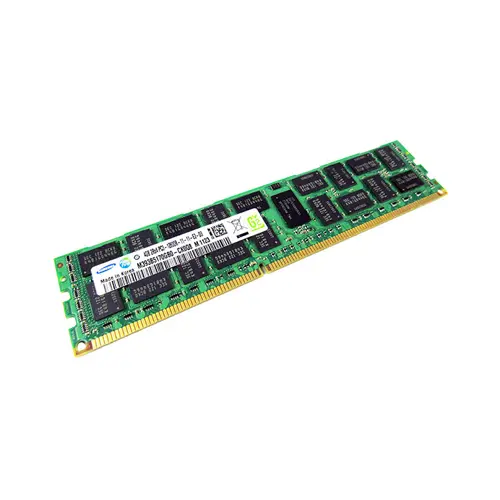
This Samsung M393B5170GB0-CK0Q8 is a server-class DDR3-1600 Registered ECC DIMM built for virtualization, memory-intensive database workloads, and enterprise environments where data integrity is non-negotiable. Its dual-rank x4 configuration maximizes bank-level parallelism for improved bandwidth efficiency, while registered signaling and full ECC protection ensure rock-steady signal integrity and single-bit error correction in densely populated multi-DIMM servers.
1. Registered signal buffering offloads the memory controller, keeping command and address lines stable when populating all DIMM slots for maximum virtualization density.
2. ECC protection detects and corrects single-bit errors in real time, preserving data accuracy during long-running financial or scientific compute jobs.
3. Dual Rank x4 organization interleaves accesses across two ranks, sustaining peak bandwidth utilization that benefits transactional databases under concurrent user loads.
4. The high data transfer rate shortens cache miss penalties, improving responsiveness for in-memory analytics and low-latency trading platforms.
5. Standard 1.5V operation ensures broad platform compatibility and predictable thermal profiles, simplifying fleet management in large-scale rack deployments.
The Samsung M393B5170GB0-CK0Q8 is unmistakably a server-grade DDR3 RDIMM, and its design choices directly address the critical pain points of data center operators. In a virtualized cluster running dozens of VMs per host, an undetected memory bit-flip can silently corrupt an entire virtual disk or crash a production database. The integrated ECC engine actively scrubs and corrects single-bit errors, making the difference between five-nines availability and an overnight outage you never saw coming. Meanwhile, the registered signal buffer on this RDIMM stabilizes the electrical load on the memory channel, allowing you to populate all 24 slots of a 2U server without sacrificing reliability — a non-negotiable requirement when scaling from 64 GB to 768 GB to accommodate growing VM footprints.
For in-memory databases like Redis or SAP HANA, latency and sustained throughput govern customer-facing response times. The dual-rank x4 organization of this module arranges 16 internal banks that the memory controller can interleave, hiding row-precharge delays and boosting command-per-clock efficiency under random access workloads. Combined with its validated 1600 MT/s speed and CL11 timing, this translates to higher query concurrency before tail latencies spike. When you are processing millions of transactions, memory errors are not statistical curiosities — they are revenue risks, and the ECC+Registered architecture of this RDIMM ensures every data structure remains intact, every session stays alive, and your capacity planning is not derailed by silent corruption.
General Virtualization
For general virtualization hosts, populate a balanced number of identical M393B5170GB0-CK0Q8 modules across memory channels to maximize bandwidth. A typical dual-socket server with three channels per CPU benefits from six or twelve 4 GB RDIMMs, providing 24 GB or 48 GB total capacity to handle moderate VM density without oversubscribing memory.
In-Memory Database
In-memory databases demand both capacity and reliability. Deploy the maximum supported modules—often 18 or 24 per server—to reach 72 GB or 96 GB using these dual-rank 4 GB RDIMMs. The ECC and registered signaling ensure data integrity under constant, latency-sensitive read/write operations, while populating all channels preserves the throughput required for large datasets.
High-Performance Computing
HPC clusters require error-resilient throughput. Install one module per channel across all available memory channels (e.g., one DIMM per channel in a triple-channel configuration) to achieve optimal bandwidth with this 1600 MT/s registered memory. This approach yields capacities like 12 GB or 24 GB per node, sufficient for many compute-bound workloads where per-core memory scaling takes priority over total capacity.
Rigorously tested server memory, compatible with Dell PowerEdge R720, HP ProLiant DL380p Gen8, Lenovo ThinkServer RD530, and similar DDR3 systems.
Q: Can I mix this M393B5170GB0-CK0Q8 with other memory modules of different brands or speeds?
A: Mixing different brands or speeds with registered ECC memory is not recommended; it can cause system instability. For reliable operation, use identical modules with the same rank, speed, and organization.
Q: Is this memory compatible with my system?
A: This DDR3-1600 Registered ECC RDIMM is designed for server platforms supporting Intel Xeon E5-2600 v1/v2 or AMD Opteron 6300 series. Verify the motherboard supports 240-pin 1.5V RDIMMs and ECC.
Q: What is the recommended DIMM population order for optimal performance?
A: Follow the server motherboard manual: typically populate one identically ranked DIMM per memory channel first, starting with slots farthest from the CPU. Balance across channels for best throughput and interleaving.
Q: Does this module support overclocking or XMP profiles?
A: No. This registered server module operates strictly at JEDEC standard DDR3-1600 CL11 for stability and reliability. Overclocking or XMP profiles are not supported on enterprise memory.
Q: What warranty and typical failure rate can I expect?
A: This module includes a 1-year warranty. As enterprise-grade Samsung DDR3 RDIMM, it exhibits a very low annualized failure rate, typically below 0.1% under proper operating conditions.