











 Secure payments
Standard refund policy
Trade Assurance
Secure payments
Standard refund policy
Trade Assurance
| Model | M393B5270QB0-YK0 |
|---|---|
| Product Type | Memory Module |
| Compliance Standards | EU RoHS,FCC |
| Memory Capacity | 4 GB |
| Memory Technology | DDR3 |
| Product Voltage | 1.35V |
| RAM Speed | 1600MHz |
| RAM Standard | DDR3-1600/PC3-12800 |
| Error Identifying | ECC |
| Signal Type | Registered |
| Column Access Strobe (CAS) | CL11 |
| Rank | Single Rank x4 |
| Quantity of Pins | 240-pin |
| RAM Genre | RDIMM |
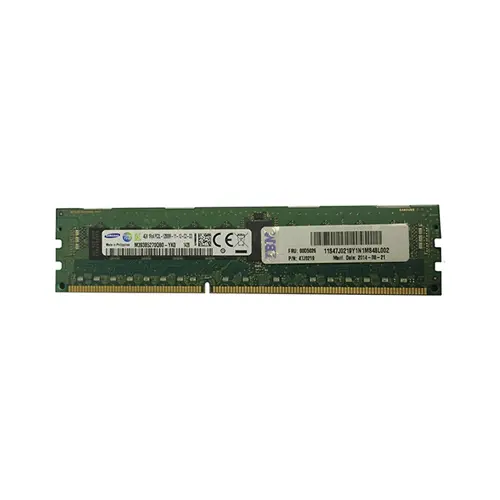
The M393B5270QB0-YK0 is a DDR3L RDIMM explicitly engineered for legacy enterprise servers running virtualization, in-memory databases, or always-on workloads where data integrity is non-negotiable. Its registered signal buffering and single-rank x4 organization stabilize high-density memory channels while the 1.35V ECC design delivers power-efficient error correction critical for maintaining uptime in mission-critical deployments.
1. ECC protection silently corrects single-bit errors, preventing data corruption in always-on database and virtualization servers.
2. Registered buffering stabilizes signal integrity when populating multiple DIMMs per channel, essential for scaling memory in dense rack servers.
3. Operating at a low 1.35V reduces server power draw and thermal output, lowering TCO in large-scale data center deployments.
4. 1600MHz speed delivers a balanced bandwidth profile for legacy enterprise applications, sustaining throughput without excessive power.
5. Single Rank x4 design minimizes electrical loading on the memory bus, enabling reliable high-speed operation in multi-slot server boards.
When you run a virtualized cluster hosting dozens of mission-critical VMs or power a high-throughput in-memory database like Redis, the memory architecture directly defines your uptime and data fidelity. The Samsung M393B5270QB0-YK0 is a DDR3L Registered ECC DIMM engineered precisely for these demands. Its ECC actively corrects single-bit errors, neutralizing silent data corruption caused by background radiation — an essential safeguard that prevents a flipped bit from crashing a hypervisor or returning a poisoned transaction in a financial trading platform. The registered buffer isolates the memory controller from the DRAM arrays, preserving signal integrity even when all 24 DIMM slots are populated; this means you can confidently scale your virtualization hosts to terabyte-class footprints without risking intermittent faults. Operating at 1.35V instead of the standard 1.5V, the module significantly reduces power consumption and thermal strain across dense rack deployments, lowering your cooling overhead and extending hardware longevity. With a 1600MHz clock, CL11 latency, and single-rank x4 organization, it delivers consistent bandwidth and predictable access patterns under heavy concurrent loads, keeping your memory-resident analytics queries fast and lock-free. This module translates directly into fewer application errors, denser consolidation ratios, and a lower total cost of service delivery — not just better specs, but tangible business resilience.
General Virtualization
For light to moderate virtualization hosts, install six to eight of these 4 GB RDIMMs across triple‑channel or quad‑channel memory banks to provide 24–32 GB of ECC‑protected capacity. This configuration balances cost and density for a dozen light VMs while Registered DIMMs maintain signal integrity in multi‑slot risers. Use identical single‑rank modules to avoid rank‑mixing penalties and keep memory latency predictable under hypervisor scheduling.
In‑Memory Database
In‑memory databases demand maximum capacity and fault tolerance, so populate all available DIMM slots with these 4 GB RDIMMs for a typical 64–128 GB pool. ECC and registered buffering are critical to prevent silent data corruption during large, sustained in‑memory workloads. Favor dual‑socket servers running DIMMs in balanced interleaved configurations to sustain high throughput without throttling.
High‑Performance Computing
HPC clusters benefit from fully populating memory channels per node with identical single‑rank 1600 MHz RDIMMs to achieve peak bandwidth. A baseline node with sixteen 4 GB modules delivers 64 GB of ECC memory and maximizes memory interleaving for scientific simulations. The 1.35 V low‑voltage operation also helps reduce aggregate power and cooling costs in dense rack deployments.
Rigorously tested server memory, compatible with Dell PowerEdge R720, HP DL380p Gen8, Lenovo ThinkServer RD530, etc.
Q: Can I mix this M393B5270QB0-YK0 with other memory modules of different brands or speeds?
A: Mixing is not recommended for server environments. Different brands or speeds may cause instability and loss of ECC functionality. Always use identical modules to ensure validated performance and data integrity.
Q: Is this memory compatible with my system?
A: This registered ECC DDR3 module targets servers with Intel Xeon 5500/5600 or AMD Opteron 6100/6200 series. Confirm your motherboard supports 1.35V RDIMMs and check the platform's qualified vendor list.
Q: What is the recommended DIMM population order for optimal performance?
A: Follow your server motherboard manual. Typically, populate identical DIMMs per channel starting from the farthest slot from the CPU. Balanced interleaving across channels ensures maximum memory bandwidth and reliability.
Q: Does this module support overclocking or XMP profiles?
A: No. As enterprise-grade registered ECC memory, it adheres strictly to JEDEC DDR3-1600 specifications. Overclocking and XMP are not supported to maintain the reliability and error correction required for server operations.
Q: What warranty and typical failure rate can I expect?
A: This module includes a 1-year warranty. Server memory typically exhibits a very low annual failure rate, often below 0.5%, due to rigorous testing. Integrated ECC further safeguards against data corruption during operation.