











 Secure payments
Standard refund policy
Trade Assurance
Secure payments
Standard refund policy
Trade Assurance
| Model | M393B5273BH1-CF8 |
|---|---|
| Product Type | Memory Module |
| Compliance Standards | EU RoHS,FCC |
| Memory Capacity | 4 GB |
| Memory Technology | DDR3 |
| Product Voltage | 1.5V |
| RAM Speed | 1066MHz |
| RAM Standard | DDR3-1066/PC3-8500 |
| Error Identifying | ECC |
| Signal Type | Registered |
| Column Access Strobe (CAS) | CL7 |
| Rank | Dual Rank x8 |
| Quantity of Pins | 240-pin |
| RAM Genre | RDIMM |
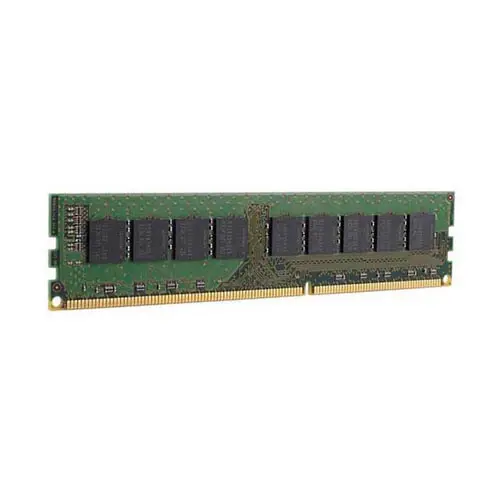
This 4GB DDR3-1066 RDIMM with ECC and registered signaling is engineered for server platforms where data integrity and uptime are critical, making it ideal for virtualization, memory-resident databases, and other enterprise workloads. Its dual-rank x8 configuration combined with CL7 low-latency access and registered buffering reduces electrical loading on the memory controller, ensuring stable operation in fully populated 240-pin server boards.
1. ECC error correction actively scrubs single-bit faults, preserving data integrity for financial transaction logs that cannot tolerate silent corruption.
2. Registered buffer minimizes electrical loading on the memory controller, making high-capacity server farms stable even when fully populated with RDIMM slots.
3. Dual Rank x8 interleaving overlays internal accesses to maximize channel utilization, boosting nested virtualization throughput under heavy consolidation ratios.
4. PC3-8500 grade bandwidth supplies consistent throughput for mid-scale content delivery nodes, preventing memory fetches from starving concurrent user requests.
5. CL7 column latency shortens the round-trip between CPU and DRAM, giving latency-sensitive caching engines a decisive response-time advantage.
The M393B5273BH1-CF8 is a 4GB DDR3-1066 RDIMM for servers. Its four defining traits—ECC error correction, Registered buffering, Dual Rank interleaving, and CL7 latency—directly address real-world pain points. In virtualized clusters, ECC neutralizes single-bit errors from cosmic radiation, preventing hypervisor-level corruption that would crash every VM. Registered buffering offloads the memory controller’s electrical load, so you can fully populate 24 DIMM slots per server—essential for running multiple memory-hungry SQL instances or dense VMware hosts. Dual Rank x8 architecture interleaves accesses across two internal ranks, boosting effective bandwidth for in-memory databases like Redis and SAP HANA. Meanwhile, a tight CAS 7 timing cuts read latency dramatically; every nanosecond translates to faster transactions and responsive dashboards. These characteristics collectively deliver bulletproof data integrity, massive capacity, and snappy performance where uptime and speed are non-negotiable.
This Samsung M393B5273BH1-CF8 is identified as server memory—a 4 GB DDR3-1066 ECC Registered DIMM (RDIMM). It targets older dual-socket platforms with triple-channel memory architectures. Below is capacity planning guidance for typical server workloads.
General Virtualization
For consolidating lightweight VMs, equip each processor with at least six 4 GB RDIMMs (24 GB per CPU). On a dual-socket server, twelve modules (48 GB total) fill both triple-channel sets evenly, enabling memory interleaving and stable bandwidth. This suits file, print, and small web-server VMs without overprovisioning.
In-Memory Database
Maximize capacity by fully populating every available slot with identical 4 GB RDIMMs. In an 18-slot dual-socket node, the resulting 72 GB is sufficient for moderate sized Redis or Memcached datasets. Keep all modules matched (same rank, speed) to preserve ECC consistency and avoid NUMA latency penalties—crucial for transactional in-memory stores.
High-Performance Computing
HPC workloads demand high sustained bandwidth. Install two dual-rank modules per channel, leveraging rank interleaving for extra reads/sec. A dual-socket server with six channels and two DIMMs per channel provides 48 GB of capacity while saturating the memory controller’s parallelism. Use identical 4 GB RDIMMs to ensure uniform timing, essential for MPI-based simulations or scientific modelling.
Rigorously tested server RDIMM, compatible with Dell PowerEdge R710, HP DL380 G7, IBM x3650 M3 and others.
Q: Can I mix this M393B5273BH1-CF8 with other memory modules of different brands or speeds?
A: Mixing brands or speeds is not recommended. ECC Registered modules must operate in uniform configurations to ensure signal integrity and prevent memory errors in server environments.
Q: Is this memory compatible with my server system?
A: Compatibility requires a server board with DDR3 ECC RDIMM support. For Intel, look for C602/C600 chipsets; for AMD, Opteron 6200/6300 series platforms. Verify your board's qualified vendor list.
Q: What is the recommended DIMM population order for optimal performance?
A: Populate identical DIMMs per channel, starting with farthest slot from CPU. Always follow the server board's manual: typically, populate blue slots first in dual-processor configurations to enable balanced memory interleaving.
Q: Does this module support overclocking or XMP profiles?
A: No, this is a server-grade Registered ECC DIMM. It adheres strictly to JEDEC DDR3-1066 standards for maximum stability and data integrity, and does not support overclocking or XMP.
Q: What warranty and typical failure rate can I expect?
A: This module comes with a 1-year warranty. Its ECC design and stringent testing deliver a very low annualized failure rate, typically warranted by an MTBF exceeding 2 million hours.