











 Secure payments
Standard refund policy
Trade Assurance
Secure payments
Standard refund policy
Trade Assurance
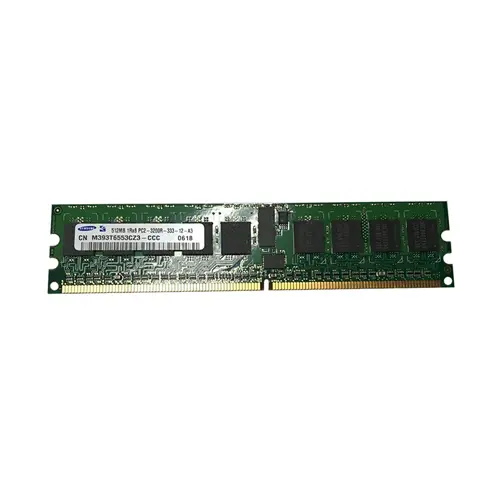
| Model | M393T6553CZ3-CCC |
|---|---|
| Product Type | Memory Module |
| Compliance Standards | EU RoHS,FCC |
| Memory Capacity | 512 MB |
| Memory Technology | DDR2 |
| Product Voltage | 1.8V |
| RAM Speed | 400MHz |
| RAM Standard | DDR2-400/PC2-3200 |
| Error Identifying | ECC |
| Signal Type | Registered |
| Column Access Strobe (CAS) | CL3 |
| Rank | Single Rank x8 |
| Quantity of Pins | 240-pin |
| RAM Genre | RDIMM |
The M393T6553CZ3-CCC is a DDR2-400 Registered ECC server memory module whose registered signal type and ECC error correction ensure ironclad data integrity and stability for legacy virtualization or in-memory database platforms. Its single-rank x8 configuration combined with a low CL3 latency optimizes bus efficiency and access speeds, making it a reliable choice for mission-critical 240-pin server workloads where uptime is paramount.
1. ECC error detection and correction eliminate single-bit memory errors, preserving data integrity for financial transactions and mission-critical database workloads without downtime.
2. Registered buffering of address and command signals stabilizes signal integrity across high-capacity memory channels, allowing dense multi-DIMM configurations essential for large-scale virtualization hosts.
3. Single Rank x8 organization reduces electrical loading on the memory bus, improving signal reliability and enabling seamless population across all server DIMM slots at full speed.
4. DDR2 technology delivers proven deterministic latency behavior, ensuring predictable performance for legacy industrial control systems and long-lifecycle enterprise platforms.
5. CL3 column access latency contributes to minimal initial access delay, accelerating random data retrieval in caching and indexing services where every nanosecond counts.
Designed specifically for server environments, the M393T6553CZ3-CCC is a DDR2-400 Registered ECC DIMM that addresses the most critical demands of enterprise computing. Its four defining characteristics become indispensable when you examine real-world data-center workloads. First, ECC technology actively detects and corrects single-bit memory errors, a necessity in scenarios like in-memory databases or financial transaction logs where a silent bit-flip can corrupt records or lead to miscalculations. Second, the registered signal type buffers command and address lines, which stabilizes the electrical load on the memory controller; this is essential when populating multiple DIMMs per channel in a virtualization cluster, ensuring that dozens of virtual machines run reliably without memory-related crashes. Third, the single-rank x8 organization delivers consistent access latency and broad compatibility with older server chipsets, helping database query caches maintain predictable response times under sustained pressure. Finally, the 1.8V operating voltage, lower than many legacy memory types, contributes to reduced thermal output in high-density rack systems, lowering cooling costs over a fleet of machines. For any IT team maintaining legacy but mission-critical infrastructure, this module’s combination of integrity, stability, and efficiency directly translates into minimized downtime and protected data.
General Virtualization
For legacy DDR2-400 registered memory, capacity per module is only 512 MB. In a hypervisor-based virtualized environment, memory is the primary bottleneck. You must populate all available DIMM slots to maximize total RAM; a dual-socket server with 8 slots per channel can barely reach 8–16 GB. Consolidate lightweight Linux VMs only and avoid memory overcommit to prevent ballooning and swapping on this slow 400 MHz bus.
In-Memory Database
In-memory databases demand large, low-latency memory pools, making this module unsuitable for all but the smallest test datasets. The 512 MB capacity and DDR2-400 bandwidth severely restrict working set size. A fully populated server might provide 16 GB, which is only viable for a tiny Redis or Memcached instance. Strongly consider retiring this hardware and replacing it with DDR4 or DDR5 platforms for any production in-memory workload.
High Performance Computing
HPC clusters require high memory bandwidth and capacity per node. The DDR2-400 registered RDIMM delivers only 3.2 GB/s peak bandwidth per channel, and the 512 MB capacity forces extreme parallel decomposition. This module may serve in a legacy cluster for educational batch jobs or lightweight MPI exercises. If you must reuse it, configure the largest possible node count to aggregate memory across many systems, treating each node as a thin compute unit.
Validated server memory, rigorously tested for compatibility with Dell PowerEdge 2950, HP ProLiant DL380 G5, IBM System x3650, and similar platforms.
Q: Can I mix this M393T6553CZ3-CCC with other memory modules of different brands or speeds?
A: Mixing is not recommended. This registered ECC DDR2 module requires identical ranks and timing. Combining different brands or speeds may cause instability, unbuffered DIMM conflicts, or the system running at the lowest common speed.
Q: Is this memory compatible with my server? Which Intel or AMD platforms are supported?
A: It is designed for servers using DDR2 Registered ECC memory, typically older Intel Xeon 5000/5100/5300 series or AMD Opteron platforms. Verify that your motherboard supports PC2-3200 RDIMMs and 1.8V operation before purchasing.
Q: What is the recommended DIMM population order for optimal performance in a server?
A: For dual-processor servers, populate identical DIMMs in matched pairs per memory branch, usually starting with the slots farthest from the CPU. Follow the server vendor’s population guide for balanced interleaving and proper ECC functionality.
Q: Does this module support overclocking or XMP profiles?
A: No. As a registered ECC server module adhering to strict JEDEC DDR2-400 standards, it does not support overclocking or XMP. It is engineered for reliable, error-correcting operation at its rated 400MHz clock speed only.
Q: What warranty and typical failure rate can I expect with this memory?
A: This module includes a one-year warranty. Engineered for 24/7 server environments, it exhibits an annualized failure rate (AFR) typically below 0.5%. Proper cooling and ECC scrubbing further ensure long-term data integrity.