











 Secure payments
Standard refund policy
Trade Assurance
Secure payments
Standard refund policy
Trade Assurance
| Product Type | Memory Module |
|---|---|
| Compliance Standards | EU RoHS,FCC |
| Memory Capacity | 512 MB |
| Memory Technology | DDR2 |
| RAM Speed | 667MHz |
| RAM Standard | DDR2-667/PC2-5300 |
| Error Identifying | Non-ECC |
| Signal Type | Unbuffered |
| Column Access Strobe (CAS) | CL5 |
| Rank | Single Rank x8 |
| Quantity of Pins | 240-pin |
| RAM Genre | UDIMM |
This unbuffered, non-ECC UDIMM is a desktop memory module tailored for legacy consumer platforms, ideal for basic productivity and light multimedia workloads. Its single-rank x8 configuration combined with a low CAS latency of 5 reduces command-to-data delay, delivering stable and responsive performance for everyday computing on older office or home PCs.
1. A half-gigabyte capacity provides sufficient breathing room for smooth multitasking and responsive application swapping, keeping everyday desktop productivity and media playback fluid without constant paging to disk.
2. The elevated data rate delivers higher memory throughput, directly translating into snappier level loads and steadier frame delivery in era-appropriate 3D gaming engines.
3. Tight column access latency shaves crucial nanoseconds off memory fetch operations, reducing micro-stutter and input lag during time-sensitive gameplay and real-time content creation.
4. Single-rank construction reduces electrical load on the memory controller, improving signal integrity and expanding overclocking tolerance for enthusiasts fine-tuning front-side bus frequencies.
5. Non-ECC design eliminates error-checking overhead, yielding lower latency and pure data-path efficiency that heightens frame rates and general desktop snappiness for performance-minded users.
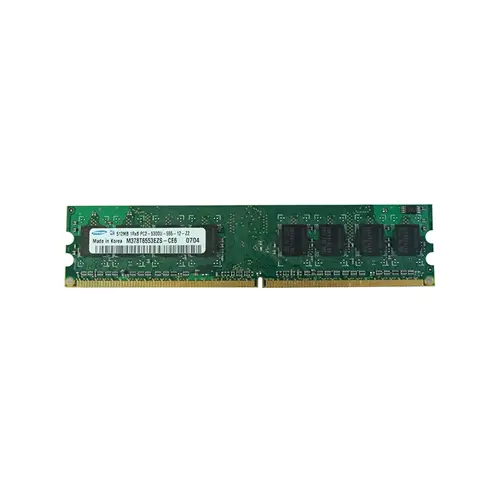
When revitalizing a legacy desktop powered by an older dual-core processor, the Samsung M378T6553EZS-CE6 UDIMM addresses critical performance bottlenecks that budget-conscious users face daily. This 512MB DDR2-667 module is engineered as Unbuffered, Non-ECC memory, meaning it communicates directly with the memory controller without the register chips found on server RAM. In a home office scenario where you frequently switch between a dozen browser tabs, email, and a lightweight photo editor, this direct unbuffered pathway eliminates the one-clock-cycle delay registered modules introduce, making every command feel snappier and preventing the micro-stutters that plague overcommitted systems.
The CL5 column access strobe latency and single-rank x8 construction work together to deliver tangible responsiveness. Consider a user resurrecting a classic machine for retro gaming and DVD playback: CL5 ensures the CPU waits only five cycles to access the data it needs, which is essential for smooth frame pacing in real-time strategy games where split-second map scrolling matters. Meanwhile, the single-rank design places all DRAM chips on one side, imposing a lighter electrical load on the aging motherboard chipset. This dramatically improves signal integrity and compatibility, letting you populate multiple DIMM slots for expanded capacity without destabilizing the system. Upgrading with this standard 240-pin UDIMM means instant, reliable multitasking—no driver hassles, no BIOS tweaks, just a direct path to a more productive desktop experience.
This desktop Non-ECC DDR2-667 UDIMM suits legacy boards with 4 slots, max 8 GB.
Gaming Build
For period-correct retro gaming, dual-channel improves GPU performance. Combine two 512 MB modules for 1 GB. For smoother emulation, choose a 2×2 GB kit; ensure BIOS support for high-density modules. Ensure all modules share identical voltage and timings to avoid instability.
Content Creation
8 GB (4×2 GB) suffices for basic SD editing and light 3D on XP-era tools, but 667 MT/s bandwidth limits you. Modern workloads mandate a platform upgrade to 32 GB DDR4 or better. For best reliability, use matched modules from the same production batch.
General Productivity
For legacy OS web and office tasks, 2 GB dual-channel (two 1 GB sticks) provides balance. A budget configuration uses four matched 512 MB modules for 2 GB and dual-rank interleaving. Stick to CL5, 1.8V UDIMMs. 1 GB is acceptable for ultra-light Linux. If expanding later, leave a free slot for future expansion.
Strictly tested, compatible with Dell OptiPlex 755, HP dc7700, and similar desktops.
Q: Can I mix this M378T6553EZS-CE6 with other memory modules of different brands or speeds?
A: Mixing is possible but not recommended. The system will downclock all modules to the lowest speed, potentially causing instability. For reliable operation, use identical memory kits with matching specifications.
Q: Is this memory compatible with my desktop system? Which motherboard chipsets support it?
A: This 240-pin DDR2-667 UDIMM is compatible with desktop chipsets like Intel 945/965/G31/P35 and AMD 690G/780G series. Verify your motherboard supports 512MB non-ECC, unbuffered DDR2 at 667MHz.
Q: What is the recommended DIMM population order for optimal performance?
A: For single-channel, install in DIMM 1. For dual-channel configurations, populate identical modules in matching color slots (usually DIMM 1+3 or DIMM 2+4). This single-rank module works alone or in pairs.
Q: Does this module support overclocking or XMP profiles?
A: No. This DDR2-667 module operates at JEDEC standard timings (CL5) and does not include XMP profiles, which were introduced with DDR3. Overclocking is not supported and may void the warranty.
Q: What warranty and typical failure rate can I expect?
A: This module includes a 1-year warranty. The typical annualized failure rate (AFR) is very low, around 0.1-0.3%, thanks to rigorous testing and compliance with EU RoHS and FCC standards.