











 Secure payments
Standard refund policy
Trade Assurance
Secure payments
Standard refund policy
Trade Assurance
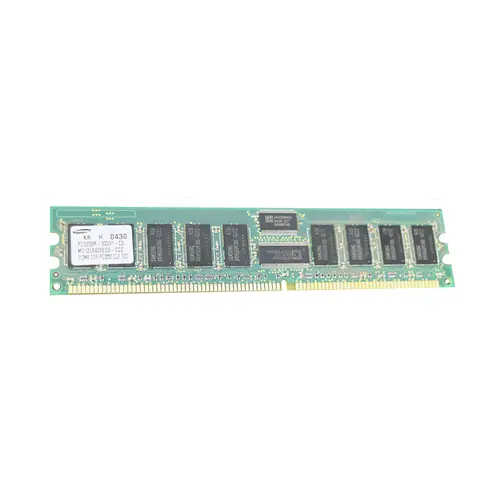
| Model | M312L6420EG0-CCC |
|---|---|
| Product Type | Memory Module |
| Compliance Standards | EU RoHS,FCC |
| Memory Capacity | 512 MB |
| Memory Technology | DDR |
| Product Voltage | 2.5V |
| RAM Speed | 400MHz |
| RAM Standard | DDR-400/PC-3200 |
| Error Identifying | ECC |
| Signal Type | Registered |
| Column Access Strobe (CAS) | CL3 |
| Rank | Single Rank x4 |
| Quantity of Pins | 184-pin |
| RAM Genre | RDIMM |
This is a legacy DDR server memory module designed for registered ECC platforms. It is ideally suited for older single or dual-processor servers running memory-intensive enterprise workloads such as virtualization and database management, where the Registered signal type and ECC error correction work together to maintain signal integrity across multiple DIMMs and ensure maximum data reliability.
1. Error correction code actively catches and repairs bit-level corruption, a critical safeguard for transactional databases and financial ledgers where even a single silent error is unacceptable.
2. Registered command buffering stabilizes the memory bus under heavy load, allowing dense server configurations to sustain reliable operation through continuous multi-tenant workloads.
3. Single Rank x4 organization balances electrical load and keeps all bank groups active, providing uniform access latencies that keep virtual machine response times predictable under high consolidation.
4. Tight column access strobe timing reduces the delay between request and retrieval, directly accelerating in-memory caching and latency-sensitive trading engines.
5. Modest per-module capacity targets dedicated lightweight roles such as network appliance caching or embedded hypervisor hosts, where steady low-power state trumps sheer density.
With its RDIMM form factor, ECC, and Registered signal type, the M312L6420EG0-CCC is unmistakably server-grade memory built for mission-critical infrastructure. Its ECC (Error Correction Code) capability is your first line of defense against silent data corruption. In a dense virtualization cluster running multiple VMs, a single-bit flip caused by background radiation can crash a guest OS or silently corrupt transactional data; ECC detects and corrects such errors in real time, preserving uptime and data integrity. The Registered (buffered) architecture is equally vital for scalability. By redriving address and command signals, it reduces the electrical load on the memory controller, letting you populate all DIMM slots without sacrificing stability—this directly supports large-memory-footprint in-memory databases like Redis or SAP HANA, where sudden signal degradation would trigger node failures. The module’s Single Rank x4 organization strikes a balance between density and command bus efficiency, minimizing contention during peak concurrent access. Finally, its DDR-400 (PC-3200) speed and CL3 latency deliver predictable 3.2 GB/s bandwidth per channel, ensuring that real-time SLA-bound workloads, from financial transactions to user authentication services, never experience memory-induced latency spikes. This memory transforms raw spec sheets into tangible business continuity.
General Virtualization
Populate legacy server boards with these DDR-400 Registered ECC modules in matched pairs to enable dual-channel operation, doubling effective bandwidth. Because each module provides only 512 MB, install a minimum of four identical DIMMs (2 GB total) to support a lightweight hypervisor and two or three small virtual machines. ECC protection is vital for stability in multi-tenant environments; never mix registered and unbuffered modules.
In-Memory Database
Maximize capacity by filling every available DIMM slot—typical Socket 940/478 platforms offer four to eight slots, yielding 2–4 GB of total memory. This configuration supports small Redis or Memcached instances where data integrity is critical. Always use identical RDIMMs so that chipkill-like ECC coverage prevents silent corruption in hosted datasets.
High-Performance Computing
Install symmetrical sets of these single-rank x4 modules across memory channels to maximize bandwidth per node. A node populated with four to eight modules (2–4 GB) is sufficient for modest-footprint MPI or scientific workloads running on ageing clusters. ECC is mandatory here to detect and correct transient errors during long-running parallel compute jobs.
Rigorously tested server memory, compatible with Dell PowerEdge 2850, HP ProLiant DL380 G4, IBM xSeries 346.
Q: Can I mix this M312L6420EG0-CCC with other memory modules of different brands or speeds?
A: Mixing modules is strongly discouraged for registered server memory. Mismatched brands or speeds may cause boot failures or system instability, as all channels must operate at the slowest common speed with identical ECC and register timings.
Q: Is this memory compatible with my system?
A: This 184-pin DDR-400 Registered ECC RDIMM targets server platforms using Intel E7520/E7320 or AMD 8000-series chipsets. Verify your board supports 2.5V, CL3 Registered DDR-400 before purchasing to ensure reliable platform operation.
Q: What is the recommended DIMM population order for optimal performance?
A: Populate identical modules in pairs per memory channel, starting with the farthest slots from the CPU. For dual-processor servers, balance load across both banks as detailed in your system board's manual to maintain symmetrical interleaving and ECC integrity.
Q: Does this module support overclocking or XMP profiles?
A: No. This is a registered DDR-400 server module with fixed JEDEC timings and ECC logic. It does not include XMP profiles and is not designed for overclocking; stable operation is guaranteed only at its rated 400MHz specification.
Q: What warranty and typical failure rate can I expect?
A: This module carries a one-year limited warranty. When operated within specification, typical annualized failure rates are extremely low, usually below 0.1%, thanks to its buffered architecture and built-in error correction capabilities.