











 Secure payments
Standard refund policy
Trade Assurance
Secure payments
Standard refund policy
Trade Assurance
| Product Type | Memory Module |
|---|---|
| Memory Capacity | 64 GB |
| Memory Technology | DDR4 |
| Product Voltage | 1.2V |
| RAM Speed | 2400MHz |
| RAM Standard | DDR4-2400/PC4-19200 |
| Error Identifying | ECC |
| Signal Type | Registered |
| Column Access Strobe (CAS) | CL17 |
| Rank | Quad Rank x4 |
| Quantity of Pins | 288-pin |
| RAM Genre | RDIMM |
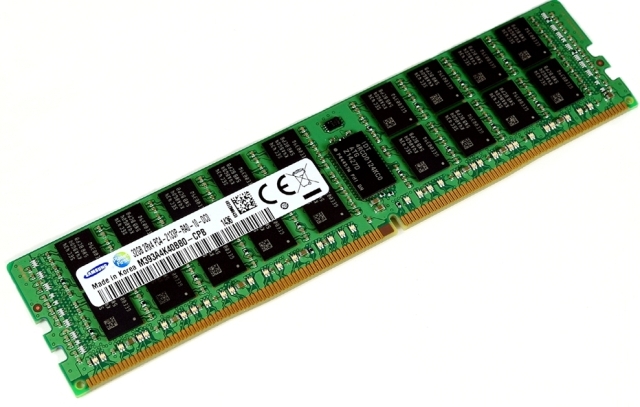
This RDIMM with ECC and registered signaling is engineered for enterprise server platforms, where it ensures data integrity in virtualization clusters and in-memory databases. The quad-rank x4 configuration enables high-density memory populations while the 1.2V low-power DDR4-2400 operation and CL17 latency deliver a balance of energy efficiency and predictable performance under sustained mission-critical workloads.
1. ECC protection silently identifies and corrects single-bit errors, ensuring uncompromised data integrity for mission-critical databases and financial transaction processing.
2. Registered signaling buffers command and address lines, enabling stable operation across heavily populated memory channels in large-scale virtualization hosts.
3. The module’s high capacity allows substantially more virtual machines per physical node, reducing server sprawl and software licensing overhead in dense cloud deployments.
4. Quad Rank x4 organization interlocks multiple rank accesses to keep memory bandwidth fully utilized, accelerating in-memory analytics and real-time data caching.
5. PC4-19200 bandwidth supplies consistent per-channel throughput, satisfying the concurrent data demands of multi-socket servers without becoming a bottleneck for mainstream enterprise workloads.
The Samsung M386A8K40BM1-CRC4Y is a 64GB DDR4-2400 Registered ECC DIMM purpose-built for enterprise servers, and its four defining characteristics translate directly into resilience and scalability in the data center. The quad-rank x4 design maximizes capacity per channel, letting you pack six times more memory into a dual-socket virtualization host. This matters when consolidating hundreds of VMs: without dense modules, you force costly trade-offs between guest count and performance. The registered architecture buffers command and address signals, preserving clean waveforms even with fully populated banks. In a 24-slot server, this prevents boot failures and silent data corruption under sustained load. ECC then becomes your real-time safety net, catching single-bit errors before they cascade into crashed hypervisors or corrupt in-memory database transactions in systems like SAP HANA, where a single bit flip could invalidate financial records. Finally, the low 1.2V operating voltage meaningfully cuts thermal footprint and energy draw across always-on clusters, directly lowering cooling costs and extending hardware lifespan. Together, these features ensure your virtualized workloads and analytical engines run with the integrity, density, and efficiency that enterprise uptime demands.
General Virtualization
A single 64GB Registered ECC module is an excellent building block for dense virtualization hosts. Deploy six to eight of these modules in a dual-socket server to reach 384–512GB, allowing you to run dozens of virtual machines comfortably with memory headroom. Populate all memory channels symmetrically (e.g., one DIMM per channel) to maximize bandwidth while retaining the ability to scale later.
In-Memory Database
Applications like Redis or SAP HANA demand both high capacity and absolute data integrity. Install four 64GB RDIMMs per processor (256GB total) as a starting point, scaling to 512GB or 1TB for larger datasets. The ECC and registered design is critical here, as it prevents single-bit errors from corrupting your live data and ensures stability under constant, high-throughput access patterns.
High-Performance Computing (HPC)
HPC workloads benefit from balanced memory bandwidth and capacity. Populate all eight channels of a dual-socket server with identical 64GB RDIMMs for a total of 512GB, stepping up to sixteen modules (1TB) for memory-bound simulations. Although DDR4-2400 is modest in frequency, the quad-rank organization helps maintain command rate efficiency, delivering the sustained throughput needed for large-scale computational fluid dynamics or climate modeling.
Tested and proven server memory, compatible with Dell PowerEdge R750, HPE ProLiant DL380 Gen10, Lenovo ThinkSystem SR650, and similar systems.
Q: Can I mix this M386A8K40BM1-CRC4Y with other memory modules of different brands or speeds?
A: Mixing is strongly discouraged for server environments. This RDIMM requires identical part numbers to ensure signal integrity and stability. Different speeds or ranks may force the entire memory bank to downgrade or cause POST failures.
Q: Is this memory compatible with my system?
A: This DDR4-2400 ECC Registered DIMM is compatible with server platforms using Intel Xeon E5-2600 v3/v4, Scalable, or AMD EPYC 7001/7002 series CPUs and corresponding chipsets. Verify if your motherboard supports LR/RDIMM and Quad Rank configurations.
Q: What is the recommended DIMM population order for optimal performance?
A: For Quad Rank x4 modules, follow your server board's population guide strictly. Typically, populate identical DIMMs per channel starting with the farthest slot from the CPU. Balance channels to maximize interleaving and avoid mixing ranks in the same channel.
Q: Does this module support overclocking or XMP profiles?
A: No. As enterprise-grade server memory, this RDIMM adheres solely to JEDEC DDR4-2400 standards. It does not support overclocking or XMP profiles. Stability and data integrity are prioritized over speculative frequency increases.
Q: What warranty and typical failure rate can I expect?
A: This module carries a 1-year warranty. Enterprise memory like this Samsung RDIMM exhibits an extremely low annualized failure rate (typically <0.5%), ensuring mission-critical reliability. Replacement is prompt per warranty terms.