











 Secure payments
Standard refund policy
Trade Assurance
Secure payments
Standard refund policy
Trade Assurance
| Product Type | Memory Module |
|---|---|
| Memory Capacity | 64 GB |
| Memory Technology | DDR4 |
| Product Voltage | 1.2 V |
| RAM Speed | 2933 MHz |
| RAM Standard | DDR4-2933/PC4-23400 |
| Error Identifying | ECC |
| Signal Type | Registered |
| Column Access Strobe (CAS) | CL21 |
| Rank | Dual Rank |
| Quantity of Pins | 288-pin |
| RAM Genre | RDIMM |
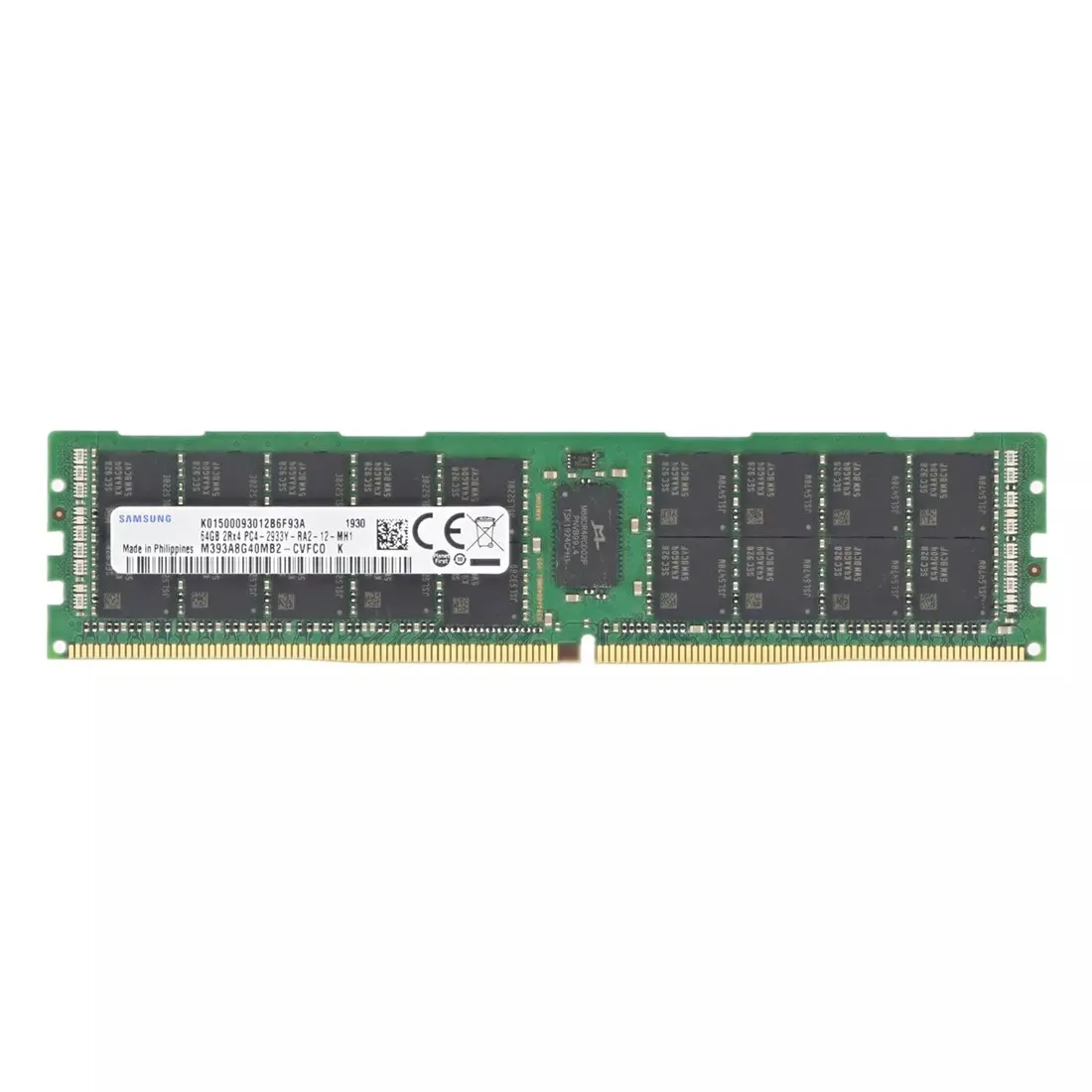
This 64GB DDR4-2933 Registered ECC RDIMM is purpose-built for server platforms handling memory-intensive workloads such as virtualization and in-memory databases, where its ECC and registered signal type deliver critical data integrity and signal stability under heavy load. The dual-rank configuration further enhances bandwidth efficiency by enabling rank interleaving, optimizing throughput in multi-DIMM enterprise deployments.
1. The large module capacity enables higher memory per server channel, directly expanding virtual machine density and reducing reliance on performance-sapping disk swap operations.
2. On-the-fly error correction preserves transactional integrity across long-running analytics and database workloads, eliminating silent data corruption risks in multi-tenant environments.
3. The registered interface buffers command/address signals to decouple electrical loading, allowing fully populated memory slots for maximum capacity in scale-up virtualization deployments.
4. The high-speed DDR4 data rate provides ample memory bandwidth to accelerate in-memory computing, real-time inference, and heavy concurrent access under fully loaded processor cores.
5. Dual-rank organization leverages rank interleaving to keep data buses saturated during random access patterns, delivering consistent low-latency throughput critical for consolidated VM and container performance.
The Samsung M393A8G40MB2-CVFCQ is a 64GB DDR4-2933 Registered ECC RDIMM, purpose-built for enterprise-class servers where data integrity and relentless uptime are non-negotiable. Its four defining characteristics directly confront real-world data center pain points. First, the massive 64GB capacity per module allows virtualization clusters to pack significantly more VMs onto each host, directly reducing hardware sprawl and licensing costs. Second, ECC actively corrects single-bit memory errors caused by background radiation, which is critical because a silent bit-flip in a hypervisor can corrupt virtual disks or force a node offline. Third, the Registered signal buffer re-drives address and command signals, stabilizing the entire memory bus when all slots are populated. This means you can scale up to terabyte-class memory configurations without the signal degradation that triggers random crashes during heavy database operations. Fourth, the Dual Rank architecture interleaves internal banks to deliver higher sustained bandwidth, accelerating in-memory databases like SAP HANA and real-time analytics. At 2933MT/s, it feeds processors faster during complex queries. Together, these features turn raw capacity into deterministic reliability, keeping your transactional workloads accurate and virtualized services running without interruption.
Server Memory Identified
This is a 64GB DDR4-2933 Registered ECC RDIMM (288-pin, Dual Rank, 1.2V). Its error correction, signal integrity, and high capacity are designed for multi-socket server platforms. Below are configuration recommendations for key workloads.
General Virtualization
Populate at least one DIMM per memory channel to balance capacity and bandwidth, typically starting with 4 modules (256GB) for a dual‑socket host. This provides ample headroom for dozens of mixed‑workload VMs while Registered ECC guards against data corruption. Scale by adding identical 64GB RDIMMs across channels to preserve uniform memory interleaving.
In‑Memory Database
Maximize total capacity by filling all channels with one 64GB Dual‑Rank RDIMM each, aiming for 512GB–1TB per server. This configuration maintains the highest per‑channel bandwidth without performance penalties from multiple ranks. ECC is critical for long‑running in‑memory datasets where a single bit error could silently corrupt transactions.
High‑Performance Computing
Populate every memory channel with one 64GB RDIMM to achieve peak sustained bandwidth across the socket. For a dual‑processor node, 12–16 such DIMMs deliver 768GB–1TB of error‑protected memory, feeding CPU cores without bottlenecks. Dual‑Rank modules maximize data rate per channel, and Registered buffering stabilises high‑speed signals in densely populated systems.
Rigorously tested RDIMM, validated for Dell PowerEdge R750, HPE ProLiant DL380 Gen10 Plus, Lenovo ThinkSystem SR650 V2.
Q: Can I mix this M393A8G40MB2-CVFCQ with other memory modules of different brands or speeds?
A: Mixing different brands or speeds is not recommended for this registered ECC memory. It may cause instability, uncorrected errors, or failure to boot. For reliable operation, always use identical modules with the same Samsung part number.
Q: Is this memory compatible with my system?
A: This 64GB DDR4-2933 RDIMM is designed for server platforms such as Intel Xeon Scalable and AMD EPYC. Please verify your motherboard’s Qualified Vendor List (QVL) for support of ECC Registered DIMMs and this specific Samsung part number.
Q: What is the recommended DIMM population order for optimal performance?
A: Refer to your server’s technical manual for population rules. Generally, install identical modules in matching slots across memory channels, filling blue or primary connectors first to maintain balanced interleaving and maximize throughput.
Q: Does this module support overclocking or XMP profiles?
A: No, this is a server-grade JEDEC-compliant RDIMM operating at standard 2933MT/s. It does not support overclocking or XMP profiles, as it is engineered for maximum data integrity and 24/7 mission-critical stability.
Q: What warranty and typical failure rate can I expect?
A: This module carries a 1-year warranty. As an enterprise-class Samsung RDIMM, it delivers exceptional reliability, with a typical annualized failure rate (AFR) well below 0.5% under specified operating conditions.