











 Secure payments
Standard refund policy
Trade Assurance
Secure payments
Standard refund policy
Trade Assurance
| Product Type | Memory Module |
|---|---|
| Memory Capacity | 64 GB |
| Memory Technology | DDR3 |
| Product Voltage | 1.5V |
| RAM Speed | 1600MHz |
| RAM Standard | DDR3-1600/PC3-12800 |
| Error Identifying | ECC |
| Signal Type | Registered |
| Column Access Strobe (CAS) | CL11 |
| Rank | Quad Rank x4 |
| Quantity of Pins | 276-pin |
| RAM Genre | CDIMM |
This 64GB DDR3-1600 registered ECC CDIMM is engineered for legacy server platforms, delivering robust data integrity for memory-intensive virtualization and in-memory database workloads. Its quad-rank x4 organization maximizes capacity per channel while the registered signal type ensures stable operation in fully populated multi-DIMM configurations.
1. 64 GB capacity per module enables dense memory configurations, allowing a single server to host more virtual machines and larger in-memory databases without sacrificing performance.
2. ECC error correction detects and corrects single-bit memory errors in real time, preventing silent data corruption that would threaten financial transaction integrity and scientific computation accuracy.
3. Registered signal buffering stabilizes address and command lines, maintaining signal integrity essential for fully populating memory channels in multi-socket enterprise servers.
4. Quad Rank x4 organization maximizes per-channel capacity while enabling chipkill-level error correction, strengthening overall system reliability for mission-critical virtualization clusters.
5. 1600 MT/s data rate delivers consistent 12.8 GB/s per-channel bandwidth, sustaining throughput-hungry analytics and concurrent multi-tenant workloads without bottlenecks.
This DDR3 server memory module, identified by its ECC, Registered signals, and 276-pin CDIMM form factor, directly addresses the most critical demands of enterprise data centers. Its four defining traits are not just specifications—they are operational safeguards.
First, Error Correcting Code (ECC) automatically detects and corrects single-bit memory errors, a silent threat that can corrupt financial transactions or database entries in a virtualized cluster running dozens of VMs. Without it, a random cosmic-ray-induced bit flip could crash a hypervisor, taking entire business services offline. Second, the Registered buffer isolates the memory controller from the electrical load of 64 GB and quad-rank x4 organization. In a fully populated server, this means you can deploy massive memory footprints for in-memory databases like SAP HANA without signal degradation or boot failures that can plague unbuffered designs. Third, the quad-rank architecture itself allows the module to populate all four logical ranks, enabling high-capacity 64 GB configurations today while leaving room for future expansion. Tight column access strobe latency of CL11 at 1600 MHz ensures that even with this density, data access remains responsive under heavy, concurrent read/write operations. Finally, the standard 1.5 V compliance ensures broad compatibility with existing server platforms, so you upgrade a production node with confidence, knowing this module was built to sustain 24/7 operation with zero tolerance for silent data corruption.
General Virtualization
For a multi-tenant hypervisor like VMware ESXi or Hyper-V, this 64 GB registered DDR3-1600 module allows dense population. Install eight identical 64 GB RDIMMs in a dual-socket system for 512 GB total, giving roughly 256 VMs with 2 GB each. The Quad Rank x4 design maximizes capacity per channel at the cost of slightly reduced frequency under full load, but virtualization workloads tolerate this well.
In-Memory Database
Memory-resident databases such as Redis or SAP HANA benefit from absolute capacity with error correction. Equip both processor memory controllers with six of these 64 GB ECC modules (768 GB total) on a 12-slot board, keeping latency-sensitive data entirely in RAM. The CL11 rating and registered signaling maintain stability during sustained 100 % memory utilization, and ECC is mandatory to prevent silent data corruption.
HPC
Large-scale simulation and modeling nodes rely on high memory bandwidth and capacity. Populate all memory channels with identical 64 GB Quad Rank RDIMMs — for example, eight modules per node for 512 GB — to feed multiple GPU accelerators or MPI processes. The 1600 MHz speed with CL11 offers a predictable balance, while registered ECC ensures correct results during week-long computations.
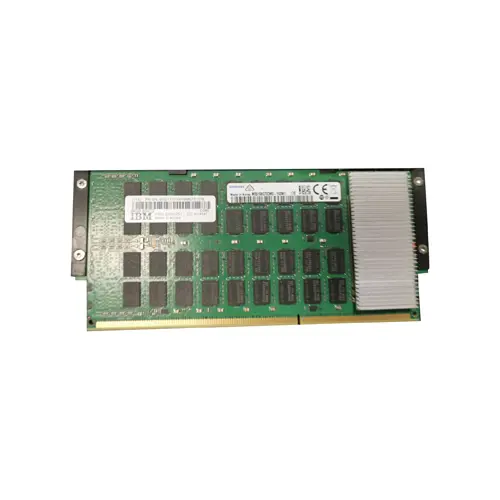
Rigorously tested Samsung 64GB DDR3-1600 Registered ECC CDIMM, compatible with Dell PowerEdge R720, HP DL380p Gen8, Lenovo RD530.
Q: Can I mix this M351B8G70DM0-YK0 with other memory modules of different brands or speeds?
A: Mixing is not recommended. Registered ECC modules require identical specifications for signal integrity. Mismatched brands or speeds can cause POST failures and data corruption in server environments.
Q: Is this memory compatible with my system?
A: This 64GB DDR3-1600 Registered ECC CDIMM is designed for dual-socket servers using Intel Xeon E5-2600 v1/v2 or AMD Opteron 6300 platforms. Confirm your motherboard supports quad-rank 276-pin RDIMMs.
Q: What is the recommended DIMM population order for optimal performance?
A: Populate identical DIMMs in the first slot of each memory channel, typically the blue slots. For quad-rank modules, balance across channels and follow the server board's specific population guide for maximum bandwidth.
Q: Does this module support overclocking or XMP profiles?
A: No. This is an enterprise Registered ECC module operating strictly at JEDEC-standard DDR3-1600. It does not support overclocking, XMP profiles, or any deviation from nominal timings.
Q: What warranty and typical failure rate can I expect?
A: It includes a one-year warranty. Built with rigorously screened components, the typical annualized failure rate is below 0.5%, ensuring dependable operation for critical server workloads.