











 Secure payments
Standard refund policy
Trade Assurance
Secure payments
Standard refund policy
Trade Assurance
| Model | M386A8K40BMB-CRC5Q |
|---|---|
| Product Type | Memory Module |
| Compliance Standards | EU RoHS,FCC |
| Memory Capacity | 64 GB |
| Memory Technology | DDR4 |
| Product Voltage | 1.2V |
| RAM Speed | 2400MHz |
| RAM Standard | DDR4-2400/PC4-19200 |
| Error Identifying | ECC |
| Signal Type | Registered |
| Column Access Strobe (CAS) | CL17 |
| Rank | Quad Rank x4 |
| Quantity of Pins | 288-pin |
| RAM Genre | RDIMM |
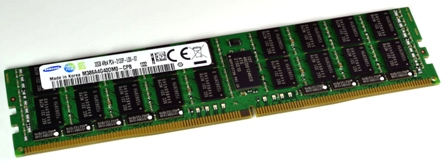
The M386A8K40BMB-CRC5Q is a 64GB DDR4-2400 Registered ECC RDIMM built for enterprise servers, providing critical data integrity for virtualization and in-memory database workloads. Its quad-rank x4 design enables high capacity density per memory channel, while the registered signal type and ECC ensure stable, error-free operation under heavy multi-DIMM configurations.
1. Registered signal type buffers command and address lines, preserving signal integrity across fully loaded memory channels in dense server configurations to maintain uptime for critical enterprise applications.
2. Quad Rank x4 organization packs more devices per module, enabling higher memory capacity per channel without sacrificing data integrity, which supports larger in-memory databases under heavy transactional loads.
3. ECC protection transparently detects and corrects single-bit errors, preventing silent data corruption in financial modeling and scientific computing where result accuracy is non-negotiable.
4. A 64GB module density allows IT architects to triple the memory footprint in a dual-socket server, directly increasing virtual machine density for private cloud consolidation.
5. DDR4-2400 bandwidth provides a balanced throughput baseline for memory-bound workloads like real-time analytics, ensuring predictable latency under sustained traffic without over-provisioning power.
The M386A8K40BMB-CRC5Q is a 64GB DDR4-2400 Registered DIMM built for servers, and its four defining characteristics translate directly into business continuity and workload performance. First, ECC error correction continuously detects and corrects single-bit memory faults, which is vital when a silent bit-flip in a financial database or a virtualized customer-facing application could cause transactional corruption rather than a simple crash. Second, the Registered signal buffer stabilizes the electrical load on the memory bus, allowing a fully populated 24-slot server to operate 64GB modules without signal degradation; that means you can confidently scale a VMware ESXi cluster to hundreds of virtual machines without random boot failures or data-scrubbing storms. Third, the quad-rank x4 organization packs 64GB onto a single module while interleaving bank groups to sustain bandwidth under heavy concurrent access—critical for in-memory analytics platforms like SAP HANA, where response times depend on extracting every available gigabyte per second. Fourth, the 1.2V operating voltage keeps thermal and power budgets in check inside dense 2U nodes, so cooling fans can stay at lower RPMs and your collocated infrastructure bears less electrical cost. In practice, these features turn an upgrade decision into a resilience guarantee—your virtual machines stay up, your in-memory datasets stay accurate, and your data center operating margins stay predictable.
This 64 GB DDR4-2400 ECC Registered quad-rank RDIMM is built for enterprise servers. Below are population recommendations for three key workloads.
General Virtualization
Populate all memory channels equally — eight modules (512 GB) in a dual-socket platform — to maximize interleaving and VM density. For 1 TB capacity, add a second DIMM per channel, accepting a speed drop to 1866 MT/s caused by quad-rank loading. Use identical modules to ensure reliability.
In-Memory Database
For latency-sensitive databases, install one DIMM per channel (512 GB) to maintain the full 2400 MT/s speed. To scale single-node capacity to 1 TB, fill two quad-rank DIMMs per channel at reduced speed; supplement with memory mirroring for data-critical deployments.
High-Performance Computing
To maximize bandwidth, equip each channel with a single 64 GB module, achieving 512 GB at 2400 MHz. Avoid pairing two quad-rank DIMMs in the same channel, which throttles bandwidth. If more memory is needed, migrate to higher-density LRDIMMs or scale horizontally.
Server memory rigorously tested for compatibility with Dell PowerEdge R760, HPE ProLiant DL380 Gen11, Lenovo ThinkSystem SR650 V3, and more.
Q: Can I mix this M386A8K40BMB-CRC5Q with other memory modules of different brands or speeds?
A: Mixing different brands or speeds is not recommended for registered server memory. It may cause instability or fail to POST. For optimal reliability, use identical modules with matching rank, latency, and part number across all channels.
Q: Is this memory compatible with my server system?
A: This 64GB DDR4-2400 RDIMM is compatible with Intel Xeon E5-2600 v3/v4 and AMD EPYC 7001 series platforms that support registered ECC memory. Always verify your server board's qualified vendor list for this specific Samsung module.
Q: What is the recommended DIMM population order for optimal performance?
A: Populate identical Quad Rank x4 RDIMMs starting with the first slot of each memory channel. Follow your server's population guide, typically filling white slots first, to enable balanced interleaving and maximize memory bandwidth.
Q: Does this module support overclocking or XMP profiles?
A: No, this server-grade RDIMM adheres to JEDEC DDR4-2400 specification only. It does not support XMP profiles or overclocking. Enterprise platforms require stable, error-correcting operation at standard speeds without performance tuning.
Q: What warranty and typical failure rate can I expect?
A: This module includes a one-year warranty. Samsung enterprise RDIMMs demonstrate an annualized failure rate (AFR) well below 0.5% under normal operating conditions, ensuring high reliability in 24/7 data center environments.