











 Secure payments
Standard refund policy
Trade Assurance
Secure payments
Standard refund policy
Trade Assurance
| Product Type | Memory Module |
|---|---|
| Memory Capacity | 64 GB |
| Memory Technology | DDR4 |
| Product Voltage | 1.2 V |
| RAM Speed | 2400 MHz |
| RAM Standard | DDR4-2400/PC4-19200 |
| Error Identifying | ECC |
| Signal Type | Registered |
| Column Access Strobe (CAS) | CL17 |
| Rank | Quad Rank x4 |
| Quantity of Pins | 288-pin |
| RAM Genre | RDIMM |
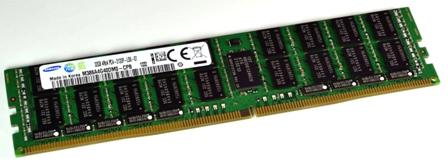
This 64GB DDR4-2400 Registered ECC RDIMM is purpose-built for enterprise servers running memory-intensive workloads such as virtualization, large-scale databases, and in-memory analytics, where end-to-end data integrity and uptime are non-negotiable. Its quad-rank x4 configuration and registered signal buffering ensure reliable high-capacity scaling per channel, while ECC actively corrects single-bit errors to prevent silent data corruption in mission-critical environments.
1. High-density 64GB capacity enables greater virtual machine consolidation per physical host, directly lowering infrastructure overhead while maintaining generous memory headroom for each workload.
2. ECC protection continuously detects and corrects single-bit errors, preserving data integrity for financial transactions and mission-critical databases that cannot tolerate silent corruption.
3. Registered signaling buffers the command and address lines, stabilizing signal integrity across fully populated server banks so you can scale to massive memory footprints without reliability tradeoffs.
4. Quad Rank x4 organization keeps memory channels deeply saturated, delivering predictable bandwidth and low jitter even when dozens of VMs contend for simultaneous access.
5. 2400MT/s throughput supplies consistent memory bandwidth for in-memory analytics and high-concurrency workloads, shrinking response times under heavy query loads.
The M386A8K40BMB-CRC4Q is a 64GB DDR4-2400 Registered ECC RDIMM purpose‑built for enterprise servers, and its four defining characteristics directly address the most critical pain points in data‑center environments. First, the registered signal type uses an on‑DIMM buffer to stabilize address and command lines, enabling four densely‑packed Quad Rank x4 ranks of memory per module. For a virtualization cluster hosting dozens of VMs, this translates into a reliable 64GB footprint per stick that won’t collapse under heavy simultaneous access—allowing you to pack more virtual machines into each server without signal integrity failures. Second, ECC error correction continuously scrubs single‑bit errors, shielding your in‑memory database such as SAP HANA or Redis from silent data corruption that could cascade into financial miscalculation or transaction loss. Third, the Quad Rank x4 organization interleaves access across multiple internal banks, delivering higher sustained bandwidth under the random, parallel workloads typical of multi‑tenant virtualized environments—so a busy database node experiences fewer stalls. Finally, the 1.2V low‑voltage design trims a facility’s cumulative power and cooling burden, which directly reduces operating cost at scale while maintaining the 2400MT/s transfer rate and CL17 latency that keep latency‑sensitive applications responsive. Together, these attributes mean uninterrupted service, data accuracy, and optimized TCO in demanding 24/7 operations.
Capacity Planning Guide for 64GB DDR4-2400 ECC RDIMM
General Virtualization
For a consolidated virtualization host running 15–25 moderate VMs, populate a dual-socket server with eight of these 64GB quad-rank modules for 512GB total. Distribute modules evenly across all memory channels to maximize interleaving, and reserve a ratio of 4:1 virtual CPUs to physical cores to maintain comfortable memory overcommit headroom.
In-Memory Database
Deploy six 64GB RDIMMs (384GB) per socket using a balanced memory architecture to keep the entire dataset in-system without swapping. With CL17 and 2400MT/s, this capacity is ideal for Redis, Memcached, or SAP HANA Express instances sustaining sub-millisecond latency under 100GB active footprints.
High-Performance Computing (HPC)
For memory-bandwidth-bound simulations, fully populate all eight channels per node with these quad-rank DIMMs for 512GB, enabling maximum read bandwidth near 153.6 GB/s per socket. Match the number of MPI ranks per node to the memory channel count, assigning one rank per NUMA domain to minimize remote accesses during large array computations.
This server memory, rigorously tested, is compatible with Dell PowerEdge R740, HPE ProLiant DL380 Gen10, and Lenovo ThinkSystem SR650.
Q: Can I mix this M386A8K40BMB-CRC4Q with other memory modules of different brands or speeds?
A: Mixing Registered ECC modules with different brands or speeds is not recommended. The memory controller will downclock all modules to the slowest common speed, often causing stability issues and unbootable states in server environments.
Q: Is this memory compatible with my system?
A: Compatibility depends on your server platform. This quad-rank DDR4-2400 RDIMM requires a motherboard supporting Registered ECC DIMMs, typically Intel Xeon E5-2600 v3/v4 or AMD EPYC 7001 series. Verify your CPU and board support 64GB LR/RDIMMs and quad-rank configurations.
Q: What is the recommended DIMM population order for optimal performance?
A: For quad-rank RDIMMs, populate identical modules following your server’s memory population guide—usually filling all channels symmetrically. With 64GB quad-rank modules, one DIMM per channel is optimal to preserve maximum speed; mixing ranks may force speed reductions.
Q: Does this module support overclocking or XMP profiles?
A: No. This is a Registered ECC DDR4 module compliant with JEDEC standard DDR4-2400 (PC4-19200) at CL17. It does not feature XMP profiles and is not designed for overclocking, prioritizing data integrity and stability in server workloads over high frequency.
Q: What warranty and typical failure rate can I expect?
A: This module is covered by a 1-year warranty against defects. Enterprise RDIMMs like this Samsung M386A8K40BMB-CRC4Q exhibit extremely low annualized failure rates (AFR), typically below 0.5%, when operated within validated server environments at specified temperature and voltage.