











 Secure payments
Standard refund policy
Trade Assurance
Secure payments
Standard refund policy
Trade Assurance
| Product Type | Memory Module |
|---|---|
| Memory Capacity | 64 GB |
| Memory Technology | DDR4 |
| Product Voltage | 1.2V |
| RAM Speed | 2400MHz |
| RAM Standard | DDR4-2400/PC4-19200 |
| Error Identifying | ECC |
| Signal Type | Registered |
| Column Access Strobe (CAS) | CL17 |
| Rank | Quad Rank x4 |
| Quantity of Pins | 288-pin |
| RAM Genre | RDIMM |
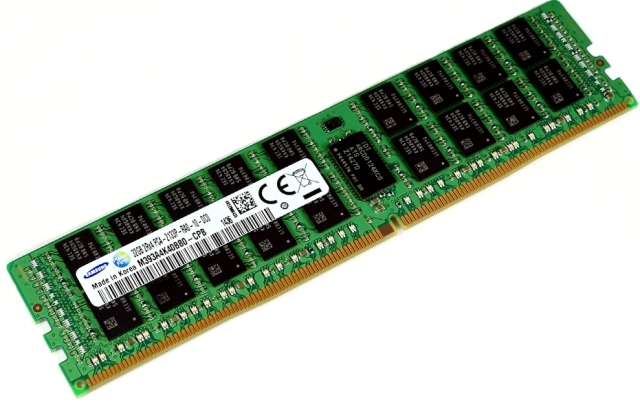
This 64GB DDR4-2400 RDIMM, operating at 1.2V with ECC and a registered signal path, is designed exclusively for server platforms where data integrity and uptime are critical, making it ideal for virtualized environments and in-memory databases. Its quad-rank x4 organization maximizes capacity per channel while the registered architecture ensures stable signal integrity under heavy load, and the CL17 latency delivers reliable, deterministic performance in memory-intensive workloads.
1. Registered signal buffering stabilizes command and address lines across fully populated server nodes, eliminating signal integrity drift that could corrupt in-memory databases during peak transactional loads.
2. ECC protection silently detects and corrects single-bit errors in real time, preserving data accuracy for financial modeling or virtualization clusters where even a flipped bit can cascade into costly logical faults.
3. Quad Rank x4 organization packs more logical banks per channel, enabling denser memory configurations that maximize VM density per host without sacrificing DIMM slot availability in scale-up architectures.
4. The DDR4-2400 interface delivers a balanced throughput ceiling that matches mid-generation Xeon memory controllers, sustaining consistent bandwidth across all channels during heavy multi-tenant I/O without throttling.
5. 64GB of depth per module turns a two-socket server into a high-capacity in-memory data tier, letting analytics engines hold entire working sets off storage and accelerating real-time dashboard response times under concurrency.
Designed for enterprise servers, the Samsung M386A8K40BM1-CRC5Y is a 64GB DDR4-2400 Registered DIMM that turns four critical engineering choices into real-world reliability for data centers. The first is ECC error correction, which continuously detects and corrects single-bit memory errors caused by background radiation or electrical noise. In a virtualization cluster hosting dozens of virtual machines, an uncorrected bit flip can silently corrupt a database transaction or crash a hypervisor, leading to costly downtime; ECC eliminates that risk at the hardware level. The second is the Registered signal buffer (RDIMM), which stabilizes the command and address lines when you fully populate a server with multiple DIMMs per channel. Without it, electrical loading degrades signal integrity and forces you to reduce speed, but registered buffering lets a database server run all 24 or more slots at rated frequency without compromise. The third advantage is the Quad Rank x4 organization, which packs more DRAM banks onto the module and increases bank-level parallelism. For an in-memory analytics platform like SAP HANA, this translates directly into higher sustained bandwidth under heavy, random access workloads, because the memory controller can interleave operations across more internal banks. Finally, the 64-gigabyte capacity per stick enables dense configurations essential for large-scale virtualization, container orchestration, and real-time data processing, where swapping to storage is not an option. Together, these features ensure that a financial trading system or a patient-record database stays accurate, responsive, and always online under the most demanding conditions.
General Virtualization
64 GB DDR4-2400 Registered DIMMs provide the high capacity per channel essential for dense virtualized environments. In a dual-socket server, installing 8 or 16 modules (512 GB–1 TB total) allows you to host dozens of VMs with headroom. Populate channels symmetrically and use identical DIMMs to maintain consistent memory bandwidth and reliability.
In-Memory Database
Latency-sensitive databases such as SAP HANA or Redis demand large, balanced memory pools. Using 64 GB RDIMMs maximizes node capacity while keeping DIMM count low; aim for one DIMM per channel to sustain 2400 MT/s speed. A minimum of 512 GB per node is typical, and all memory channels must be populated evenly to avoid performance hot spots.
High-Performance Computing
HPC workloads require both ample capacity and sustained bandwidth. Quad-rank x4 64 GB DIMMs deliver high density without sacrificing rank interleaving—for instance, four modules give 256 GB per socket. In dual-socket nodes, install eight identical DIMMs (two per channel) to balance capacity and bandwidth, operating at the rated 2400 MHz with CL17 latency for predictable throughput.
Server memory rigorously validated for Dell PowerEdge R740, HPE ProLiant DL380 Gen10, Lenovo ThinkSystem SR650, and more.
Q: Can I mix this M386A8K40BM1-CRC5Y with other memory modules of different brands or speeds?
A: Mixing is not recommended for server environments. Mismatched ranks, speeds, or vendors can cause instability and may disable ECC or downgrade performance. Always use identical modules for validated configurations.
Q: Is this memory compatible with my server? Which Intel or AMD platforms support this module?
A: This is a DDR4-2400 ECC Registered DIMM designed for Intel Xeon E5-2600 v3/v4 and select AMD EPYC platforms. Verify your server’s memory QVL and chipset support for 64GB Quad Rank RDIMMs.
Q: What is the recommended DIMM population order for optimal performance?
A: To maintain balanced interleaving, install identical Quad Rank RDIMMs in the slots specified by your server manual, starting farthest from the CPU. Avoid mixing different rank counts per channel.
Q: Does this module support overclocking or XMP profiles?
A: No. This server-grade Registered ECC DIMM runs at the JEDEC-defined DDR4-2400 standard. It does not support XMP or overclocking, as these conflict with the reliability and error correction required for enterprise workloads.
Q: What warranty and typical failure rate can I expect?
A: This module includes a 1-year warranty. In validated server environments, such memory typically shows an annualized failure rate below 0.5%, with ECC correcting single-bit errors on the fly.