











 Secure payments
Standard refund policy
Trade Assurance
Secure payments
Standard refund policy
Trade Assurance
| Product Type | Memory Module |
|---|---|
| Memory Capacity | 64 GB |
| Memory Technology | DDR4 |
| Product Voltage | 1.2 V |
| RAM Speed | 2666 MHz |
| RAM Standard | DDR4-2666/PC4-21300 |
| Error Identifying | ECC |
| Signal Type | Registered |
| Column Access Strobe (CAS) | CL19 |
| Rank | Quad Rank x4 |
| Quantity of Pins | 288-pin |
| RAM Genre | RDIMM |
This 64 GB DDR4-2666 Registered ECC module is engineered for server platforms handling memory-intensive workloads such as virtualization and in-memory databases, where its Quad Rank x4 organization delivers high capacity per channel while Registered signaling ensures reliable operation under heavy load. ECC protection and a CAS latency of 19 provide strong data integrity and predictable performance, making it a dependable choice for enterprise environments that demand stability and resilience.
1. ECC memory detects and corrects single-bit errors in real time, preventing silent data corruption in mission-critical databases and financial transactions around the clock.
2. Registered signal buffering stabilizes large memory populations, allowing dense server configurations to scale beyond standard DIMM limits without compromising command integrity.
3. Quad Rank x4 organization maximizes capacity per channel while maintaining balanced loading, boosting virtualization density so more VMs run smoothly on a single host.
4. A 64 gigabyte capacity per module empowers in-memory analytics and large-scale caching, cutting storage I/O latency and accelerating real-time decision engines.
5. DDR4-2666 speed delivers a high-bandwidth pipeline that keeps multi-core server processors fed, sustaining throughput under heavy concurrent user loads and massive parallel workloads.
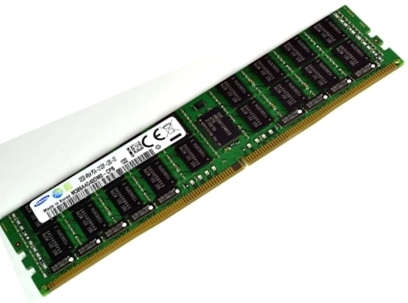
The Samsung M386A8K40BM2-CTD7Y is a 64GB DDR4-2666 Registered DIMM with ECC, purpose-built for the relentless demands of modern servers. In a dense virtualization cluster, this module directly translates into higher consolidation ratios. You can confidently pack more virtual machines onto a single host because the 64GB capacity gives each guest ample breathing room, while hardware ECC silently detects and corrects single-bit memory errors. This prevents silent data corruption from flipping a critical bit in a hypervisor page table, an event that could otherwise crash dozens of production VMs simultaneously without warning.
When running an in-memory database like Redis or SAP HANA, data integrity is non-negotiable. A flipped bit inside a live transaction log is catastrophic. ECC transforms memory from a potential liability into a trusted foundation, ensuring every financial record or user session remains bit-perfect. The Registered buffer is equally vital: it stabilizes command and address signals when you fully populate all 24 DIMM slots in a dual-socket server. Without it, signal degradation would force you to drop speeds or reduce capacity. The quad-rank x4 organization further maximizes density on each module, delivering the enormous memory footprint these databases crave while maintaining consistent DDR4-2666 bandwidth at CL19. This isn’t just a memory upgrade; it’s insurance against downtime and a direct enabler of heavy workload consolidation.
General Virtualization
For a hypervisor hosting multiple VMs, populate at least six to eight identical 64GB RDIMMs across balanced memory channels to maximize bandwidth and leave DIMM slots free for future scaling. A total of 384–512GB using these quad-rank modules per dual-socket server comfortably handles moderate consolidation, while reserving capacity for memory overcommit avoids swapping to disk.
In-Memory Database
In-memory workloads demand large, contiguous capacity and high reliability; install a full set of 12 or 16 of these 64GB RDIMMs per two-socket node (768GB–1TB) to hold entire datasets in DRAM. Pair modules identically across all memory channels and interleave them to sustain ultra-low latency under heavy transactional loads, and always populate with ECC RDIMMs to prevent silent data corruption.
High-Performance Computing
HPC clusters benefit from consistent per-core memory bandwidth; populate one or two 64GB RDIMMs per memory channel (e.g., eight modules per socket) to deliver 4 or 8 GB per core for simulation and modeling codes. The registered ECC design ensures stability during multi-day runs, while keeping ranks balanced minimizes latency penalties across NUMA nodes in dense compute nodes.
Server memory, rigorously tested. Confirmed compatible with Dell PowerEdge R760, HPE ProLiant DL380 Gen10, Lenovo ThinkSystem SR650, and similar servers.
Q: Can I mix this M386A8K40BM2-CTD7Y with other memory modules of different brands or speeds?
A: Mixing RDIMMs with different brands, speeds, or ranks is not recommended. It may cause instability or prevent booting. For reliable operation, always install identical modules with the same Samsung part number.
Q: Is this memory compatible with my system?
A: This DDR4-2666 ECC Registered DIMM suits servers and workstations using Intel Xeon Scalable or AMD EPYC platforms. Confirm your motherboard’s memory QVL or consult the system manufacturer for validated configurations.
Q: What is the recommended DIMM population order for optimal performance?
A: Populate DIMMs per your server board’s manual, typically filling identical slots per memory channel first (e.g., blue slots). Balanced configurations across all memory channels ensure maximum bandwidth and interleaving efficiency.
Q: Does this module support overclocking or XMP profiles?
A: No, this module runs at its JEDEC standard speed of DDR4-2666 CL19. Enterprise-class RDIMMs do not support overclocking or XMP; they prioritize signal integrity and error‑free operation in server environments.
Q: What warranty and typical failure rate can I expect?
A: This Samsung module carries a one-year warranty. It features ECC for single-bit error correction, resulting in an extremely low uncorrected failure rate and high reliability in 24/7 operation.