











 Secure payments
Standard refund policy
Trade Assurance
Secure payments
Standard refund policy
Trade Assurance
| Product Type | Memory Module |
|---|---|
| Memory Capacity | 64 GB |
| Memory Technology | DDR4 |
| Product Voltage | 1.2 V |
| RAM Speed | 2933 MHz |
| RAM Standard | DDR4-2933/PC4-23400 |
| Error Identifying | ECC |
| Signal Type | Registered |
| Column Access Strobe (CAS) | CL21 |
| Rank | Dual Rank x4 |
| Quantity of Pins | 288-pin |
| RAM Genre | RDIMM |
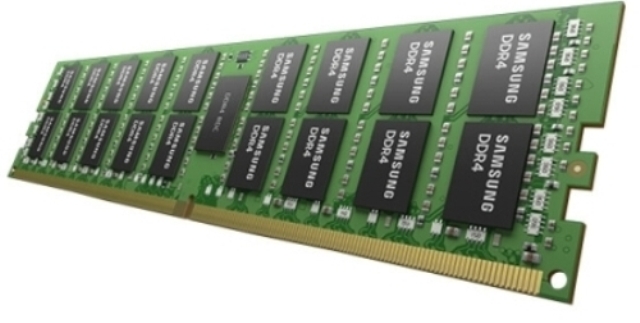
This 64GB DDR4-2933 Registered ECC module, configured as a Dual Rank x4 RDIMM, is engineered for server platforms handling memory-intensive workloads such as virtualization and in-memory databases. Its registered signal type and ECC ensure exceptional signal integrity and data reliability, while the Dual Rank x4 organization boosts interleaving efficiency to sustain low-latency throughput at CL21 under heavy load.
1. A 64 GB capacity per module allows dense memory configurations in virtualization hosts, supporting significantly more virtual machines without sacrificing performance per guest.
2. ECC protection continuously corrects single-bit memory errors, preserving data integrity for financial databases and mission-critical workloads where silent corruption is unacceptable.
3. Registered signal buffering stabilizes command and address lines across high-capacity memory channels, enabling large-scale deployments to run 24/7 without signal degradation.
4. Operating at 2933 MT/s, the module supplies ample throughput to keep modern multi-core server CPUs fed, reducing data starvation during heavy analytics or database queries.
5. Dual Rank x4 organization leverages bank-level parallelism to boost effective bandwidth under mixed workloads, preventing memory contention when simultaneous services vie for access.
When managing a virtualized cluster hosting dozens of VMs, a single undetected bit flip in memory can cascade into corrupted transactions, silent data loss, or unplanned downtime. The Samsung M393A8G40AB2-CVFCQ eliminates that risk with integrated ECC, automatically correcting single-bit errors in real time and detecting multi-bit faults before they compromise your workloads. Its Registered DIMM architecture buffers command and address signals, so a single server board can reliably support the full 64 GB capacity without signal degradation, even when all DIMM slots are populated.
In memory-intensive analytics and in-memory databases like SAP HANA or Redis clusters, bottleneck is often not raw CPU speed but data bandwidth. This module’s dual-rank x4 organization and 2933 MT/s speed interleave memory accesses across multiple internal banks, reducing latency under heavy concurrent read/write pressure while pushing throughput beyond what single-rank configurations can achieve. At a low 1.2 V operating voltage, it also curbs thermal load inside dense rack servers, letting you scale memory capacity without exceeding cooling budgets. For a hypervisor struggling with large nested page tables or a real-time fraud detection engine that must hold terabytes of hot data near the processor, these four characteristics—error resilience, registered buffering, optimized rank structure, and power efficiency—directly translate into consistent uptime, faster query responses, and lower total cost of ownership.
General Virtualization
This 64GB RDIMM is ideal for dense virtualization hosts running hypervisors like VMware ESXi or Hyper-V. Populate six or eight identical modules per server to achieve 384–512GB of balanced capacity, allowing comfortable overcommit ratios for 20–30 typical VMs. Distributing modules evenly across all memory channels maximizes throughput and minimizes NUMA latency in multi-socket systems.
In-Memory Database
For Redis, Memcached, or SAP HANA workloads, latency is critical and capacity must eliminate swapping. Deploy twelve of these 64GB sticks in a dual-socket server for 768GB, staying within a single rank-per-channel configuration for lowest latency. Dual-rank x4 construction offers strong signal integrity, and ECC protection is essential for data consistency during in-memory processing.
High-Performance Computing (HPC)
HPC clusters benefit from both capacity and bandwidth. Configure nodes with one DIMM per channel (1DPC) using eight or sixteen of these modules to hit 512GB or 1TB at full 2933MT/s speed. The registered ECC design stabilizes large-scale parallel simulations, and the dual-rank organization supplies enough bank groups to keep CPU cores saturated during memory-intensive computational fluid dynamics or weather modeling.
Rigorously tested 64GB DDR4-2933 RDIMM, compatible with Dell PowerEdge R740, HPE ProLiant DL380 Gen10, Lenovo ThinkSystem SR650.
Q: Can I mix this M393A8G40AB2-CVFCQ with other memory modules of different brands or speeds?
A: Mixing is not recommended for server environments. Different brands, speeds, or ranks can cause instability. For guaranteed compatibility and reliable ECC operation, populate with identical M393A8G40AB2-CVFCQ modules only.
Q: Is this memory compatible with my system?
A: This DDR4-2933 ECC Registered RDIMM is designed for servers. It supports platforms using Intel Xeon Scalable or AMD EPYC processors. Please verify your motherboard's QVL for 64GB 2Rx4 PC4-23400 RDIMM compatibility before purchasing.
Q: What is the recommended DIMM population order for optimal performance?
A: Follow your server motherboard manual for balanced memory configuration. Typically, populate identical DIMMs per channel, starting with the furthest slot from the CPU. For dual-rank RDIMMs, matching sets across memory channels ensures maximum throughput.
Q: Does this module support overclocking or XMP profiles?
A: No. This is an enterprise-grade ECC RDIMM operating strictly at JEDEC standard DDR4-2933 with CL21 timings. It does not support overclocking or XMP profiles, as stability and data integrity are prioritized over speed.
Q: What warranty and typical failure rate can I expect?
A: This module includes a 1-year warranty. Enterprise DDR4 RDIMMs have an extremely low annualized failure rate, typically well under 0.5%, backed by rigorous testing and Samsung's quality manufacturing.