











 Secure payments
Standard refund policy
Trade Assurance
Secure payments
Standard refund policy
Trade Assurance
| Product Type | Memory Module |
|---|---|
| Memory Capacity | 64 GB |
| Memory Technology | DDR4 |
| Product Voltage | 1.2 V |
| RAM Speed | 2933 MHz |
| RAM Standard | DDR4-2933/PC4-23400 |
| Error Identifying | ECC |
| Signal Type | Registered |
| Column Access Strobe (CAS) | CL21 |
| Rank | Quad Rank x4 |
| Quantity of Pins | 288-pin |
| RAM Genre | RDIMM |
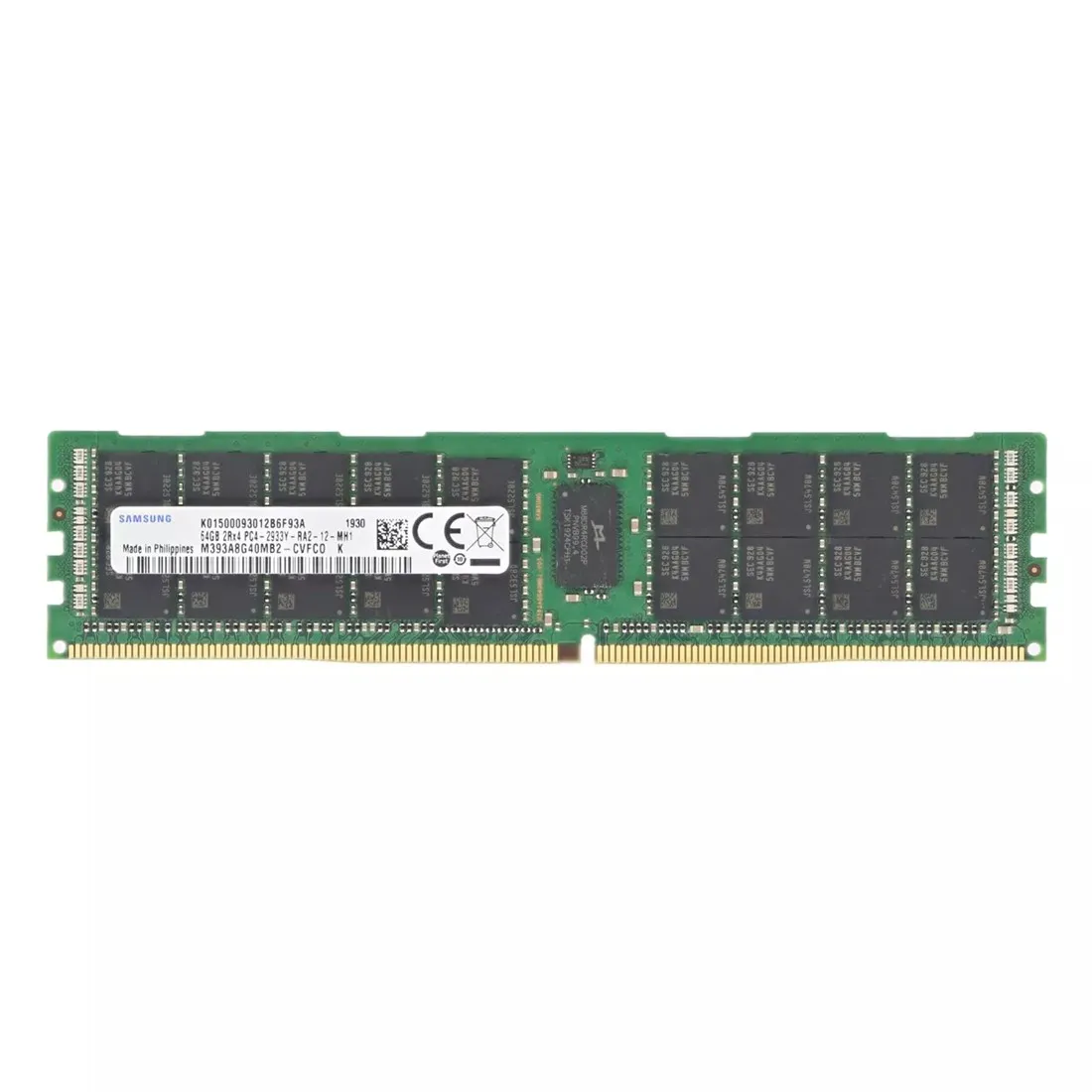
Designed for enterprise servers, this 64GB DDR4-2933 Registered ECC module with Quad Rank x4 organization delivers exceptional memory density and stability for virtualization, in-memory databases, and mission-critical workloads. Its registered signal type and ECC error correction ensure data integrity under heavy load, while the Quad Rank configuration maximizes capacity per channel without sacrificing reliability on modern platforms.
1. ECC error correction actively detects and corrects single-bit memory errors, preventing silent data corruption in mission-critical enterprise databases and financial transactions.
2. Registered signal buffering dramatically increases per-channel memory capacity, allowing hypervisors to densely pack virtual machines without sacrificing signal integrity.
3. Quad Rank x4 organization populates all bank groups efficiently, delivering sustained bandwidth under heavy multi-tenant workloads and large in-memory analytics.
4. The 2933 MT/s data rate provides a balance of high throughput and moderate power, ideal for maintaining per-slot performance in fully populated server nodes.
5. A 64 GB module enables high memory density per server, maximizing the number of VDI instances or containerized applications that can run concurrently on a single host.
The Samsung M393A8G40MB2-CVF6Y is a 64GB DDR4-2933 RDIMM purpose-built for enterprise servers, where unplanned downtime directly translates into revenue loss. Its ECC technology is non-negotiable for data integrity. In a virtualization cluster hosting dozens of critical VMs, a single undetected bit-flip in a memory-resident database index can corrupt transactional records or cause silent data corruption that propagates through backups for months. ECC immediately detects and corrects single-bit errors, turning a potential financial and forensic disaster into a non-event. The Registered signal type, which buffers command and address lines, is what makes this extreme 64GB capacity on a quad-rank DIMM physically and electrically stable. Without a register, the memory controller would be overwhelmed by the load of 72 x4 DRAM chips, leading to signal degradation and boot failures. For you, this means confidently populating all 16 or 24 DIMM slots in a dual-socket server to reach multi-terabyte footprints without sacrificing speed. The quad-rank x4 architecture further amplifies performance in real workloads: an in-memory database like Redis or SAP HANA benefits from the aggressive bank-level parallelism inside each rank, delivering higher sustained bandwidth and lower effective latency under random access patterns. Combined with the 2933 MT/s transfer rate, this RDIMM ensures that when hundreds of concurrent users query your data engine during peak trading or reporting windows, memory bandwidth never becomes the bottleneck. This is not just a specification sheet; it is an architecture for mission-critical reliability at scale.
General Virtualization
For a hypervisor hosting multiple VMs, dense capacity per channel is critical. Deploy six or eight of these 64 GB quad-rank RDIMMs across the server’s memory channels to reach 384–512 GB, balancing CPU cores with a typical 4:1 vCPU-to-pCore ratio while leaving room for memory overcommitment. Configure identical modules in each channel to maintain balanced memory interleaving and ensure stable 2933 MT/s operation even under mixed read/write workloads.
In-Memory Database
In-memory databases such as Redis, SAP HANA, or MemSQL demand the lowest latency and absolute data integrity. Populate all memory channels with two 64 GB RDIMMs per channel (one DIMM per channel if quad-rank loading limits speed) to maximize capacity without dropping below 2933 MT/s. ECC and registered signaling protect against single-bit errors during heavy cache eviction and commit log writes, making 512 GB or more a practical sweet spot for real-time analytics.
High-Performance Computing
HPC clusters running MPI-based simulations or CFD solvers require high bandwidth per node. Configure one quad-rank 64 GB RDIMM per channel across all available channels to sustain peak 2933 MT/s bandwidth, avoiding the speed penalties of two DIMMs per channel. With eight channels this yields 512 GB of reliable, ECC-protected memory, delivering the bandwidth needed for large unstructured grids while registered buffering stabilizes signal integrity under sustained, data-intensive parallel computations.
Rigorously tested server memory, validated for Dell PowerEdge R740/R750, HPE DL380 Gen10, and Lenovo ThinkSystem SR650.
Q: Can I mix this M393A8G40MB2-CVF6Y with other memory modules of different brands or speeds?
A: Mixing brands or speeds with Registered DIMMs is not recommended. It forces operation at the slowest module’s speed and often causes instability or POST failures in server platforms.
Q: Is this memory compatible with my Intel Xeon or AMD EPYC server platform?
A: This 64GB DDR4-2933 RDIMM works with systems supporting 2Rx4 Registered ECC memory at 1.2V. Validate your CPU and motherboard compatibility, particularly for quad-rank 288-pin RDIMMs.
Q: What is the recommended DIMM population order for optimal performance?
A: Follow your server manual’s balanced population order. Typically, install identical DIMMs into all memory channels, starting with the farthest slot from the CPU per channel to balance ranks.
Q: Does this module support overclocking or XMP profiles?
A: No. This enterprise Registered ECC module runs strictly at JEDEC-standard DDR4-2933 with no XMP or overclocking support, prioritizing data integrity and 24/7 operational stability over enthusiast tuning.
Q: What warranty and typical failure rate can I expect?
A: It includes a 1-year warranty. Enterprise DDR4 RDIMMs like this typically demonstrate an AFR below 0.5% under specified conditions, ensuring high reliability in compatible, well-cooled servers.