











 Secure payments
Standard refund policy
Trade Assurance
Secure payments
Standard refund policy
Trade Assurance
| Product Type | Memory Module |
|---|---|
| Memory Capacity | 64 GB |
| Memory Technology | DDR4 |
| Product Voltage | 1.2 V |
| RAM Speed | 2933 MHz |
| RAM Standard | DDR4-2933/PC4-23400 |
| Error Identifying | ECC |
| Signal Type | Registered |
| Column Access Strobe (CAS) | CL21 |
| Rank | Quad Rank x4 |
| Quantity of Pins | 288-pin |
| RAM Genre | RDIMM |
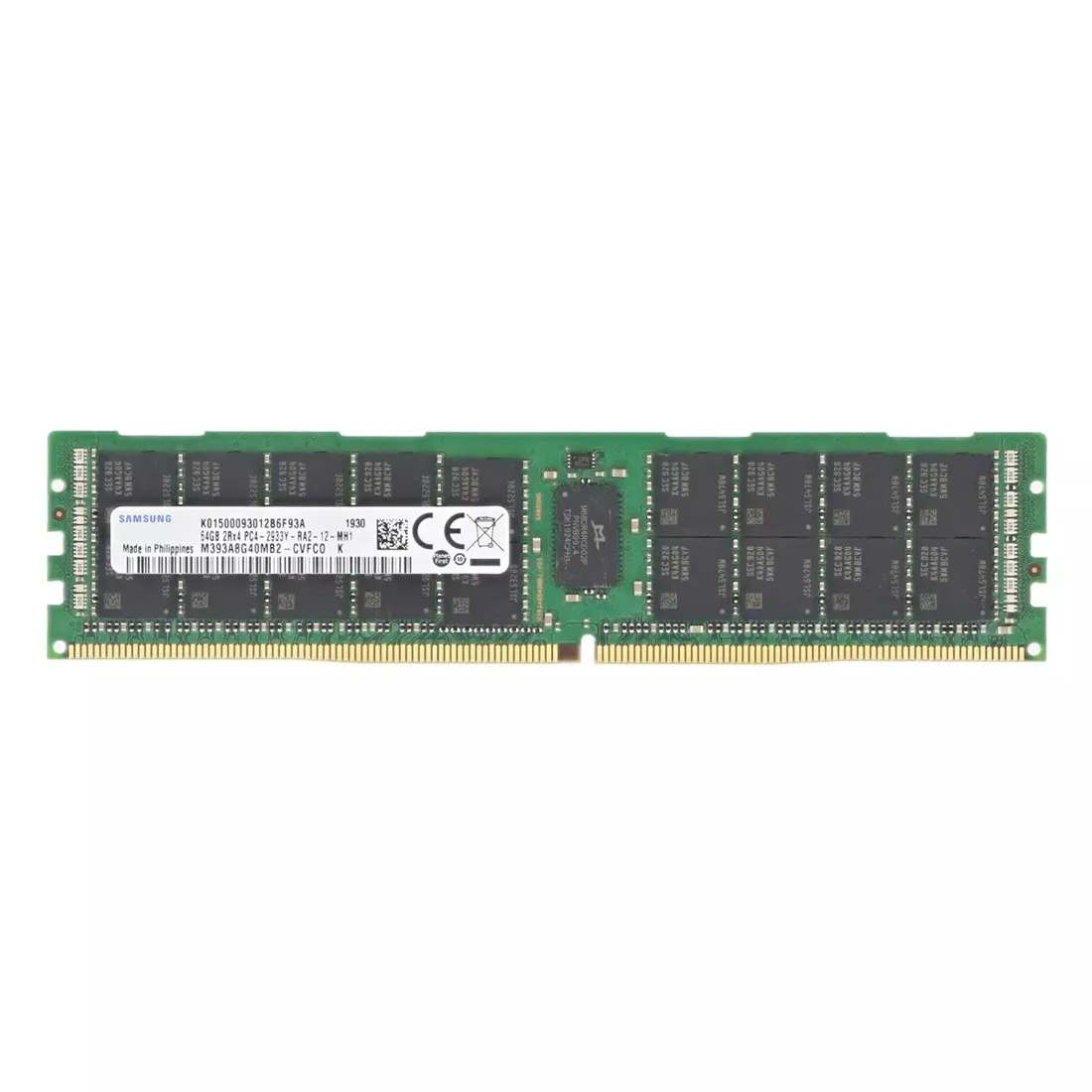
This 64GB DDR4-2933 Registered ECC module with quad-rank x4 organization is ideally suited for enterprise servers and virtualization platforms requiring robust data integrity, where its ECC and registered signal type ensure rock-solid stability under heavy, sustained workloads. The quad-rank configuration maximizes capacity density per channel while maintaining signal integrity through buffering, making it an excellent choice for memory-intensive applications like in-memory databases and large-scale hypervisor deployments.
1. A massive 64GB capacity per module allows dense memory configurations, enabling far higher virtual machine counts per server without sacrificing performance headroom.
2. ECC protection continuously corrects single-bit errors and detects multi-bit faults, preserving data integrity in long-running transactional and analytics workloads.
3. Registered signal architecture stabilizes command and address lines under heavy DIMM population, maintaining reliable operation across fully loaded multi-socket platforms.
4. Quad Rank x4 organization deeply interleaves banks across the memory channel, sustaining elevated bandwidth utilization under the random access patterns typical of virtualized and database environments.
5. High-speed DDR4 signaling delivers the raw throughput required to feed many-core processors, preventing memory bottlenecks during large-scale in-memory computing and real-time data processing.
The M393A8G40MB2-CVFB0 is a 64GB DDR4-2933 Registered DIMM purpose-built for enterprise servers, where reliability is not optional but foundational. Its ECC capability silently corrects single-bit errors induced by background radiation or electrical noise. In a high-frequency trading database, one uncorrected flip could instantly corrupt a critical transaction; ECC eliminates that silent data corruption, acting as a non-negotiable insurance policy for your data integrity. The Registered buffer stabilizes the command and address bus, letting you populate all memory channels with dense modules without signal degradation. For a virtualized cluster running dozens of VMware guests per host, this directly means you consolidate more workloads into fewer servers, confident that the hypervisor layer remains rock-solid. Meanwhile, the quad-rank x4 organization uses interleaving to mask latency and amplify bandwidth, which dramatically accelerates in-memory analytics. When SAP HANA must scan billions of rows under concurrent queries, that sustained throughput delivers real-time insights instead of dragging into swap. Finally, a 1.2V operating voltage lowers power draw per module, shrinking your cooling overhead and operational costs across a multi-rack deployment. Together, these four attributes transform memory from a simple component into a strategic enabler of mission-critical performance and resilience.
General Virtualization
For dense VM hosting with a dual-socket server, populate at least 12 of these 64 GB RDIMMs per node to achieve 768 GB total memory, matching a typical 1:4 core-to-GB ratio for moderate overcommit. Leverage the registered ECC design and quad-rank structure to maintain signal integrity even with all channels populated, and configure memory interleaving for balanced NUMA access across processor sockets.
In-Memory Database
Deploy 8 to 16 modules (512 GB–1 TB) per server to keep entire datasets resident in RAM, minimizing storage I/O. Use a symmetric configuration—one DIMM per channel—to deliver the full DDR4-2933 bandwidth, and rely on the ECC protection to meet the strict data integrity requirements of platforms like Redis, Memcached, or SAP HANA.
High-Performance Computing
For memory-bandwidth-sensitive workloads such as CFD or weather modeling, install one DIMM per channel (typically 8 or 16 modules) to maximize transfer rates without rank-level loading penalties. While quad-rank DIMMs can limit peak frequency, the 2933 MT/s speed and 1.2 V operating voltage keep power per module low, allowing dense, large-memory-footprint nodes that scale to multi-terabyte configurations across a cluster.
Rigorously tested, verified compatible with Dell PowerEdge R740, HPE ProLiant DL380 Gen10, Lenovo ThinkSystem SR650, and more.
Q: Can I mix this M393A8G40MB2-CVFB0 with other memory modules of different brands or speeds?
A: Mixing different brands or speeds is not recommended for RDIMMs. This may lead to signal integrity issues, system instability, or forced fallback to the lowest common speed. Use identical modules for guaranteed compatibility.
Q: Is this memory compatible with my system?
A: This 64GB DDR4-2933 Registered ECC DIMM is designed for servers using Intel Xeon Scalable or AMD EPYC platforms. Please verify your motherboard supports 2933MT/s RDIMMs with Quad Rank x4 and a 288-pin interface.
Q: What is the recommended DIMM population order for optimal performance?
A: For optimal performance, populate identical DIMMs per memory channel following the server board's population guide. Typically, start with slots furthest from the CPU, balancing across channels to enable interleaving and maintain full memory bandwidth.
Q: Does this module support overclocking or XMP profiles?
A: No. This is an enterprise-grade Registered ECC module running at JEDEC standard DDR4-2933. It does not support overclocking or XMP profiles, as stability and data integrity are prioritized over speed adjustments in server environments.
Q: What warranty and typical failure rate can I expect?
A: This module includes a one-year warranty. Enterprise DDR4 RDIMMs have very low annualized failure rates, typically under 0.5%, when operated within specified conditions. Proper cooling and compatible platforms further ensure long-term reliability.