











 Secure payments
Standard refund policy
Trade Assurance
Secure payments
Standard refund policy
Trade Assurance
| Product Type | Memory Module |
|---|---|
| Compliance Standards | RoHS,WEEE |
| Memory Capacity | 64 GB |
| Memory Technology | DDR4 |
| Product Voltage | 1.2 V |
| RAM Speed | 2933 MHz |
| RAM Standard | DDR4-2933/PC4-23400 |
| Error Identifying | ECC |
| Signal Type | Registered |
| Column Access Strobe (CAS) | CL21 |
| Rank | Quad Rank x4 |
| Quantity of Pins | 288-pin |
| RAM Genre | RDIMM |
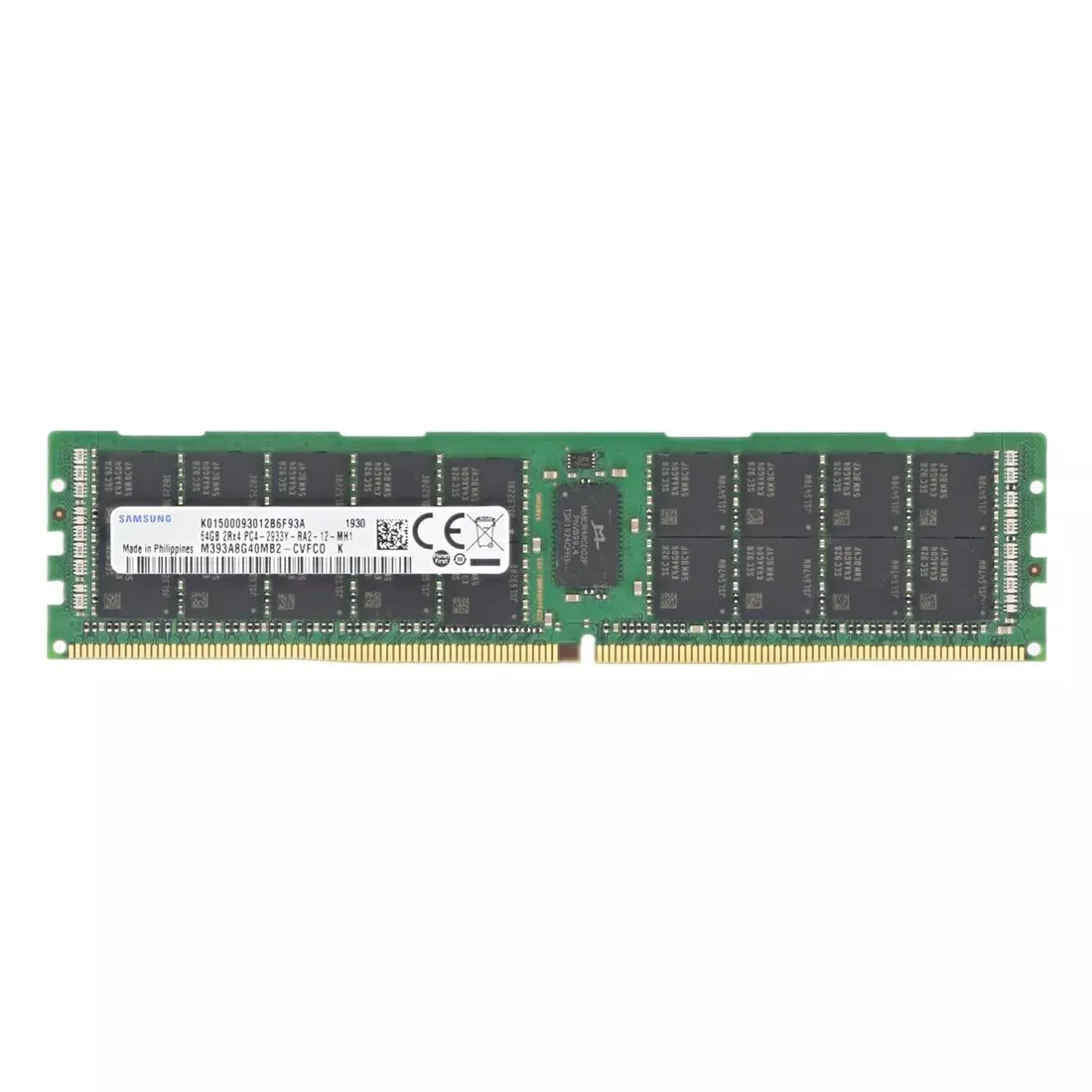
Designed for enterprise server platforms, this 64GB DDR4-2933 Registered ECC RDIMM excels in memory-intensive workloads such as virtualization and in-memory databases where data integrity is non-negotiable. Its quad-rank x4 organization maximizes capacity density per channel while the registered signal type ensures stable operation in multi-DIMM configurations, and ECC provides robust single-bit error correction to maintain system uptime.
1. A massive memory capacity per module enables dense server deployments to consolidate more virtual machines and accelerate large in-memory databases without performance bottlenecks.
2. Integrated error correction code detects and corrects single-bit flaws, preserving data integrity for critical enterprise workloads, financial ledgers, and scientific computations.
3. Register logic buffers command and address lines, stabilizing signal integrity across high-capacity memory arrays and allowing scalable platforms to reliably maximize their total memory footprint.
4. Quad rank organization packs greater density per channel, keeping memory buses efficiently saturated under heavy concurrency for smooth virtualization and real-time analytics.
5. Elevated clock speed delivers the bandwidth required for rapid data access and throughput, minimizing latency in response-sensitive services such as high-frequency trading and large-scale cloud operations.
When you are running a virtualized cluster hosting dozens of mission-critical VMs or an in-memory database like SAP HANA, this Samsung M393A8G40MB2-CVFBQ server memory does not just sit in a slot—it actively prevents financial and reputational damage. Its ECC engine silently corrects single-bit errors caused by background radiation, meaning a flipped bit in a live transactional ledger or a Redis cache will never cascade into corrupted results. The registered buffer converts a single command bus into a stable, multi-rank signaling path, so you can populate all 24 DIMM slots per chassis without signal collapse—this guarantees that your VMware or Proxmox hosts keep all VMs responsive during a spike, and you avoid random host crashes during night operations. The quad-rank x4 organization gives you a dense 64 GB per stick, letting your database engine keep entire hot tables in memory while handling more concurrent queries at 2933 MT/s. With a cool 1.2 V operating voltage, these RDIMMs also lower your rack-level power draw and thermal stress, shrinking your collocation bills and extending hardware lifespan across the entire cluster. For any administrator who cannot afford silent data rot or downtime, these four traits translate directly into trusted uptime and lower total cost of ownership.
General Virtualization
For dense virtualization hosts, this 64GB RDIMM enables high VM density without oversubscribing memory. Equip dual-socket servers with at least 8 identical modules (512GB total) to populate one DIMM per channel and maintain balanced NUMA performance. The registered ECC design ensures data integrity for mixed tenant workloads.
In-Memory Database
Memory-resident databases like Redis or SAP HANA demand both capacity and fault tolerance. Deploy configurations of 16 modules per host (1TB) to hold large datasets entirely in RAM. The CL21 latency and 2933 MT/s speed strike a balance between access time and bandwidth, while quad-rank x4 organization maximizes capacity per slot for scale-up database nodes.
High Performance Computing
HPC clusters benefit from uniform memory bandwidth across all channels. Use a minimum of 8 modules per node for symmetric multiprocessing, delivering over 187 GB/s theoretical bandwidth per socket. The 1.2V operating voltage reduces thermal load in dense racks, and registered signaling stabilises large arrays under sustained compute-bound simulation runs.
Validated for server compatibility: rigorously tested with Dell PowerEdge R760, HPE ProLiant DL380 Gen11, Lenovo ThinkSystem SR650 V3, and Supermicro SYS-620P-TR.
Q: Can I mix this M393A8G40MB2-CVFBQ with other memory modules of different brands or speeds?
A: Mixing is not recommended. Registered ECC modules should be identical in rank, speed, and chip organization to maintain signal integrity and ensure reliable error correction across all channels.
Q: Is this memory compatible with my system?
A: It is designed for servers using Intel Xeon Scalable or AMD EPYC platforms with DDR4 Registered ECC support. Please verify against your motherboard's qualified vendor list for 2933MT/s RDIMMs.
Q: What is the recommended DIMM population order for optimal performance?
A: Populate identical DIMMs per channel, starting with the slots farthest from the CPU. Balance capacity and ranks across all memory channels as detailed in your server’s population guide to maximize throughput.
Q: Does this module support overclocking or XMP profiles?
A: No. This enterprise server module follows strict JEDEC DDR4-2933 specifications and does not support overclocking or XMP, as reliability and data integrity are prioritized over variable speeds.
Q: What warranty and typical failure rate can I expect?
A: Backed by a one-year warranty. Built with Samsung’s enterprise-grade components, it delivers very low annualized failure rates under standard server operating conditions, ensuring long-term mission-critical stability.