











 Secure payments
Standard refund policy
Trade Assurance
Secure payments
Standard refund policy
Trade Assurance
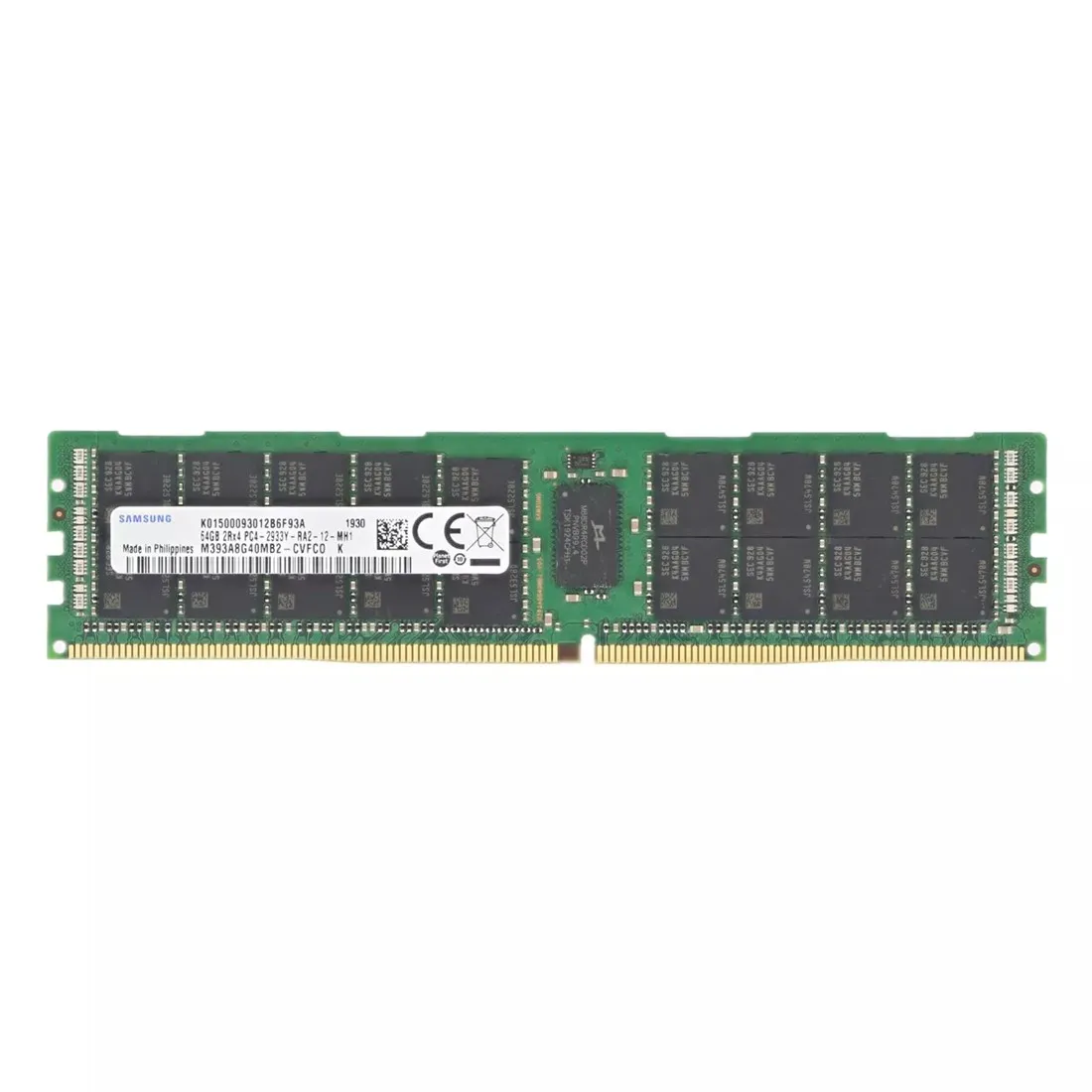
| Product Type | Memory Module |
|---|---|
| Memory Capacity | 64 GB |
| Memory Technology | DDR4 |
| Product Voltage | 1.2 V |
| RAM Speed | 2933 MHz |
| RAM Standard | DDR4-2933/PC4-23400 |
| Error Identifying | ECC |
| Signal Type | Registered |
| Column Access Strobe (CAS) | CL21 |
| Rank | Dual Rank |
| Quantity of Pins | 288-pin |
| RAM Genre | RDIMM |
This dual-rank DDR4-2933 Registered DIMM with ECC delivers optimal data integrity and signal stability for enterprise servers, making it ideal for memory-bound workloads like virtualization and in-memory databases where reliability at scale is critical. Its dual-rank configuration enhances memory interleaving for improved bandwidth efficiency, while the registered signal type ensures consistent performance across dense, multi-DIMM memory channels.
1. A dense memory capacity per module optimizes server slot utilization, allowing expansive virtualization and large database instances to reside in fewer physical servers.
2. The elevated memory speed accelerates data throughput, shrinking query completion times for online transaction processing and real-time analytics.
3. Integrated error correction eliminates single-bit faults on the fly, upholding data accuracy over extended uptime cycles necessary for financial and healthcare systems.
4. Registering the command interface stabilizes high-capacity memory configurations, enabling massive memory footprints without compromising signal quality in multi-socket platforms.
5. Dual-rank interleaving exploits internal bank parallelism, delivering consistent bandwidth saturation that sustains throughput during heavy multi-tenant cloud workloads.
The M393A8G40MB2-CVFS is a 64 GB DDR4-2933 registered DIMM engineered for server platforms where downtime is unacceptable and data fidelity is non-negotiable. Its four defining characteristics translate directly into real-world infrastructure reliability.
First, ECC error correction actively detects and corrects single-bit memory faults. In a memory database like SAP HANA or Redis holding billions of in-memory records, an undetected bit-flip can corrupt transactional data and trigger cascading failures. ECC turns a silent data corruption risk into a self-healing event. Second, the registered signal buffer stabilizes high-capacity configurations by redriving command and address signals. When you populate 16 or more such 64 GB DIMMs in a virtualization host running dozens of VMs, the buffer eliminates signal degradation and prevents random crashes that would otherwise evict all tenants from memory. Third, the dual-rank organization leverages rank interleaving, allowing the memory controller to hide refresh and row activation gaps. This lifts effective bandwidth for mixed read/write workloads, meaning a hypervisor can schedule more vCPUs without stalling on I/O waits. Finally, the 2933 MT/s speed with a 1.2 V operating voltage balances throughput with power efficiency across dense rack deployments, keeping thermal budgets in check while sustaining high utilization under orchestration platforms like Kubernetes or VMware vSphere. Together, these attributes ensure that every transaction, query, and container runs on a foundation of uncorrupted data, consistent low latency, and uncompromised availability.
General Virtualization
For a typical hypervisor hosting mixed VMs, populate the server with a balanced set of 64 GB RDIMMs across all memory channels to maximize bandwidth while keeping moderate density. Using eight or twelve modules of this 64 GB dual-rank part in a 2-socket system easily provides 512 GB to 768 GB of total capacity, comfortably supporting dozens of standard VMs without overcommitting memory under load. Stick to identical 2933 MT/s ECC Registered DIMMs to ensure consistent latency and avoid clock speed downgrades from mixed ranks.
In-Memory Database
In-memory databases thrive on both high capacity and minimal access latency, so deploy a full-channel configuration of these 64 GB dual-rank RDIMMs to hold entire datasets in DRAM. For a single-socket system with eight channels, installing one 64 GB DIMM per channel yields 512 GB, which suits medium-sized Redis or SAP HANA instances; adding a second DIMM per channel doubles capacity to 1 TB while still operating at 2933 MT/s on supported platforms. Always populate channels symmetrically to leverage interleaving and avoid performance bottlenecks from unbalanced memory architectures.
High-Performance Computing
HPC workloads demand sustained memory bandwidth, so place at least one 64 GB RDIMM in every available memory channel of each node to saturate the processor’s memory interface. For dual-socket clusters, a 1 DIMM per channel (1DPC) layout with these dual-rank modules often hits the sweet spot between capacity per core and peak bandwidth, yielding 256 GB–512 GB per node while maintaining 2933 MT/s speed. Avoid exceeding two DIMMs per channel if the CPU specification calls for a speed drop at 2DPC, as HPC scaling is sensitive to any reduction in memory frequency.
Proven compatible with Dell PowerEdge R750, HPE ProLiant DL380 Gen10 Plus, Lenovo ThinkSystem SR650 V2 after rigorous testing.
Q: Can I mix this M393A8G40MB2-CVFS with other memory modules of different brands or speeds?
A: Mixing RDIMMs with different brands, speeds, or ranks is not recommended in servers. It may lead to system instability or downclocking to the lowest common speed, impacting mission-critical reliability.
Q: Is this memory compatible with my system?
A: This DDR4-2933 ECC Registered DIMM is designed for servers based on Intel Xeon Scalable or AMD EPYC platforms. Please verify your motherboard’s memory Qualified Vendor List (QVL) for compatibility.
Q: What is the recommended DIMM population order for optimal performance?
A: Populate identical DIMMs symmetrically across memory channels, starting with the farthest slot per channel. For dual-processor servers, balance DIMMs equally between CPUs and adhere to 1 DIMM per channel for maximum throughput.
Q: Does this module support overclocking or XMP profiles?
A: No. This server-grade RDIMM strictly adheres to JEDEC standards and does not support XMP profiles or overclocking. It operates at fixed JEDEC timings to ensure 24/7 data integrity.
Q: What warranty and typical failure rate can I expect?
A: This module includes a one-year warranty. As an enterprise-class component, its annualized failure rate (AFR) is typically below 0.1% under specified operating conditions, ensuring exceptional long-term reliability.