











 Secure payments
Standard refund policy
Trade Assurance
Secure payments
Standard refund policy
Trade Assurance
| Product Type | Memory Module |
|---|---|
| Compliance Standards | RoHS,WEEE |
| Memory Capacity | 64 GB |
| Memory Technology | DDR4 |
| Product Voltage | 1.2 V |
| RAM Speed | 3200 MHz |
| RAM Standard | DDR4-3200/PC4-25600 |
| Error Identifying | ECC |
| Signal Type | Registered |
| Column Access Strobe (CAS) | CL22 |
| Rank | Quad Rank x4 |
| Quantity of Pins | 288-pin |
| RAM Genre | RDIMM |
This 64GB DDR4-3200 RDIMM with ECC and a quad-rank x4 organization is purpose-built for enterprise servers and demanding virtualization or in-memory database workloads, where its Registered signal type and ECC engine guarantee data integrity under high-density memory configurations. The quad-rank design maximizes capacity per channel while maintaining reliable operation at 1.2V, making it ideal for scaling up memory-intensive applications without sacrificing stability.
1. A dense 64GB capacity per module lets a single server host far more virtual machines and memory-hungry databases, deferring costly hardware expansion.
2. ECC protection transparently detects and corrects in-flight data errors, preserving end-to-end integrity for financial transactions and long-running analytical jobs.
3. The registered signal path re-drives command and address buses cleanly across fully loaded channels, so large-memory servers stay stable even with all slots populated.
4. Quad Rank x4 organization interleaves accesses across multiple sets of DRAM dies, keeping throughput consistently high under the concurrent load of containerized microservices.
5. 3200MT/s transfer speed feeds each CPU core with data quickly, shrinking response times for real-time caching, inference, and heavily threaded enterprise workloads.
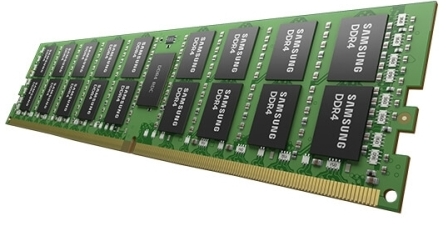
The M386A8K40DM2-CWE is a server-class RDIMM, purpose-built for the relentless demands of modern data centers. Its four defining characteristics directly address the critical pain points of IT infrastructure. The integrated ECC technology silently corrects single-bit errors caused by cosmic radiation or electrical interference, a non-negotiable safeguard when a flipped bit in a financial transaction or a virtual machine's memory space could cascade into application crashes or data corruption. The Registered buffer stabilizes signal integrity, enabling the system to populate all channels with 64GB Quad Rank modules without jeopardizing command address timing; this directly translates to scaling up to terabytes of reliable RAM in a virtualization cluster, where hosting hundreds of VMs requires dense, rock-solid memory. For in-memory databases like SAP HANA or large-scale analytics, the DDR4-3200 speed feeds the CPU with 25.6 GB/s of bandwidth per channel, and the Quad Rank x4 organization leverages interleaving to reduce latency and boost throughput under heavy loads. When your database restart costs thousands per minute, this memory’s combination of massive capacity, uncorrected error prevention, and consistent low-latency throughput isn’t a luxury—it’s the foundation of service-level agreements and operational continuity.
General Virtualization
Deploy registered ECC RDIMMs to maximize reliability under mixed-tenant workloads. Populate all memory channels symmetrically — typically eight 64 GB modules per socket in a 2-socket server — to deliver balanced bandwidth and a total capacity of 512 GB. This configuration comfortably hosts dozens of virtual machines while protecting against uncorrected errors.
In-Memory Database
In-memory platforms like SAP HANA require terabyte-scale footprints with minimal latency. Install the maximum number of these 64 GB quad-rank modules across all populated channels, ideally achieving 1 TB or more per node. Always balance DIMMs per processor to avoid NUMA penalties and sustain the deterministic throughput that real-time analytics demand.
High-Performance Computing (HPC)
HPC clusters often prioritize bandwidth per core over raw capacity. Use a single 64 GB RDIMM per channel (one DIMM per channel) to run the memory bus at the highest achievable speed, which reduces latency in bandwidth-bound simulations. Add additional modules only when the dataset outgrows that footprint, keeping population symmetrical to preserve aggregate bandwidth.
Rigorously tested 64GB DDR4-3200 RDIMM compatible with Dell PowerEdge R760, HPE ProLiant DL380 Gen11, and Lenovo ThinkSystem SR650 V3.
Q: Can I mix this M386A8K40DM2-CWE with other memory modules of different brands or speeds?
A: Mixing this 64GB DDR4-3200 RDIMM with modules of different brands, speeds, or ranks is not recommended. It may cause system instability, POST failures, or reduced performance. Always populate identical modules for validated server environments.
Q: Is this memory compatible with my system? (Intel/AMD server platform)
A: This 64GB DDR4-3200 Registered ECC module is compatible with Intel Xeon Scalable and AMD EPYC platforms supporting 288-pin RDIMMs. Verify that your server's memory QVL includes quad-rank x4 ECC RDIMMs at 1.2V.
Q: What is the recommended DIMM population order for optimal performance?
A: For quad-rank RDIMMs, balance channels and populate identical DIMMs per channel. Follow your server’s memory population guide, typically filling blue slots first. Avoid mixing rank types within the same channel to maintain optimal signal integrity.
Q: Does this module support overclocking or XMP profiles?
A: No. This is a server-grade Registered ECC DIMM running JEDEC DDR4-3200 CL22 standard. Overclocking and XMP are not supported, as server platforms prioritize data integrity and stability over performance tuning.
Q: What warranty and typical failure rate can I expect?
A: This module carries a 1-year warranty. Enterprise-class ECC RDIMMs have very low annualized failure rates, typically under 0.5%, when operated within specified conditions. We replace any defective unit promptly within the warranty period.