











 Secure payments
Standard refund policy
Trade Assurance
Secure payments
Standard refund policy
Trade Assurance
| Product Type | Memory Module |
|---|---|
| Compliance Standards | CE |
| Memory Capacity | 64 GB |
| Memory Technology | DDR5 |
| Product Voltage | 1.1 V |
| RAM Speed | 4800 MHz |
| RAM Standard | DDR5-4800/PC5-38400 |
| Error Identifying | ECC |
| Signal Type | Registered |
| Column Access Strobe (CAS) | CL40 |
| Rank | Dual Rank x4 |
| Quantity of Pins | 288-pin |
| RAM Genre | RDIMM |
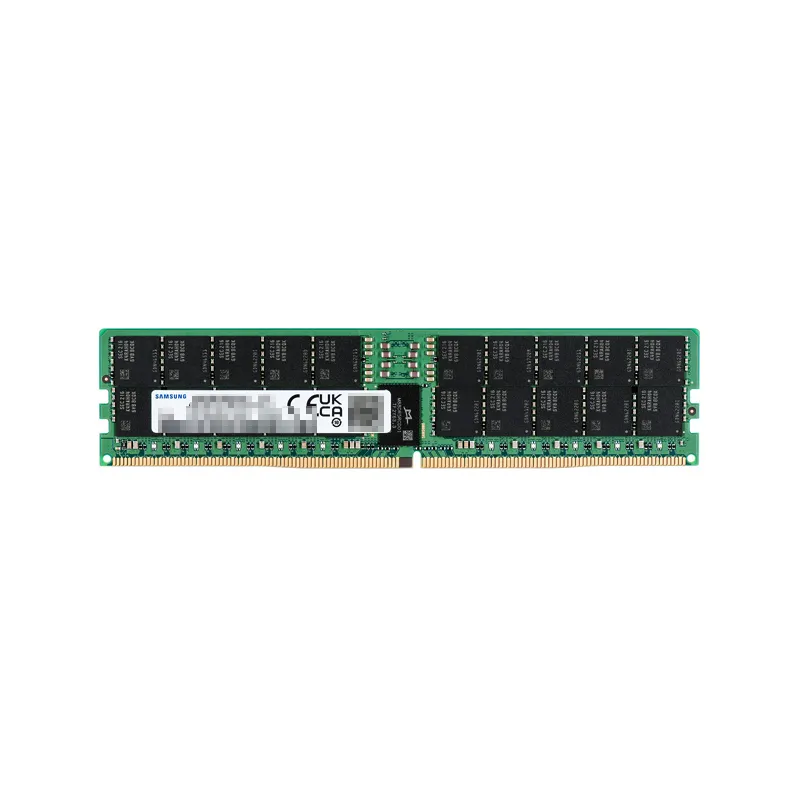
Designed for server-class deployments, this 64GB DDR5-4800 Registered ECC RDIMM delivers exceptional data integrity and system stability for virtualization clusters and in-memory databases. Its dual-rank x4 organization and CL40 latency optimize memory interleaving and bandwidth efficiency, while the registered signal type reliably scales across heavily populated 288-pin platforms.
1. A 64GB module delivers expansive memory headroom, enabling significantly higher virtual machine density per host and smoother large in-memory database operations.
2. On-die ECC hardens data integrity by silently correcting single-bit errors, which is indispensable for mission-critical workloads where undetected corruption means financial loss or system crashes.
3. Registered signal buffering stabilizes the electrical load on the memory bus, permitting fully populated server boards to reach maximum capacity without compromising signal quality at speed.
4. DDR5 technology raises memory bandwidth and power efficiency, supplying the throughput multi-core server processors need for heavily parallelized tasks like AI model serving and real-time analytics.
5. Dual Rank x4 interleaving keeps bank groups busy during burst accesses, effectively saturating the memory channel and minimizing access delays under high concurrency transactional workloads.
The Samsung M321R8GA0BB0-CQKEG is unmistakably a server-class DDR5 RDIMM, and its four defining characteristics directly answer the toughest demands of modern data centers. The 4800 MT/s speed and PC5-38400 bandwidth turn memory-bound bottlenecks into throughput—in a memory database like Redis or SAP HANA, this means millions of real-time transactions complete without latency spikes, keeping responsive dashboards alive even as virtual machine density climbs. ECC error correction is not optional here: a flipped bit inside a financial trading cache or an EHR record can corrupt millions in value or compromise patient safety; ECC silently corrects these errors before they become application crashes or silent data corruption. The registered clock driver proves its worth when you populate dual-rank DIMMs across all channels to reach massive capacities—it buffers address and control signals, preventing signal degradation that would otherwise force you to sacrifice VM density in a vSAN cluster. And the 64 GB Dual Rank x4 organization interleaves accesses across rank banks, significantly boosting sustained read bandwidth for complex OLAP queries while letting a single server host far more containerized microservices before hitting swap. For a hypervisor running business-critical workloads, that translates into deterministic performance, hardened uptime, and confidence to consolidate without compromise.
General Virtualization
For a hypervisor hosting 10–15 mixed VMs, deploy six or eight identical 64 GB RDIMMs across the memory channels to reach 384–512 GB total capacity while maintaining balanced NUMA access. Populate one DIMM per channel where possible to maximize bandwidth, and leave one channel free per socket for future scale-out without replacing existing modules.
In-Memory Database
In-memory workloads like Redis or SAP HANA demand both capacity and resilience, making this 64 GB ECC Registered DIMM ideal. Configure a 512 GB–1 TB pool using eight to sixteen modules in a symmetric population, and mirror or spare ranks are recommended if the platform supports them to guard against uncorrectable errors at runtime.
High Performance Computing
HPC clusters benefit from the Dual Rank x4 organization’s high bank count, which improves throughput under random access patterns. Build each node with one DIMM per memory channel (typically eight per socket) to saturate the 4800 MT/s bandwidth, and favor dual-socket configurations that deliver 1 TB of total memory for large-scale simulation datasets without resorting to slower storage.
Server DDR5 RDIMM rigorously tested and compatible with Dell PowerEdge R760, HPE ProLiant DL380 Gen11, Lenovo ThinkSystem SR650 V3.
Q: Can I mix this M321R8GA0BB0-CQKEG with other memory modules of different brands or speeds?
A: Mixing RDIMMs of different brands or speeds is strongly discouraged. It often leads to system instability or failure to POST. For guaranteed reliability, populate all channels with identical modules using the same rank and timings.
Q: Is this memory compatible with my system?
A: This DDR5-4800 Registered ECC module is designed for server platforms supporting the JEDEC standard, including Intel Xeon Scalable (Sapphire Rapids/Emerald Rapids) and AMD EPYC 9004 Series processors. Please consult your server vendor's Qualified Vendor List.
Q: What is the recommended DIMM population order for optimal performance?
A: To maximize memory interleaving and bandwidth, populate DIMMs per your server motherboard manual. Typically, you should fill the farthest slot per channel first, balancing identical modules across all populated memory controllers symmetrically.
Q: Does this module support overclocking or XMP profiles?
A: No. This enterprise-grade RDIMM adheres strictly to JEDEC standard profiles for mission-critical stability. It does not support XMP or overclocking, as data integrity and 24/7 operational reliability take absolute precedence over non-standard speeds.
Q: What warranty and typical failure rate can I expect?
A: This module includes a one-year warranty. As a rigorously tested server-grade RDIMM, it exhibits an extremely low annualized failure rate (AFR), typically below 0.5%, ensuring long-term reliability for demanding data center deployments.