











 Secure payments
Standard refund policy
Trade Assurance
Secure payments
Standard refund policy
Trade Assurance
| Product Type | Memory Module |
|---|---|
| Memory Capacity | 64 GB |
| Memory Technology | DDR5 |
| Product Voltage | 1.1 V |
| RAM Speed | 4800 MHz |
| RAM Standard | DDR5-4800/PC5-38400 |
| Error Identifying | ECC |
| Signal Type | Registered |
| Column Access Strobe (CAS) | CL40 |
| Rank | Dual Rank x4 |
| Quantity of Pins | 288-pin |
| RAM Genre | RDIMM |
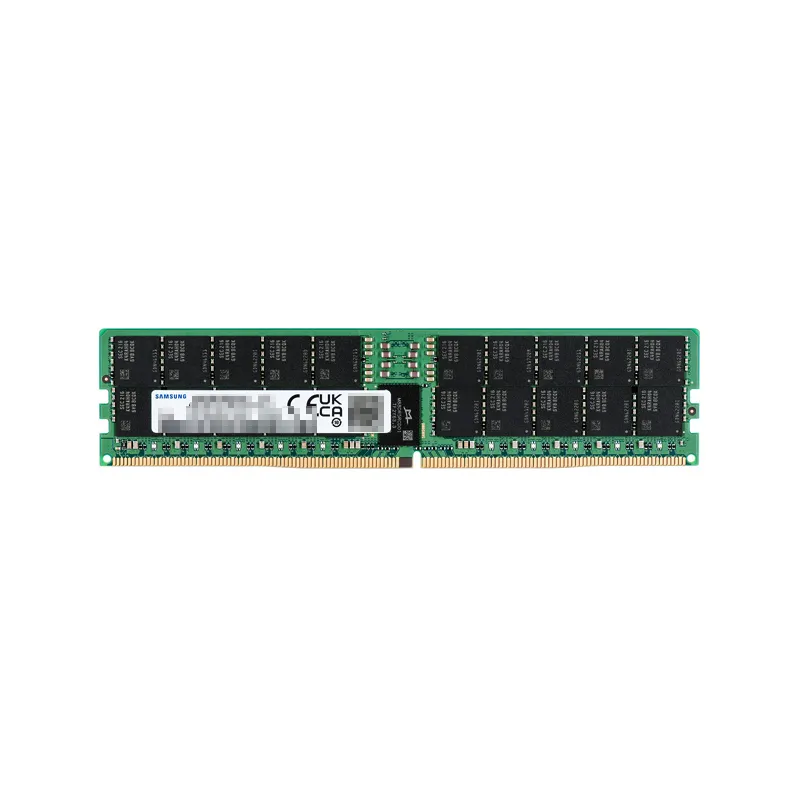
This DDR5-4800 Registered DIMM with ECC and a dual-rank x4 configuration is engineered for enterprise servers and workstations running memory-intensive workloads such as virtualization, in-memory databases, and large-scale data analytics. The registered signal buffering and integrated error correction deliver exceptional signal integrity and data reliability under high-capacity, multi-DIMM configurations, while the dual-rank design enhances interleaving for improved bandwidth utilization.
1. With 64GB capacity per module, this RDIMM supports dense virtualization and large in-memory datasets, enabling smooth consolidation of multiple enterprise workloads without performance degradation.
2. DDR5 technology brings higher burst rates and improved power efficiency, providing the elevated data throughput essential for concurrent analytics and containerized microservices.
3. Integrated ECC silently corrects single-bit memory errors, safeguarding data integrity in always-on databases and financial transaction systems where accuracy is non-negotiable.
4. The registered signal type buffers command and address lines, preserving signal integrity across fully populated channels and ensuring deterministic latency under heavy load.
5. A dual-rank x4 organization allows per-channel rank interleaving, keeping the memory pipeline fully utilized and delivering consistent bandwidth for multi-threaded server applications.
The Samsung M321R8GA0BB0-CQKVE is a server-class DDR5 Registered DIMM, and its four core specifications directly address the pain points of modern data center workloads. In a dense virtualization cluster running dozens of VMs per host, the 64 GB capacity and Dual Rank x4 organization are critical: dual rank interleaves memory accesses across two internal ranks, delivering measurably higher bandwidth and reduced latency under the heavy concurrent demands of multiple virtual machines, which translates to smoother application response and the ability to consolidate more tenants on the same hardware without I/O bottlenecks. Meanwhile, the Registered (RDIMM) signal buffering with its dedicated register chip stabilizes the command and address buses at 4800 MT/s, ensuring reliable operation even when all DIMM slots are populated—a must for scaling to terabytes of memory in a single server without signal integrity failures. For in-memory databases such as SAP HANA or Redis clusters, the integrated ECC becomes non-negotiable. A single undetected bit flip in a financial transaction log or real-time analytics dataset can corrupt results or cause silent data loss; ECC automatically detects and corrects single-bit errors in the DDR5 data stream, preserving data integrity at the hardware level around the clock. Operating at a cool 1.1 V, this module also reduces thermal load in high-density racks, sustaining performance without driving up cooling costs. In essence, this RDIMM turns a commodity server into a trustworthy foundation for latency-sensitive, mission-critical services where both speed and correctness are equally vital.
General Virtualization
Deploy this 64GB DDR5-4800 RDIMM in a dual-socket server with eight or sixteen modules to achieve 512GB–1TB total capacity, which comfortably supports 30–50 typical VMs per host. Populate all memory channels symmetrically—one DIMM per channel for balanced 4800MT/s operation—to maximize bandwidth for mixed-workload hypervisor environments.
In-Memory Database
Target a minimum of eight identical modules for 512GB, ideally 16 modules for 1TB to keep large datasets fully resident in RAM. The registered ECC and dual-rank x4 design deliver the reliability and low-latency CL40 access that Redis, Memcached, or SAP HANA demand, while populating two DIMMs per channel delivers high capacity with only a mild speed trade-off.
High-Performance Computing
Configure one DIMM per channel across all available memory channels—often 12 or 16 modules for 768GB–1TB—to extract maximum memory bandwidth per core. The DDR5-4800 speed and dual-rank organization optimize throughput for MPI-based simulations and CFD solvers, and ECC ensures data integrity during multi-node runs that can last days.
Rigorously validated server RAM: compatible with Dell PowerEdge R760, HPE ProLiant DL380 Gen11, Lenovo ThinkSystem SR650 V3.
Q: Can I mix this M321R8GA0BB0-CQKVE with other memory modules of different brands or speeds?
A: Mixing RDIMMs of different brands or speeds is strongly discouraged. Inconsistent ranks, timings, or ECC characteristics may cause instability, POST failures, or reduced reliability on server platforms. Always use identical modules per channel for validated performance.
Q: Is this memory compatible with my system? I have an Intel Xeon Scalable and AMD EPYC server.
A: This DDR5-4800 RDIMM is compatible with 4th Gen Intel Xeon Scalable (Sapphire Rapids) and AMD EPYC 9004 series platforms that support 288-pin Registered DIMMs. Verify motherboard QVL and CPU memory support lists for validated configurations.
Q: What is the recommended DIMM population order for optimal performance?
A: For dual-socket servers, populate identical DIMMs per channel following the system vendor’s memory population guidelines. Typically, fill the furthest slot from the CPU in each channel first. Balanced configurations maximize memory bandwidth and interleaving.
Q: Does this module support overclocking or XMP profiles?
A: No. As a JEDEC-compliant DDR5-4800 Registered DIMM with ECC, it operates only at standard speeds. Server-class memory does not support XMP or overclocking, as stability and data integrity are prioritized over frequency tuning.
Q: What warranty and typical failure rate can I expect?
A: This module includes a one-year warranty. M3213R8GA0BB0-CQKVE RDIMMs undergo rigorous testing and demonstrate a very low AFR (annualized failure rate), typically below 0.5% under specified server operating conditions.