











 Secure payments
Standard refund policy
Trade Assurance
Secure payments
Standard refund policy
Trade Assurance
| Product Type | Memory Module |
|---|---|
| Memory Capacity | 64 GB |
| Memory Technology | DDR5 |
| Product Voltage | 1.1 V |
| RAM Speed | 4800 MHz |
| RAM Standard | DDR5-4800/PC5-38400 |
| Error Identifying | ECC |
| Signal Type | Registered |
| Column Access Strobe (CAS) | CL40 |
| Rank | Dual Rank x4 |
| Quantity of Pins | 288-pin |
| RAM Genre | RDIMM |
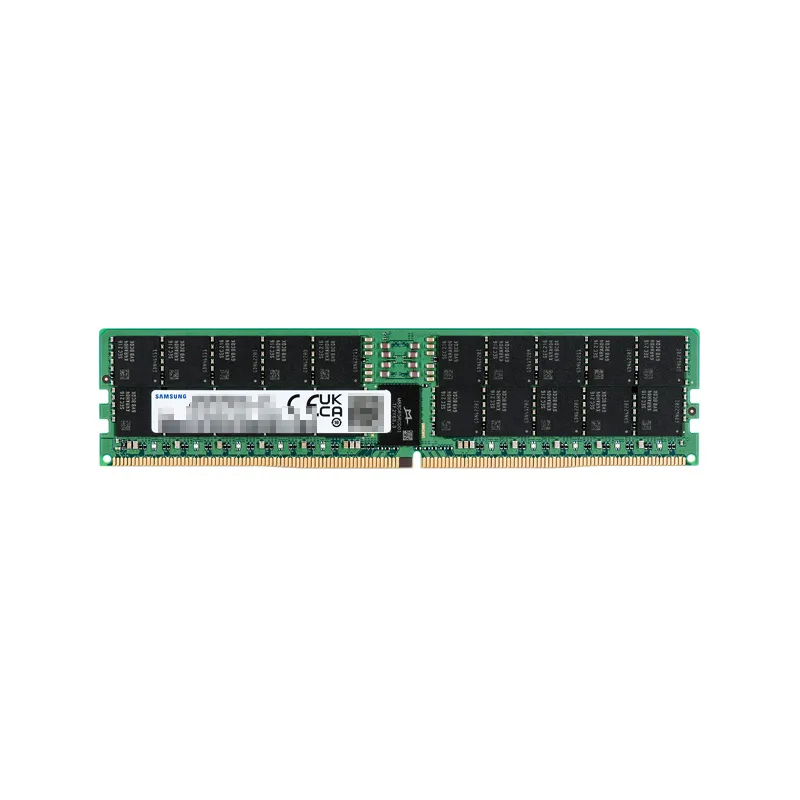
This DDR5-4800 Registered ECC module is engineered for enterprise servers and high-performance workstations, ideally suited for memory-intensive workloads such as virtualization, in-memory databases, and large-scale data analytics. Its dual-rank x4 organization and registered architecture ensure superior signal integrity and data reliability under heavy load, while ECC protection guards against single-bit errors to maintain operational consistency in mission-critical environments.
1. A 64GB capacity per module dramatically increases memory density per server node, enabling more virtual machines and larger in-memory databases without sacrificing footprint.
2. DDR5 technology doubles the burst length and delivers higher bandwidth, accelerating real-time analytics and data-intensive enterprise workloads.
3. ECC protection automatically detects and corrects single-bit errors, preserving data integrity in mission-critical financial and healthcare transactions.
4. Registered signal buffering stabilizes command and address lines across fully loaded server boards, ensuring reliable operation when all DIMM slots are populated.
5. Dual Rank x4 organization interleaves memory banks to maximize channel utilization, sustaining throughput under the heavy concurrent access patterns of virtualized environments.
Based on its RDIMM form factor, ECC support, and Registered signal type, the M321R8GA0BB0-CQKZH is unequivocally server-grade memory. In a virtualized cluster running dozens of VMs, a simple cosmic-ray-induced bit flip in non-ECC RAM can corrupt a virtual disk or silently crash a container. This module’s ECC engine detects and corrects single-bit errors in real time, directly preserving the integrity of your hypervisor and guest operating systems without downtime. Meanwhile, the Registered clock driver buffers address and command signals, stabilizing the electrical load when you populate all channels of a dual-socket server. This means you can confidently deploy 64GB of high-density DDR5 capacity per stick without risking signal degradation or boot failures. For an in-memory database like Redis or SAP HANA, the Dual Rank x4 organization interleaves memory banks to hide refresh gaps and sustain 4800MT/s throughput under heavy read-modify-write workloads. The 1.1V operating voltage also reduces thermal strain inside dense rack enclosures, keeping total cost of ownership in check as your data footprint scales.
General Virtualization
For dense VM consolidation on dual-socket platforms, populate six to eight identical 64 GB RDIMMs per CPU to achieve 384–512 GB memory footprints while maintaining balanced NUMA access. Registered ECC and dual‑rank x4 construction supply the data integrity and high interleave bandwidth essential for hypervisor stability, so avoid mixing ranks or speeds that would degrade access to DRAM page hits.
In‑Memory Database
Scale a single server to 1–2 TB by installing 16–32 of these 64 GB modules across 16 DIMM slots, fully saturating all memory channels for maximum concurrent read/write operations. The CL40 latency at DDR5‑4800, combined with ECC resilience, keeps real‑time analytics and Redis or SAP HANA workloads error‑free even under full‑table scans.
High‑Performance Computing
Deploy one module per memory channel (8×64 GB on a typical 8‑channel HPC node) to deliver 512 GB with smooth, predictable bandwidth for MPI‑parallel simulation codes. Dual‑rank x4 organization pushes IOPS‑per‑channel boundaries, while registered 1.1 V signaling permits dense rack deployments without thermal throttling during multi‑day CFD or molecular dynamics runs.
Compatibility rigorously tested; verified on Dell PowerEdge R760, HPE ProLiant DL380 Gen11, Lenovo ThinkSystem SR650 V3, Supermicro SYS-621H-TN12R.
Q: Can I mix this M321R8GA0BB0-CQKZH with other memory modules of different brands or speeds?
A: Mixing RDIMMs of different brands, speeds, or ranks is not recommended. It may cause stability issues, prevent ECC from functioning correctly, and limit all modules to the lowest common speed. For guaranteed reliability, use identical Samsung modules.
Q: Is this memory compatible with my system?
A: This 64GB DDR5-4800 ECC RDIMM is designed for servers using Intel Xeon Scalable (Sapphire Rapids/Emerald Rapids) or AMD EPYC 9004/8004 series processors. Verify your motherboard supports registered DDR5 ECC modules and 64GB RDIMMs.
Q: What is the recommended DIMM population order for optimal performance?
A: Follow your server motherboard manual for balanced memory channels. Typically, populate identical DIMMs starting from the farthest slot from the CPU in each channel. For dual-rank x4 RDIMMs, populate one DIMM per channel first to maximize bandwidth.
Q: Does this module support overclocking or XMP profiles?
A: No, this is a JEDEC-standard DDR5-4800 ECC RDIMM for servers. It does not support XMP or overclocking. Server memory prioritizes stability, data integrity, and 24/7 operation under ECC protection over variable frequency profiles.
Q: What warranty and typical failure rate can I expect?
A: This Samsung module includes a one-year warranty. RDIMMs built with Samsung DRAM have an industry-leading low annualized failure rate (typically under 0.5%), backed by rigorous binning and testing for robust 24/7 enterprise environments.