











 Secure payments
Standard refund policy
Trade Assurance
Secure payments
Standard refund policy
Trade Assurance
| Product Type | Memory Module |
|---|---|
| Memory Capacity | 64 GB |
| Memory Technology | DDR5 |
| Product Voltage | 1.1 V |
| RAM Speed | 4800 MHz |
| RAM Standard | DDR5-4800/PC5-38400 |
| Error Identifying | ECC |
| Signal Type | Registered |
| Column Access Strobe (CAS) | CL40 |
| Quantity of Pins | 288-pin |
| RAM Genre | RDIMM |
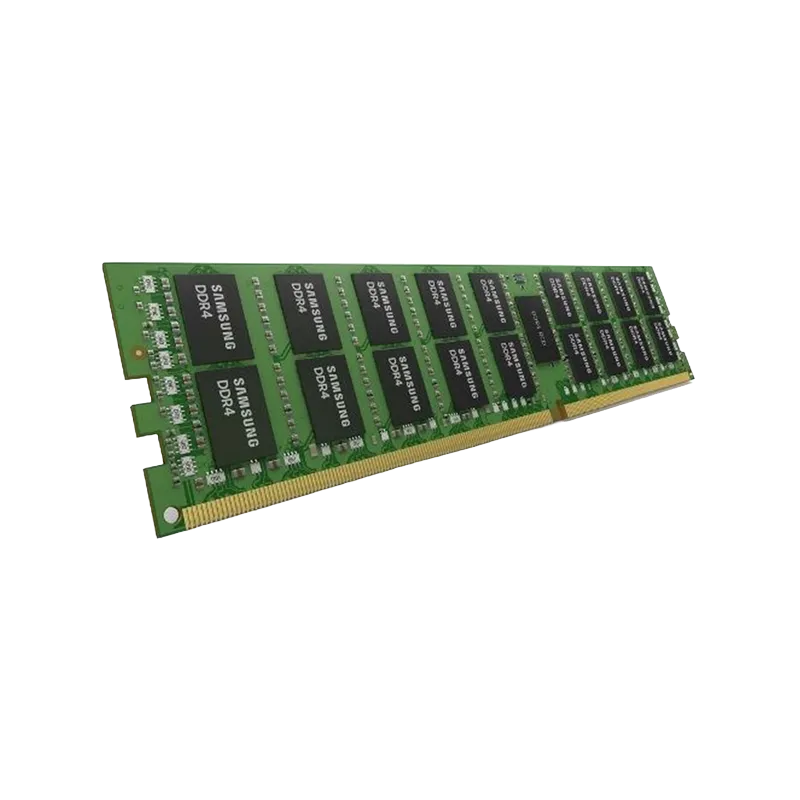
This 64GB DDR5-4800 registered ECC module is purpose-built for server platforms, delivering uncompromised data integrity and reliability for memory-intensive workloads such as virtualization, in-memory databases, and enterprise analytics. The registered signal architecture stabilizes high-density memory configurations by reducing electrical loading on the memory controller, while the CL40 latency keeps response times tight for latency-sensitive transactions.
1. A 64GB capacity per module drastically increases memory density, allowing a single server to host more virtual machines without sacrificing performance or resorting to slower storage offload.
2. DDR5 technology doubles the burst length and delivers higher bandwidth at the module level, directly accelerating in-memory databases and real-time analytics workloads.
3. A 4800 megatransfers per second data rate ensures that modern multi-core server CPUs receive instructions and data fast enough to stay fully utilized under heavy concurrent traffic.
4. On-die ECC corrects single-bit errors in real time, preserving data integrity for financial transactions and long-running scientific computations where even one flipped bit can be catastrophic.
5. A registered clock driver buffers command and address signals, enabling the server to populate all memory channels with multiple modules and maintain rock-solid signal integrity at scale.
For a server-class DDR5 registered DIMM like the M321R8GA0BB0-CQKRH, raw specifications only matter when they translate into uptime and transaction integrity in your data center. This 64GB RDIMM brings four capabilities that directly address the pain of modern enterprise workloads. The massive 64GB capacity per module means you can pack more virtual machines onto a single host without choking on memory overcommit—critical when your virtualization cluster is billing application instances to multiple internal tenants. Dual in-line with that, DDR5-4800 bandwidth ensures that an in-memory database like SAP HANA or Redis can re-index large tables and serve real-time analytics without queue build-up, because each clock cycle at 4800MT/s moves more data with reduced CL40 latency than previous generations could at higher latencies.
The registered signal buffering is what lets you populate all channels on a dual-socket platform and still boot with total stability—no more mystery lock-ups when scaling to 1TB or beyond. And ECC error correction is non-negotiable the moment a bit flip in a financial ledger row could mean a misreported balance. In a memory database cluster, you are essentially trusting the RAM as the permanent store; ECC catches those silent single-bit corruptions before they become committed logical errors. Together, these four traits turn a DIMM into a risk-mitigation instrument for always-on services and data-consistency-critical operations.
General Virtualization
A single 64GB DDR5 Registered ECC module provides a strong foundation for moderate-density hypervisor hosts. For typical 2-socket servers, populate at least eight identical modules across all memory channels (1 DIMM per channel) to maintain balanced bandwidth and avoid NUMA penalties. Start with 512GB (8×64GB) for 40–60 general-purpose VMs, and scale by adding matching 64GB sticks in multiples of eight as workload density grows.
In-Memory Database
In-memory analytics and caching platforms like Redis or SAP HANA demand both large capacity and data integrity. Deploy six or twelve of these 64GB RDIMMs in a dual-CPU server (3 DIMMs per channel for 2-2-2 or 4-4-4 balanced configs) to reach 384–768GB with ECC protection. Always configure fully populated memory channels to maximize throughput, and set BIOS power limits to lock voltage at 1.1V for sustained reliability under heavy write loads.
High-Performance Computing
HPC clusters need maximum memory bandwidth per node. Install one 64GB DIMM per channel across all eight channels of a modern DDR5 platform for peak stream bandwidth, yielding 512GB per node. If capacity per core is the priority, use two DIMMs per channel (16 total) to reach 1TB, but expect a slight drop in rated speed. Registered ECC is mandatory to prevent silent data corruption during multi-day simulation runs.
Validated for Dell PowerEdge R760, HPE ProLiant DL380 Gen11, and Lenovo ThinkSystem SR650 V3—rigorously tested.
Q: Can I mix this M321R8GA0BB0-CQKRH with other memory modules of different brands or speeds?
A: Mixing registered DIMMs with different brands or speeds is strongly discouraged. Even if the system posts, it may induce signal integrity issues, forcing the memory controller to downclock all modules to the lowest common speed and disabling full ECC protection.
Q: Is this memory compatible with my server?
A: This 64GB DDR5-4800 RDIMM with ECC is designed for dual-socket Intel Xeon Scalable (Sapphire Rapids) and AMD EPYC 9004 Series platforms using 4800 MHz-capable SP5/LGA4677 sockets. Verify your board's qualified vendor list for this specific M321R8GA0BB0-CQKRH part number.
Q: What is the recommended DIMM population order for optimal performance?
A: For optimal performance, populate identical modules one per channel first, starting with the furthest slot from the CPU. On a typical 8-channel server board, fill all first DIMM slots (white slots) before adding a second module to any channel.
Q: Does this module support overclocking or XMP profiles?
A: No. This is a JEDEC-standard registered server DIMM. It runs strictly at its SPD-defined profile of DDR5-4800 CL40 1.1V and does not support XMP 3.0 or any overclocking functionality, prioritizing data center reliability over enthusiast tuning.
Q: What warranty and typical failure rate can I expect?
A: This module is covered by a one-year warranty. Enterprise-class RDIMMs using Samsung 16Gb dies typically exhibit an annualized failure rate well below 0.5%, assuming proper system cooling and within spec voltage/temperature operation.