











 Secure payments
Standard refund policy
Trade Assurance
Secure payments
Standard refund policy
Trade Assurance
| Product Type | Memory Module |
|---|---|
| Memory Capacity | 64 GB |
| Memory Technology | DDR5 |
| Product Voltage | 1.1 V |
| RAM Speed | 5600 MHz |
| RAM Standard | DDR5-5600/PC5-44800 |
| Error Identifying | ECC |
| Signal Type | Registered |
| Column Access Strobe (CAS) | CL4 |
| Rank | Dual Rank x4 |
| Quantity of Pins | 288-pin |
| RAM Genre | RDIMM |
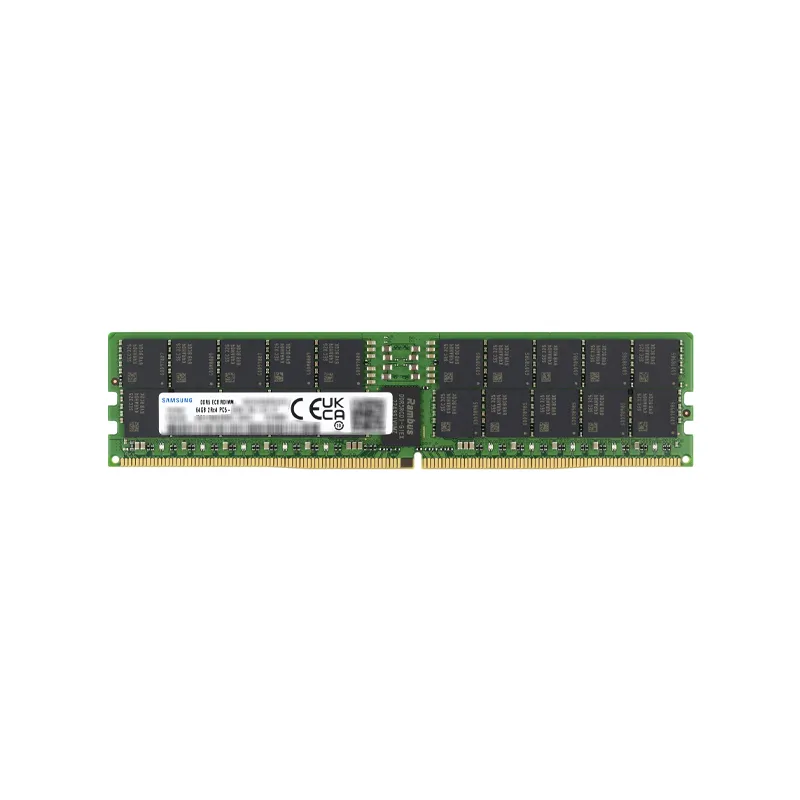
This is a server-class DDR5 Registered ECC module (RDIMM) purpose-built for data integrity in virtualized environments and in-memory databases, leveraging a Dual Rank x4 configuration that maximizes bank-level parallelism for sustained throughput under heavy multi-threaded workloads. Its ultra-low CAS latency of CL4 at 5600 MT/s delivers exceptional responsiveness, while the 1.1V operating voltage and registered signaling ensure stable, power-efficient operation in dense rack deployments where error correction is non-negotiable.
1. 64GB capacity per module dramatically increases memory density per server node, allowing larger in-memory databases and more virtual machines on a single physical host.
2. 5600MT/s transfer speed elevates memory bandwidth to keep pace with multi-core CPUs, crucial for real-time analytics and high-frequency trading workloads.
3. ECC error correction continuously detects and corrects single-bit errors, preserving data integrity in mission-critical enterprise applications and reducing unplanned downtime.
4. Registered signal type buffers command and address signals, maintaining signal integrity across fully loaded server memory channels with multiple DIMMs per channel.
5. Dual Rank x4 organization interleaves accesses across two internal rank groups, keeping memory channels fully saturated for consistent performance in dense virtualization and container orchestration environments.
When a financial services firm runs hundreds of virtual machines on a single VMware node, or an in-memory database like SAP HANA processes millions of transactions per second, memory integrity and capacity directly determine uptime and revenue. The M321R8GA0PB0-CWMCH is an RDIMM engineered precisely for these enterprise server workloads, and four of its design choices translate into critical real-world resilience.
First, its DDR5-5600 speed delivers 44.8 GB/s of peak bandwidth per channel, dramatically reducing latency in virtualized environments where dozens of VMs contend for shared resources. Second, integrated ECC corrects single-bit errors on the fly, preventing silent data corruption that could otherwise crash a hypervisor or produce inaccurate financial reports. Third, the registered (buffered) architecture stabilizes signal integrity across densely populated boards, enabling a single server to confidently host 1 TB or more of RAM without command-address instability. Finally, the dual-rank x4 organization with 64 GB capacity maximizes bank-level parallelism. In practice, this means a Redis cluster or an OLTP database sustains higher IOPS under heavy user loads because the memory controller can interleave requests across internal banks, reducing average access time. For IT architects, these characteristics are not abstract specifications—they are the difference between a platform that scales transparently and one that introduces costly, unpredictable downtime.
Server Memory Capacity Planning Guide
This 64GB DDR5-5600 Registered ECC RDIMM is engineered for enterprise-class servers, providing data integrity and high capacity per module. Optimal configuration depends heavily on workload characteristics and memory channel architecture.
General Virtualization
For a typical hypervisor hosting mixed VMs, memory is often the primary constraint before CPU. Utilizing dual-socket servers with eight channels per socket, populate six modules per CPU (six-channel balanced) to achieve 384GB per host while leaving room for future scaling. Always configure identical DIMMs across all populated channels to maintain uniform latency and avoid NUMA penalties.
In-Memory Database
Redis, SAP HANA, or Memcached deployments demand low latency and massive capacity. Populate all available memory channels with these 64GB RDIMMs in a balanced configuration—for an 8-channel platform, eight modules deliver 512GB with maximum bandwidth. Ensure dual-rank modules like this one are used for optimal interleaving. Never mix capacities per channel; go fully populated for large datasets.
High Performance Computing
HPC applications benefit from peak memory bandwidth. Install one DIMM per channel (1DPC) to sustain the highest 5600MT/s speed without downgrading. A 16-DIMM dual-processor node yields 1TB capacity using these modules, ideal for memory-bandwidth-bound simulations. Monitor cooling and power budgets closely, as densely populated RDIMM configurations increase thermal output.
Validated server memory: rigorously tested with Dell PowerEdge R760, HPE ProLiant DL380 Gen11, Lenovo ThinkSystem SR650 V3, and others.
Q: Can I mix this M321R8GA0PB0-CWMCH with other memory modules of different brands or speeds?
A: Mixing brands or speeds in server environments is not recommended. It may lead to instability, signal noise, and reduced reliability. For guaranteed performance, use identical modules with matching part numbers.
Q: Is this memory compatible with my system?
A: This DDR5-5600 Registered ECC RDIMM is compatible with latest Intel Xeon Scalable and AMD EPYC platforms that support DDR5 Registered memory. Please verify your server board's memory QVL for validated configurations.
Q: What is the recommended DIMM population order for optimal performance?
A: Follow your server motherboard’s balanced memory population guide. Typically, populate identical DIMMs in the first slot of each memory channel to maximize bandwidth and enable proper interleaving for optimal throughput.
Q: Does this module support overclocking or XMP profiles?
A: No. This is a strictly JEDEC-compliant Registered DDR5 server module. It does not support overclocking, XMP, or EXPO profiles, as reliability and data integrity take precedence in enterprise environments.
Q: What warranty and typical failure rate can I expect?
A: This module includes a 1-year warranty. It is built to stringent enterprise standards, resulting in extremely low AFR. Extensive testing ensures high reliability for 24/7 mission-critical server operations.