











 Secure payments
Standard refund policy
Trade Assurance
Secure payments
Standard refund policy
Trade Assurance
| Product Type | Memory Module |
|---|---|
| Memory Capacity | 64 GB |
| Memory Technology | DDR5 |
| RAM Speed | 5600 MHz |
| RAM Standard | DDR5-5600/PC5-44800 |
| Error Identifying | ECC |
| Signal Type | Registered |
| Column Access Strobe (CAS) | CL46 |
| Rank | Dual Rank x4 |
| Quantity of Pins | 288-pin |
| RAM Genre | RDIMM |
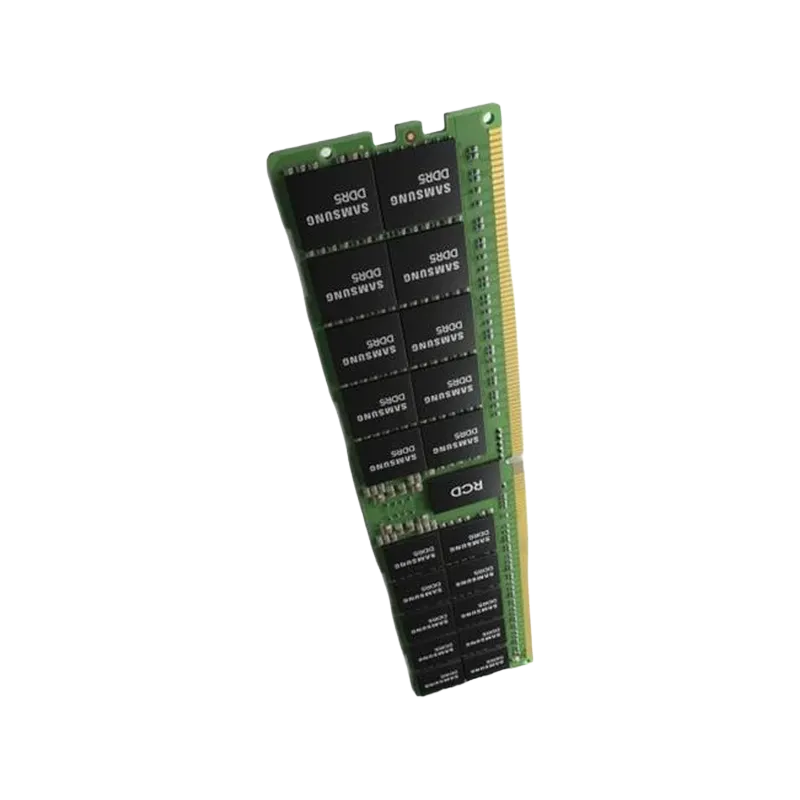
This 64GB DDR5-5600 RDIMM, with its dual-rank x4 organization and registered ECC, delivers the data integrity essential for virtualization and in-memory database workloads where silent memory errors cannot be tolerated. The dual-rank configuration maximizes memory bandwidth per channel under heavy load, ensuring stable, high-capacity throughput for mission-critical server platforms.
1. A generous 64GB per module enables higher memory density in rack servers, directly increasing the number of virtual machines and in-memory databases that can run simultaneously on a single node.
2. 5600MT/s throughput accelerates memory-bandwidth-intensive workloads like real-time analytics and AI inference, effectively reducing data bottlenecks in multi-socket platforms.
3. On-die ECC transparently corrects single-bit errors, safeguarding financial transactions and long-running scientific computations against silent data corruption and unplanned downtime.
4. Registered signal buffering stabilizes command and address lines, allowing fully-populated 24-DIMM configurations in 2U servers for maximum capacity scalability without sacrificing signal integrity.
5. Dual Rank x4 organization interleaves accesses across internal banks, keeping memory channels fully saturated to deliver consistent low-latency performance under heavy virtualization consolidation.
As a memory product specialist, let me explain why the M321R8GA0EB0-CWMXH RDIMM is critical for modern servers. This 64GB DDR5-5600 module integrates ECC, Registered buffering, Dual Rank x4 design, and 5600MT/s speed—four attributes that directly combat real data center headaches. In a virtualization cluster, ECC is indispensable: it transparently corrects single-bit errors induced by background radiation, preventing silent data corruption that could crash VMs or compromise databases. The Registered architecture buffers command and address signals, so you can populate every DIMM slot without electrical loading issues, enabling the terabytes of RAM needed to consolidate hundreds of virtual machines on a single host. For in-memory databases such as Redis or SAP HANA, Dual Rank x4 allows rank interleaving, which hides latency and amplifies bandwidth, accelerating millions of transactions per second. When married to 5600MT/s throughput, analytical queries complete in microseconds. This is the reliability, scalability, and performance your workloads demand.
General Virtualization
For general virtualization hosts, populate a minimum of eight identical 64 GB RDIMMs across the platform’s memory channels to balance capacity and interleaving. A 1 DIMM per channel (1DPC) configuration at the rated DDR5-5600 speed keeps latency low while providing ample headroom for VM density. Avoid mixing ranks or capacities in the same channel to prevent the memory controller from downclocking to a slower common speed.
In-Memory Database
In-memory databases demand both large capacity and sustained throughput, so fully populate all channels with dual‑rank x4 RDIMMs using a balanced 2DPC layout if the platform supports it at 4800 MT/s or higher. This module’s registered ECC and 64 GB density yield terabytes of reliable memory per socket, minimizing paging and protecting data integrity during heavy write‑back loads. Monitor row‑hammer mitigations at this scale and keep spare DIMMs on hand for rapid service.
High-Performance Computing
HPC clusters benefit from filling every memory channel evenly with these RDIMMs to maximize bandwidth-sensitive workload performance. Configure 1DPC for peak 5600 MT/s operation on compute nodes running fluid dynamics or weather modeling, then step down to 2DPC only when capacity-bound. Align the total memory per node to the job’s working set, ensuring NUMA-aware process pinning keeps memory access local to each socket’s controllers.
Rigorously tested and compatible with Dell PowerEdge R760, HPE DL365 Gen11, Lenovo SR650 V3, and more.
Q: Can I mix this M321R8GA0EB0-CWMXH with other memory modules of different brands or speeds?
A: Mixing RDIMMs is strongly discouraged. This module runs at DDR5-5600 CL46; different brands or speeds can cause signal integrity issues, forcing the entire memory bus to downclock and potentially compromising server stability.
Q: Is this memory compatible with my system?
A: Compatibility requires a server platform supporting DDR5 Registered ECC memory, such as 4th Gen Intel Xeon Scalable or AMD EPYC 9004 series. Verify your motherboard's QVL for this 64GB DDR5-5600 RDIMM to ensure proper operation.
Q: What is the recommended DIMM population order for optimal performance?
A: Populate identical DIMMs per-channel, balancing across memory controllers. For a dual-rank x4 RDIMM like this, fill one DIMM per channel first, then add the second, following your server's specific slot numbering to maximize interleaving and throughput.
Q: Does this module support overclocking or XMP profiles?
A: No. As an enterprise-grade DDR5 Registered ECC module, it operates strictly at JEDEC-standard DDR5-5600 with no XMP or overclocking profiles. Consistent, validated performance and data integrity take priority over dynamic frequency adjustments.
Q: What warranty and typical failure rate can I expect?
A: This module includes a 1-year warranty. Being built to server-class reliability standards with ECC, it exhibits an extremely low annualized failure rate (AFR) under normal operating conditions, ensuring long-term mission-critical availability.