











 Secure payments
Standard refund policy
Trade Assurance
Secure payments
Standard refund policy
Trade Assurance
| Product Type | Memory Module |
|---|---|
| Memory Capacity | 64 GB |
| Memory Technology | DDR5 |
| Product Voltage | 1.1 V |
| RAM Speed | 5600 MHz |
| RAM Standard | DDR5-5600/PC5-44800 |
| Error Identifying | ECC |
| Signal Type | Registered |
| Rank | Dual Rank x4 |
| Quantity of Pins | 288-pin |
| RAM Genre | RDIMM |
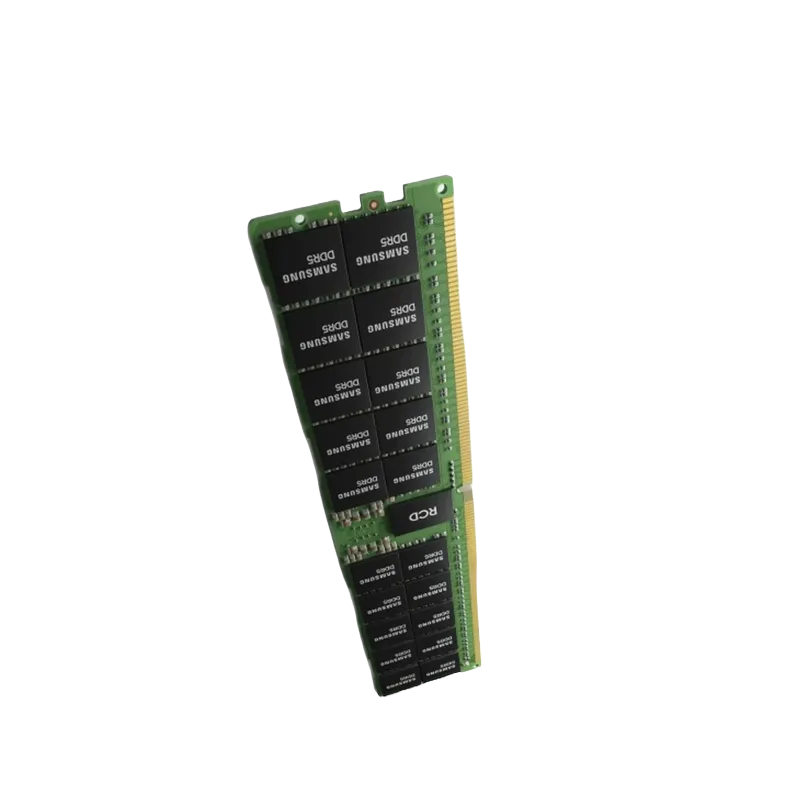
This DDR5-5600 Registered ECC RDIMM is engineered for enterprise server platforms, delivering mission-critical data integrity through error correction and enhanced signal stability via its registered architecture. The dual-rank x4 configuration maximizes memory throughput for demanding workloads like virtualization and in-memory databases, making it ideal for scale-out data center deployments.
1. 64 GB capacity per module allows dense memory configurations in dual-socket servers, supporting more virtual machines and larger in-memory databases without sacrificing DIMM slot availability.
2. DDR5 technology doubles the burst length and bank groups over previous generations, effectively feeding modern high-core-count server CPUs with sustained bandwidth for data-hungry workloads.
3. 5600 MT/s transfer rate accelerates real-time analytics and AI inference pipelines, shrinking the latency gap between main memory and last-level cache in heavily loaded systems.
4. On-die ECC combined with side-band correction hardens data integrity from cosmic-bit-flips, meeting the silent data corruption requirements of financial modeling and 24/7 mission-critical services.
5. Dual rank x4 organization interlocks parallel access across both ranks, sustaining throughput per channel under memory interleaving and boosting consolidation density in virtualized environments.
The Samsung M321R8GA0EB2-CWM is a 64 GB DDR5-5600 registered server DIMM whose four defining characteristics—high-speed DDR5, ECC, registered buffering, and a dual-rank x4 organization—directly translate to operational resilience in the data center. In a dense virtualization cluster running hundreds of VMs per node, every DIMM slot must be populated to its maximum; the registered clock buffer regenerates control signals, preserving signal integrity across massive memory configurations and preventing bus errors that would otherwise silently corrupt the hypervisor and bring down entire business services. Simultaneously, on-die ECC continuously detects and corrects single-bit flips caused by background radiation, shielding critical workloads such as financial ledgers or inventory databases from undetected data poisoning. For in-memory databases like Redis or SAP HANA, the dual-rank x4 layout exploits bank interleaving to service concurrent queries with lower latency, while the 5600 MT/s bandwidth keeps the CPU fed during real-time analytics. This combination keeps your virtualization platform stable under full memory load and ensures that every transaction running in a memory-resident database remains both accurate and fast, turning enterprise hardware into a genuinely dependable business foundation.
Server Memory Capacity Planning Guide for 64GB DDR5-5600 RDIMMs
This 64GB DDR5-5600 Registered DIMM with ECC is designed for server platforms. Its dual-rank x4 organization and 1.1V operation suit data-center workloads demanding high capacity and reliability. Use the following per-scenario configuration advice.
General Virtualization
Populate one DIMM per channel (1DPC) across all available memory channels to balance capacity and bandwidth. For a typical 8-channel server, install eight 64GB modules for 512GB total. This configuration avoids the speed reductions of 2DPC, delivers full 5600 MT/s, and provides enough headroom for dense virtual machine consolidation.
In-Memory Database
Maximize capacity by filling all channels with two DIMMs per channel (2DPC) if the platform supports it, yielding up to 1TB with sixteen modules on an 8-channel system. Accept the minor frequency downgrade to 4400–4800 MT/s that occurs at 2DPC; capacity and in-memory data locality outweigh raw bandwidth for large Redis or SAP HANA instances. Use identical modules to maintain rank symmetry and reliable ECC operation.
High Performance Computing
Prioritize memory bandwidth with a 1DPC population across every channel. Install one 64GB module per channel (eight units on 8-channel CPUs) to sustain full 5600 MT/s speeds. Dual-rank x4 construction already provides strong rank interleaving, maximizing throughput per core for HPC simulations. Avoid mixing capacities or ranks to guarantee uniform NUMA latency and stable performance under sustained CPU-bound loads.
Rigorously tested compatible with Dell PowerEdge R760, HPE DL380 Gen11, Lenovo SR650 V3.
Q: Can I mix this M321R8GA0EB2-CWM with other memory modules of different brands or speeds?
A: Mixing different brands or speeds is strongly discouraged for RDIMMs. It may cause signal integrity issues and system instability. For production servers, install identical modules with the same MPN to ensure validated compatibility and reliable performance.
Q: Is this memory compatible with my system?
A: This DDR5-5600 registered ECC module is designed for servers with Intel Xeon Scalable (Sapphire Rapids+) or AMD EPYC (Genoa+) platforms. Verify your server board supports 288-pin DDR5 RDIMMs and the specific capacity/rank configuration.
Q: What is the recommended DIMM population order for optimal performance?
A: Populate identical modules following your server vendor's guidelines. Typically, balance dual-rank x4 RDIMMs across all memory channels, filling the farthest slot from the CPU per channel first, to maximize interleaving and bandwidth efficiency.
Q: Does this module support overclocking or XMP profiles?
A: No, this is a JEDEC-compliant server RDIMM. It does not support overclocking or XMP. It operates only at standard DDR5-5600 speed and timings, prioritizing stability, data integrity, and ECC functionality over performance tuning.
Q: What warranty and typical failure rate can I expect?
A: This module includes a one-year warranty. Enterprise RDIMMs undergo rigorous screening and burn-in, yielding very low failure rates. ECC further protects data, and typical annualized failure rates are well below 0.5% under proper conditions.