











 Secure payments
Standard refund policy
Trade Assurance
Secure payments
Standard refund policy
Trade Assurance
| Product Type | Memory Module |
|---|---|
| Memory Capacity | 64 GB |
| Memory Technology | DDR5 |
| Product Voltage | 1.1 V |
| RAM Speed | 6400 MHz |
| RAM Standard | DDR5-6400/PC5-51200 |
| Error Identifying | ECC |
| Signal Type | Registered |
| Column Access Strobe (CAS) | CL52 |
| Rank | Dual Rank x4 |
| Quantity of Pins | 288-pin |
| RAM Genre | RDIMM |
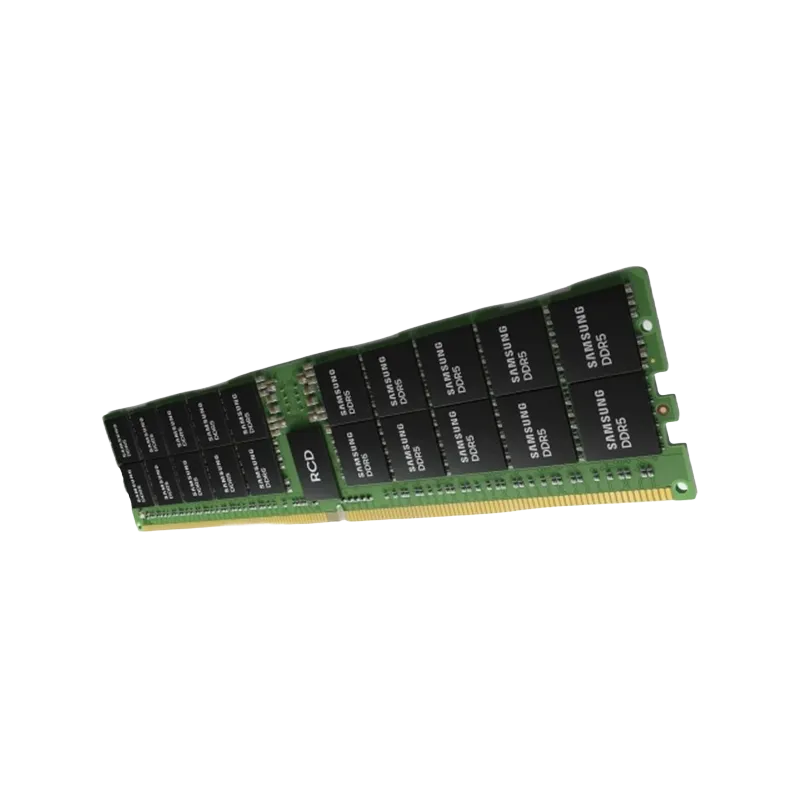
This 64GB DDR5-6400 Registered ECC RDIMM is purpose-built for enterprise server platforms running memory-intensive workloads such as virtualization, in-memory databases, and large-scale data analytics where data integrity is non-negotiable. Its dual-rank x4 configuration maximizes bank-level parallelism to sustain high bandwidth under heavy load, while the registered signal type ensures robust signal integrity across densely populated memory channels.
1. A 64GB module capacity allows enterprises to pack more virtual machines per server, maximizing consolidation ratios without sacrificing application headroom.
2. DDR5 technology elevates channel bandwidth dramatically, letting cloud platforms race through large-scale data sets for accelerated real-time analytics.
3. ECC protection silently corrects transient memory faults, safeguarding transactional databases and long-duration scientific computations from silent data corruption.
4. The registered interface buffers control signals across fully populated racks, preserving command clarity when scaling up to terabyte-class memory footprints.
5. Dual Rank x4 organization keeps memory channels saturated with interleaved operations, delivering steady throughput under heavy multi-tenant virtualization loads.
Designed as a 64GB DDR5-6400 Registered DIMM with ECC, the M321R8GA0EB2-CCPHC is purpose-built for modern servers, where every bit of data integrity and system stability directly impacts business revenue. Its 6400 MT/s speed and dual-rank x4 organization deliver the sheer bandwidth necessary for memory-hungry virtualization clusters—when you are hosting dozens of virtual machines on a single node, that throughput prevents the hypervisor from becoming a bottleneck and keeps all tenant applications responsive. The true safeguard, however, is ECC. In a memory database like SAP HANA, a silent bit-flip caused by background radiation can corrupt financial records without warning; ECC detects and corrects these errors in real time, turning a potential audit failure into a non-event. Meanwhile, the registered signal buffer stabilizes the electrical load across all 288 pins, allowing you to populate all DIMM slots without sacrificing signal quality. This is critical when scaling up capacity for in-memory analytics—you get the 64GB density today and the headroom to expand, all while the lower 1.1V DDR5 voltage aids thermal management in dense rack deployments.
General Virtualization
For dense VM consolidation, populate at least eight of these 64 GB RDIMMs across the server’s memory channels to achieve balanced capacity and bandwidth. A common starting point is 512 GB (eight modules) in a 1 DIMM-per-channel configuration, scaling to 1 TB or more as hypervisor host memory pressure grows. Always install identical dual‑rank DIMMs to preserve uniform latency and avoid NUMA imbalances.
In-Memory Database
Maximize capacity per socket by filling all available channels with these 64 GB registered modules — a single 8‑channel CPU can support 1 TB using sixteen DIMMs. Use a single‑rank‑sparing / mirroring policy only if uptime demands it; otherwise, leave memory unprotected to avoid the 12 – 25 % capacity penalty. For Redis or SAP HANA workload, target symmetrical population to keep data locality optimal.
High-Performance Computing
Deploy one DIMM per channel across all memory controllers to deliver peak 6400 MT/s throughput, satisfying bandwidth‑hungry CFD or weather simulation codes. Pair with a modern server that supports unbuffered‑like latencies on RDIMMs and consider eight 64 GB modules per node for a strong 512 GB footprint. When scaling out, maintain homogeneous configurations across nodes to guarantee reproducible run‑times and simplify cluster scheduling.
Rigorously tested for compatibility with servers: Dell PowerEdge R760, HPE ProLiant DL380 Gen11, Lenovo ThinkSystem SR650 V3.
Q: Can I mix this M321R8GA0EB2-CCPHC with other memory modules of different brands or speeds?
A: Mixing modules is strongly discouraged. Mismatched ranks, ICs, or timings may cause signal integrity issues and system instability. Always populate with identical Samsung M321R8GA0EB2-CCPHC parts to maintain validated server performance and reliability.
Q: Is this memory compatible with my system?
A: This 64GB DDR5-6400 Registered ECC module targets server platforms like 4th Gen Intel Xeon Scalable (Sapphire Rapids) and AMD EPYC 9004 series. Please confirm your board supports 288-pin DDR5 RDIMMs at 6400MT/s and 64GB capacity.
Q: What is the recommended DIMM population order for optimal performance?
A: Populate one DIMM per channel first, using the farthest slot from the CPU. For two-socket servers, balance identical modules across sockets. Always refer to your system’s service guide to maximize interleaving, bandwidth, and data integrity.
Q: Does this module support overclocking or XMP profiles?
A: No. This is a JEDEC-standard, enterprise-grade RDIMM engineered for 24/7 data-center reliability. It runs strictly at DDR5-6400 with fixed CL52 timings; XMP and manual overclocking are not supported to preserve error-free operation.
Q: What warranty and typical failure rate can I expect?
A: You receive a one-year warranty. Built with Samsung’s stringent testing, this module achieves an ultra-low annualized failure rate (typically <0.01%), ensuring exceptional longevity for mission-critical server operations under specified conditions.