











 Secure payments
Standard refund policy
Trade Assurance
Secure payments
Standard refund policy
Trade Assurance
| Model | M386B8G70DE0-YH9 |
|---|---|
| Product Type | Memory Module |
| Compliance Standards | EU RoHS,FCC |
| Memory Capacity | 64 GB |
| Memory Technology | DDR3 |
| Product Voltage | 1.35V |
| RAM Speed | 1333MHz |
| RAM Standard | DDR3-1333/PC3-10600 |
| Error Identifying | ECC |
| Signal Type | Registered |
| Column Access Strobe (CAS) | CL9 |
| Rank | Octal Rank x4 |
| Quantity of Pins | 240-pin |
| RAM Genre | RDIMM |
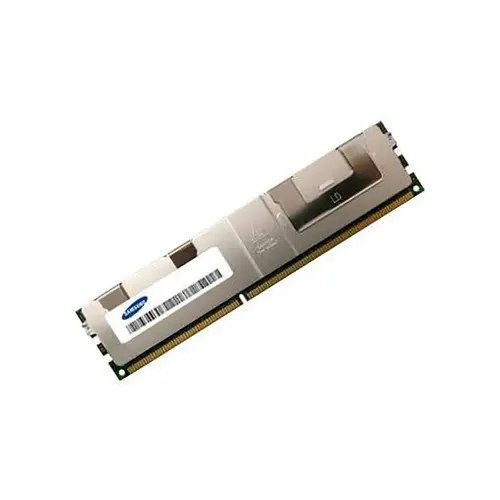
This 64GB DDR3-1333 Registered ECC module (M386B8G70DE0-YH9) is purpose-built for legacy servers and workstations demanding high memory capacity with data integrity, making it ideal for virtualization hosts and in-memory databases that require stable, error-corrected operation. Its octal-rank x4 organization and registered signaling enable dense population of up to 64GB per DIMM at 1.35V low-voltage, while ECC reliably detects and corrects single-bit errors to prevent silent data corruption in long-running mission-critical workloads.
1. High-density module capacity allows dense server virtualization, packing more VMs per node without sacrificing memory headroom for critical applications.
2. ECC protection silently corrects single-bit errors, preserving data integrity in always-on financial or database transactions.
3. Registered signaling buffers command and address lines, enabling stable large-memory configurations across multiple DIMMs under continuous enterprise load.
4. Octal Rank x4 organization maximizes bank-level parallelism, delivering sustained throughput to countless concurrent virtual machines.
5. Ultra-low voltage operation trims datacenter power draw and thermal stress, lowering total cost of ownership in dense rack deployments.
The M386B8G70DE0-YH9 is a 64GB DDR3 Registered DIMM with ECC, instantly identifying it as server-class memory built for data center workloads where reliability and density are non-negotiable.
Its ECC functionality actively detects and corrects single-bit errors caused by background radiation, which means a financial transaction database or a virtualized customer CRM will not suffer silent data corruption that could cascade into costly miscalculations or system crashes. The Registered signal buffer enables the server to populate all memory channels with large-capacity modules while preserving clean command and address signals; in a dense VMware cluster running dozens of virtual machines, this prevents signal degradation that would otherwise cause random boot failures or memory training faults. The Octal Rank x4 organization lets the memory controller interleave requests across eight internal ranks, significantly boosting effective bandwidth for an in-memory database like Redis or SAP HANA, where millions of small, concurrent queries must race through the memory bus with minimal latency. Operating at 1.35V low voltage, this module reduces thermal load and energy consumption across a full rack, lowering your cooling costs and extending the service life of both the DIMMs and the surrounding components. Together, these characteristics deliver uncompromised uptime, sustained high throughput, and predictable performance for mission-critical enterprise applications.
General Virtualization
For virtualized environments demanding high memory density, deploy one 64 GB RDIMM per memory channel to balance capacity with bandwidth. A dual‑socket server with four channels per socket can deliver 512 GB of RAM, comfortably hosting 50+ typical VMs. The module’s 1.35 V low‑voltage operation also curbs power and cooling costs in dense server farms.
In-Memory Database
Maximize capacity by fully populating all DIMM slots with these 64 GB modules, accepting a possible speed reduction to 1066 MHz or 800 MHz due to the octal‑rank load. A four‑socket server with 24 slots per socket can reach 6 TB, enabling entire OLTP or analytics datasets to reside in DRAM for Redis, Memcached, or SAP HANA‑like workloads. This configuration prizes capacity over peak frequency.
High Performance Computing (HPC)
For bandwidth‑sensitive simulations, install one 64 GB module per memory channel to sustain the full 1333 MT/s transfer rate and avoid multi‑rank clock penalties. This yields 256 GB per socket on a typical quad‑channel platform, providing ample capacity per node while preserving the lowest latency. Scale horizontally by adding more nodes rather than over‑stacking channels, keeping per‑node bandwidth at its peak.
Rigorously tested ECC Registered server RAM, compatible with Dell PowerEdge R720/R620, HP DL380p Gen8, etc.
Q: Can I mix this M386B8G70DE0-YH9 with other memory modules of different brands or speeds?
A: Mixing with modules of different brands or speeds is not recommended. It may cause signal integrity issues and system instability. For enterprise environments, populate identically specced RDIMMs across all channels to ensure reliable operation.
Q: Is this memory compatible with my system?
A: This 64GB DDR3-1333 Registered ECC RDIMM is compatible with select Intel Xeon E5-2600/E5-2400 series and AMD Opteron 6300/4300 platforms. Verify that your server board supports 1.35V octal-rank x4 240-pin modules and check the vendor’s qualified vendor list (QVL).
Q: What is the recommended DIMM population order for optimal performance?
A: Follow your server board's manual for balanced memory configuration. Typically, populate identical modules starting with the first slot of each channel. For octal-rank kits, install them sequentially across memory channels to maximize interleaving and bandwidth.
Q: Does this module support overclocking or XMP profiles?
A: No, this is an enterprise-grade Registered ECC DIMM compliant with JEDEC DDR3-1333 CL9 standards. It does not support overclocking or Intel XMP profiles, as reliability and data integrity take precedence over frequency tuning.
Q: What warranty and typical failure rate can I expect?
A: This module includes a one-year warranty. As a rigorously tested enterprise RDIMM, it exhibits a very low annualized failure rate (AFR), typically below 0.5%, ensuring stable long-term operation in data center environments.