











 Secure payments
Standard refund policy
Trade Assurance
Secure payments
Standard refund policy
Trade Assurance
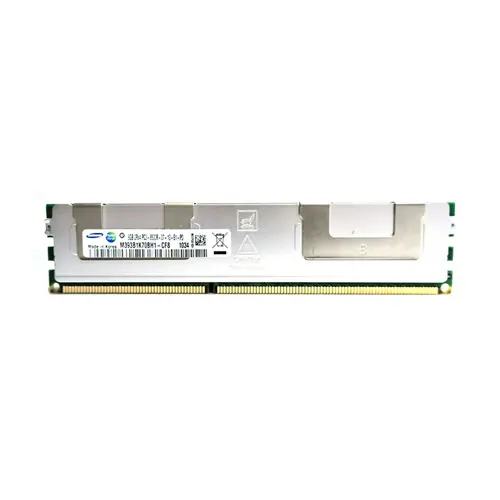
| Model | M393B1K70BH1-CF8 |
|---|---|
| Product Type | Memory Module |
| Compliance Standards | EU RoHS,FCC |
| Memory Capacity | 8 GB |
| Memory Technology | DDR3 |
| Product Voltage | 1.5V |
| RAM Speed | 1066MHz |
| RAM Standard | DDR3-1066/PC3-8500 |
| Error Identifying | ECC |
| Signal Type | Registered |
| Column Access Strobe (CAS) | CL7 |
| Rank | Dual Rank x4 |
| Quantity of Pins | 240-pin |
| RAM Genre | RDIMM |
This Samsung 8GB DDR3-1066 Registered ECC RDIMM is engineered for server platforms where data integrity and stability under continuous load are non-negotiable, making it ideal for virtualization hosts, memory-resident databases, and entry-level enterprise storage systems. Its dual-rank x4 organization with CL7 latency and registered signaling enhances signal integrity in multi-DIMM configurations while delivering reliable error correction, ensuring consistent performance in 24/7 mission-critical environments.
1. ECC protection continuously detects and corrects single-bit errors, preventing silent data corruption in financial ledgers and transactional databases.
2. Registered signal buffering stabilizes command and address paths, allowing dense multi-DIMM configurations to scale reliably in large virtualization clusters.
3. Dual Rank x4 organization maximizes channel interleaving, keeping throughput consistent under heavy simultaneous reads and writes for hosted VMs.
4. The per-module capacity allows granular memory expansion to match virtual machine density targets without sacrificing performance headroom.
5. The memory speed delivers balanced bandwidth that sustains concurrent multi-tenant workloads while maintaining low power draw in energy-conscious data centers.
The Samsung M393B1K70BH1-CF8 is a server‑grade DDR3 Registered DIMM, purpose‑built for mission‑critical datacenter environments where data integrity and system stability are non‑negotiable. Its ECC capability automatically detects and corrects single‑bit errors, silently preventing the bit flips that cosmic radiation or electrical noise can cause. In a virtualization cluster, where dozens of VMs share memory space, an uncorrected error could cascade into guest crashes or corrupted transactions—ECC eliminates that risk. The registered signal architecture buffers control signals, dramatically reducing the electrical load on the memory controller. This enables you to populate all channels with multiple DIMMs without timing failures, a practical necessity when scaling a hypervisor host to 512 GB or more. The module’s dual‑rank x4 organization leverages rank interleaving to boost effective bandwidth; during heavy online transaction processing on an in‑memory database, concurrent read/write streams flow with measurably lower latency. Paired with a CAS latency of just 7 cycles, this RDIMM delivers the tight response times that financial trading platforms or real‑time analytics engines demand. For your data‑centric workloads, every one of these features translates directly into higher uptime, consistent throughput, and uncompromised data accuracy.
General Virtualization
For a typical hypervisor hosting multiple VMs, populate at least six modules to leverage triple-channel or quad-channel architectures on older DDR3-era servers. An initial configuration of six 8GB RDIMMs (48GB total) provides headroom for moderate consolidation, while scaling to twelve modules (96GB) on dual-socket boards accommodates more VMs without excessive overcommitment.
In-Memory Database
In-memory databases demand both capacity and fault tolerance. Install identical 8GB registered ECC RDIMMs in multiples that match the memory interleaving boundary—commonly eight or twelve modules for 64GB or 96GB total. This ensures balanced memory access across all channels, sustains low latency at CL7, and delivers the data integrity required by systems like Redis or SAP HANA.
High-Performance Computing (HPC)
HPC clusters benefit from populated but not fully saturated memory channels to balance bandwidth and power. Use eight 8GB RDIMMs (64GB per node) arranged in a uniform quad-channel configuration, leaving room for future doubling. The dual-rank x4 organization enhances command/address parallelism, while the registered interface stabilizes signal integrity across densely packed compute blades, crucial for MPI workloads running sustained calculations.
Rigorously tested, compatible with Dell PowerEdge R710/R720, HP ProLiant DL380p Gen8, Lenovo ThinkServer RD630, and more.
Q: Can I mix this M393B1K70BH1-CF8 with other memory modules of different brands or speeds?
A: Mixing is strongly discouraged. Registered ECC memory requires matched ranks and timings. Combining dissimilar modules may cause POST failures or silent data corruption in server environments.
Q: Is this memory compatible with my Intel Xeon or AMD EPYC server platform?
A: Compatibility depends on the CPU memory controller and motherboard. This DDR3 Registered DIMM generally supports Intel Xeon E5/E7 v1/v2 and equivalent AMD Opteron platforms requiring 1.5V, 240-pin RDIMMs.
Q: What is the recommended DIMM population order for optimal performance using this module?
A: Follow your server board manual, typically populating identical dual-rank DIMMs per channel starting from the farthest slot from the CPU. Balanced interleaving across memory channels maximizes throughput.
Q: Does this module support overclocking or XMP profiles?
A: No. This is a JEDEC-compliant server RDIMM operating at fixed DDR3-1066 timings. Overclocking and XMP are not supported, as stability and data integrity are prioritized in enterprise environments.
Q: What warranty and typical failure rate can I expect for this memory?
A: This module comes with a 1-year warranty. Typical annualized failure rate for enterprise RDIMMs is around 0.2-0.5% under proper thermal and voltage conditions, ensuring high reliability.