











 Secure payments
Standard refund policy
Trade Assurance
Secure payments
Standard refund policy
Trade Assurance
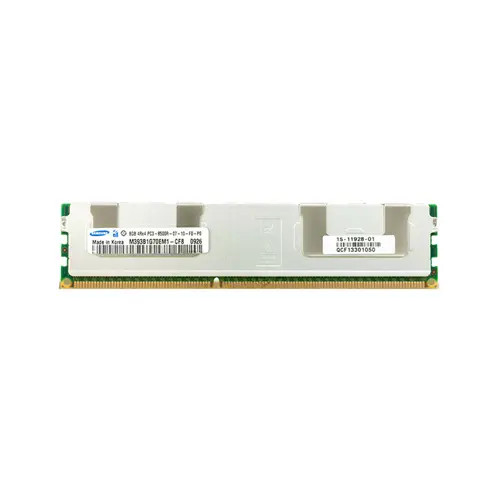
| Model | M393B1G70EM1-CF8 |
|---|---|
| Product Type | Memory Module |
| Compliance Standards | EU RoHS,FCC |
| Memory Capacity | 8 GB |
| Memory Technology | DDR3 |
| Product Voltage | 1.5V |
| RAM Speed | 1066MHz |
| RAM Standard | DDR3-1066/PC3-8500 |
| Error Identifying | ECC |
| Signal Type | Registered |
| Column Access Strobe (CAS) | CL7 |
| Rank | Quad Rank x4 |
| Quantity of Pins | 240-pin |
| RAM Genre | RDIMM |
As a DDR3-1066 registered ECC RDIMM, this module is tailored for legacy server platforms like Intel Xeon 5500/5600 series, where its 8 GB capacity and Quad Rank x4 organization maximize memory density in multi-slot configurations for virtualization and in-memory databases. The combination of ECC error correction and registered signaling ensures data integrity and signal stability under fully populated memory channels, while the CL7 low latency helps maintain responsive performance in transaction-heavy workloads.
1. ECC protection silently corrects single-bit memory faults, preserving transactional integrity for database operations and eliminating unplanned downtime in always-on enterprise servers.
2. Registered signal buffering stabilizes high-density memory channels, enabling seamless scaling of virtualization hosts without signal degradation or performance drops.
3. Quad Rank x4 organization maximizes bank-level parallelism, sustaining consistent bandwidth under heavy multi-VM consolidation and improving multi-tenant responsiveness.
4. Generous per-module capacity offers a dense building block for hypervisors, allowing larger in-memory workloads and broader virtual machine fleets per physical node.
5. The mainstream operating frequency delivers reliable baseline throughput, balancing energy efficiency and predictable data flow in thermally constrained data centers.
When you are responsible for a virtualized cluster hosting dozens of business-critical workloads, a single undetected memory error is not just a statistic—it is a potential outage. The Samsung M393B1G70EM1-CF8 is an 8GB DDR3-1066 Registered DIMM engineered precisely for these server environments, and four of its design characteristics directly dictate your uptime and performance. First, ECC technology actively corrects single-bit errors before they corrupt a financial transaction or a healthcare record, meaning your memory-resident databases maintain absolute data integrity under continuous operation. Second, the registered buffer decouples the memory controller from the DRAM chips, enabling the system to support large-capacity quad-rank configurations across all slots without signal degradation—this is what allows you to confidently populate an entire virtualization host with ample, stable RAM for dozens of VMs. Third, the Quad Rank x4 organization doubles the module’s internal bank count, increasing row-hitting efficiency for memory-intensive applications like in-memory caching with Redis or real-time analytics. Finally, a CAS latency of just 7 cycles at 1066MHz delivers the predictable, low-latency response that a large SAP HANA instance demands, preventing transaction queuing during peak load. In your rack, these are not mere specifications; they are the difference between peak-hour fluency and a 3 a.m. page.
Capacity Planning Guide for DDR3 Registered ECC Memory (M393B1G70EM1-CF8)
This 8GB DDR3-1066 Registered ECC RDIMM is designed for server-class platforms. Its error correction and buffered architecture prioritize stability and data integrity over raw speed, making it suitable for legacy enterprise environments. Below are recommended configurations for typical server workloads.
General Virtualization
For a moderate-density hypervisor hosting 10–15 light VMs, install six to eight identical modules across all memory channels to balance capacity and interleaving. Populate in matched groups of three or four per CPU (e.g., 6×8GB for 48GB total) to enable triple-channel interleaving and maintain ECC multi-bit protection. Avoid mixing quad-rank DIMMs on the same channel to prevent signal loading issues.
In-Memory Database
In-memory workloads such as Redis or SAP HANA demand maximum capacity and reliability. Fully populate all DIMM slots with these 8GB quad-rank RDIMMs—for a dual-socket system with 18 slots per CPU, that yields up to 288GB. Configure sparing or mirroring modes if the platform supports it, trading raw capacity for higher resilience. Be aware of the 1066MHz speed; large rank counts may force a frequency drop, so verify BIOS rank limitations.
High-Performance Computing
HPC clusters often prioritize memory bandwidth. Install six or twelve identical modules per node to populate all memory channels symmetrically (e.g., 6×8GB per socket). This ensures balanced access across channels, reducing latency in MPI- intensive tasks. Given the quad-rank density, check for any required voltage or timing adjustments to sustain full rated speed under load.
Strictly validated server RDIMM, compatible with Dell PowerEdge R710, HP ProLiant DL380 G7, IBM x3650 M3.
Q: Can I mix this M393B1G70EM1-CF8 with other memory modules of different brands or speeds?
A: Mixing is not recommended for server environments. Different brands or speeds may cause stability issues, especially with ECC Registered memory. For reliable operation, use identical modules across all channels.
Q: Is this memory compatible with my system?
A: It’s designed for servers supporting DDR3 ECC Registered DIMMs, such as Intel Xeon E5-2600 v1/v2 platforms or AMD Opteron 6300 series. Verify your board supports quad rank 8GB RDIMMs at 1066MHz.
Q: What is the recommended DIMM population order for optimal performance?
A: Follow your server board’s manual; generally, populate each memory channel identically, starting from the slot farthest from the CPU. For this quad rank module, balanced channel loading is critical.
Q: Does this module support overclocking or XMP profiles?
A: No. As an enterprise-grade server RDIMM, it strictly adheres to JEDEC DDR3-1066 standards. Overclocking and XMP are disabled to ensure maximum data integrity and 24/7 stability.
Q: What warranty and typical failure rate can I expect?
A: It comes with a one-year warranty. Enterprise memory like this typically has an extremely low annualized failure rate (AFR) below 0.5%, ensuring long-term reliability in demanding server deployments.