











 Secure payments
Standard refund policy
Trade Assurance
Secure payments
Standard refund policy
Trade Assurance
| Product Type | Memory Module |
|---|---|
| Memory Capacity | 8 GB |
| Memory Technology | DDR3 |
| Product Voltage | 1.35V |
| RAM Speed | 1066MHz |
| RAM Standard | DDR3-1066/PC3-8500 |
| Error Identifying | ECC |
| Signal Type | Registered |
| Column Access Strobe (CAS) | CL7 |
| Rank | Quad Rank x8 |
| Quantity of Pins | 240-pin |
| RAM Genre | RDIMM |
This DDR3-1066 Registered ECC DIMM is a server-grade memory module engineered for virtualization, in-memory databases, and mission-critical enterprise workloads where data integrity cannot be compromised. The quad-rank x8 configuration maximizes capacity density per channel while the registered signal topology decouples electrical loading, and the CL7 latency delivers responsive access in ECC-protected environments.
1. ECC error correction catches and corrects single-bit memory faults on the fly, preserving transactional integrity in always-on database and virtualization servers.
2. Registered signal buffering stabilizes command and address lines under fully-populated configurations, enabling reliable operation across dozens of DIMMs in high-density racks.
3. Quad Rank x8 organization packs more logical banks into a single module, maximizing memory capacity per slot for large VM footprints without sacrificing server node count.
4. 1.35V low-voltage operation cuts overall rack power draw and thermal load, lowering cooling overhead in scale-out data center deployments.
5. CL7 low column access latency accelerates cache-line fills for latency-sensitive enterprise workloads like in-memory analytics and high-frequency trading systems.
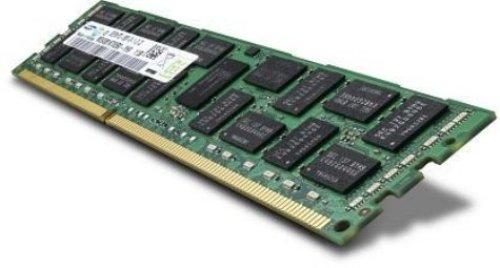
Engineered for unwavering reliability in the server room, the Samsung M393B1K73DH0-YF8 is a DDR3 Registered DIMM built to solve the critical pain points of enterprise computing. In a dense virtualization cluster hosting dozens of VMs, a single undetected bit-flip in a hypervisor’s memory can corrupt guest operating systems and silently cascade errors across your entire infrastructure. The module’s ECC engine corrects single-bit errors and detects multi-bit faults on the fly, directly protecting data integrity and eliminating the financial risk of silent data corruption. Equally vital, the Registered signal buffer stabilizes the command and address buses when populating multiple DIMMs per channel. For a memory-intensive in-memory database like Redis or SAP HANA, where whole datasets live in RAM, this buffer allows you to stack Quad Rank modules without compromising signal integrity. The quad-rank x8 organization maximizes capacity density per slot, while the 1.35V low-voltage operation slashes power consumption and thermal load in a fully populated 24-DIMM server, cutting your cooling bill. Even with this robust signal conditioning, the tight CL7 latency ensures rapid data delivery, accelerating transactional responsiveness when every nanosecond counts.
General Virtualization
Deploy a balanced mix of capacity and cost by populating all memory channels evenly — typically six or eight identical 8 GB RDIMMs for a total of 48–64 GB on a dual‑socket server. This satisfies moderate VM density (20–30 light VMs) while preserving the power efficiency of 1.35 V DDR3. Avoid mixing quad‑rank DIMMs with other ranks in the same channel to prevent speed degradation.
In-Memory Database
Achieve the largest addressable footprint by fully loading all DIMM slots with these 8 GB quad‑rank modules — up to 384 GB on a 24‑slot dual‑processor platform. Because in‑memory workloads are latency‑sensitive, populate one DIMM per channel first to run at the rated 1066 MT/s before filling second slots. The low 1.35 V supply reduces thermal stress when all slots are occupied, sustaining reliability for 24/7 operation.
High-Performance Computing (HPC)
Configure the memory subsystem for bandwidth saturation: install one registered 8 GB DIMM in each memory channel to maximize interleaving and avoid performance penalties from quad‑rank loading. A common node setup uses 4‑6 modules per socket (64–96 GB total) and prioritizes CAS 7 latency for fast iteration. Where memory‑bound applications require more capacity, add an identical second DIMM per channel but expect a slight frequency drop on legacy DDR3 platforms.
Rigorously tested. Compatible with Dell PowerEdge R710/R610, HP ProLiant DL380 G7, and more.
Q: Can I mix this M393B1K73DH0-YF8 with other memory modules of different brands or speeds?
A: Mixing brands or speeds is not recommended for this RDIMM. It may cause signal integrity issues, system instability, or boot failure. For reliable operation, use identical Samsung modules with the same M393B1K73DH0-YF8 part number across all channels.
Q: Is this memory compatible with my system?
A: This DDR3 Registered ECC module is designed for servers with Intel Xeon E5-2400/2600 v1/v2 or AMD Opteron 4300/6300 series platforms. Verify your board supports 8 GB quad-rank RDIMMs running at 1066 MHz (PC3-8500) and 1.35 V operation.
Q: What is the recommended DIMM population order for optimal performance?
A: Populate identical DIMMs per channel, starting with the slot farthest from the CPU. Balance identical quad-rank modules across all memory channels. Refer to your server manual: quad-rank RDIMMs typically require specific slot restrictions to maintain 1066 MHz speed.
Q: Does this module support overclocking or XMP profiles?
A: No. As a server Registered ECC DIMM, this module adheres strictly to JEDEC DDR3-1066 specifications for mission-critical stability. It does not support overclocking, XMP profiles, or any non-standard voltage adjustments beyond its 1.35 V low-voltage profile.
Q: What warranty and typical failure rate can I expect?
A: This Samsung memory module is covered by a one-year warranty. Its true server-grade construction typically yields an annualized failure rate (AFR) well below 0.5%, ensuring long-term reliability in 24/7 enterprise environments.