











 Secure payments
Standard refund policy
Trade Assurance
Secure payments
Standard refund policy
Trade Assurance
| Model | M393B1K73DH0-CF8 |
|---|---|
| Product Type | Memory Module |
| Compliance Standards | EU RoHS,FCC |
| Memory Capacity | 8 GB |
| Memory Technology | DDR3 |
| Product Voltage | 1.5V |
| RAM Speed | 1066MHz |
| RAM Standard | DDR3-1066/PC3-8500 |
| Error Identifying | ECC |
| Signal Type | Registered |
| Column Access Strobe (CAS) | CL7 |
| Rank | Quad Rank x4 |
| Quantity of Pins | 240-pin |
| RAM Genre | RDIMM |
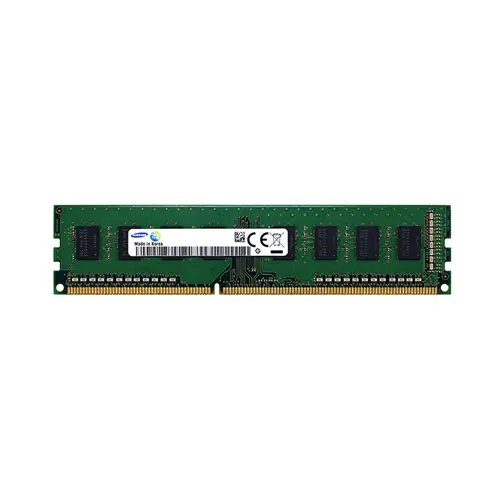
Designed for enterprise servers, this DDR3-1066 RDIMM with ECC and registered signaling ensures data integrity in virtualized environments and memory-intensive database applications. Its Quad Rank x4 configuration maximizes capacity per channel, while the CL7 latency delivers responsive access for tightly coupled workloads.
1. 8GB capacity per module delivers the density foundation needed to allocate more memory per virtual machine, directly increasing consolidation ratios in virtualized data centers.
2. ECC error correction actively detects and repairs single-bit data faults in real time, shielding mission-critical workloads from silent corruption that could otherwise trigger application crashes.
3. Registered signal buffering strengthens address and command stability across fully loaded memory channels, ensuring consistent operation when scaling to massive server memory footprints.
4. Quad Rank x4 organization packs the maximum independent memory banks into a single slot, sustaining high bandwidth utilization for memory-intensive analytics and large-scale virtualization.
5. 1066MHz clock rate provides a dependable throughput baseline that remains stable even with all DIMM slots populated, preserving predictable latency for always-on enterprise services.
The M393B1K73DH0-CF8 is an 8GB DDR3-1066 Registered DIMM with ECC, built specifically for server environments where uptime and data integrity are non-negotiable. Its Registered signal type buffers the command and address lines, meaning you can populate all memory channels with quad-rank modules like this one without destabilizing the memory controller. In a dense virtualization cluster running dozens of VMs, that stability directly prevents host crashes that would otherwise cascade across your entire workload. The ECC function silently corrects single-bit errors—a critical safeguard when a cosmic ray could flip a bit inside an in-memory database, corrupting financial transactions or customer records without warning. The quad-rank x4 organization packs more DRAM banks per channel, boosting row-hit rates under heavy concurrent access. For an in-memory caching layer like Redis or Memcached, this translates into lower tail latencies because the controller finds open pages more often, avoiding costly precharge cycles. With a 1.5V operating voltage and PC3-8500 bandwidth, it keeps thermal load predictable inside constrained 1U chassis, letting you scale memory capacity while staying within power budgets that directly affect colocation costs. This module turns your aging DDR3 infrastructure into a dependable, cost-effective workhorse where data accuracy and consistent performance matter far more than headline transfer rates.
General Virtualization
Virtualization demands high capacity for multiple VMs. Populate all memory channels per socket uniformly—typically six of these 8GB RDIMMs (48GB) in a dual-socket server—to maintain balanced interleaving. These registered ECC modules enhance reliability under heavy multi-tenant loads. For moderate consolidation, two DIMMs per channel (12 modules, 96GB total) offers cost-effective headroom.
In-Memory Database
Databases like Redis or SAP HANA need maximum capacity and reliability. Fill all DIMM slots with these ECC Registered modules, aiming for 128GB or more per server. Distribute modules symmetrically across channels to avoid NUMA latency, and keep a spare for advanced ECC to protect in-flight data.
High-Performance Computing (HPC)
HPC prioritizes bandwidth over capacity. Install eight identical 8GB RDIMMs—one per channel on a four-channel dual-socket board—to maximize channel interleaving. Because this DDR3-1066 speed is modest, populate only essential slots to avoid downclocking with more DIMMs. This 64GB configuration delivers peak throughput for parallel simulations while meeting capacity needs.
Rigorously tested server memory. Compatible with Dell PowerEdge R720, HP ProLiant DL380p Gen8, IBM System x3650 M4.
Q: Can I mix this M393B1K73DH0-CF8 with other memory modules of different brands or speeds?
A: Mixing is not recommended. Different brands or speeds may cause ECC and register conflicts on server boards. For guaranteed stability, install identical quad-rank PC3-8500 modules with matching timings and voltage.
Q: Is this memory compatible with my system?
A: This DDR3 Registered ECC RDIMM fits servers based on Intel Xeon 5600/5500 or AMD Opteron 6100 series platforms. Verify BIOS support for 8GB quad-rank x4 modules rated at 1066MHz and 1.5V.
Q: What is the recommended DIMM population order for optimal performance?
A: Follow the server board's population guide. Typically, populate channel A first. With this quad-rank module, limit DIMMs per channel to preserve 1066MHz and avoid mixing with single/dual-rank DIMMs.
Q: Does this module support overclocking or XMP profiles?
A: No. As a server-class Registered ECC DIMM, it strictly follows JEDEC DDR3-1066 specifications. Overclocking or XMP is not supported; data integrity and error correction take priority.
Q: What warranty and typical failure rate can I expect?
A: This module carries a 1-year warranty. Thanks to rigorous testing and premium ICs, typical annualized failure rate remains well below 1%, ensuring dependable ECC operation for mission-critical workloads.