











 Secure payments
Standard refund policy
Trade Assurance
Secure payments
Standard refund policy
Trade Assurance
| Model | M393B1K70CH0-YH9Q5 |
|---|---|
| Product Type | Memory Module |
| Compliance Standards | EU RoHS,FCC |
| Memory Capacity | 8 GB |
| Memory Technology | DDR3 |
| Product Voltage | 1.35V |
| RAM Speed | 1333MHz |
| RAM Standard | DDR3-1333/PC3-10600 |
| Error Identifying | ECC |
| Signal Type | Registered |
| Column Access Strobe (CAS) | CL9 |
| Rank | Dual Rank x4 |
| Quantity of Pins | 240-pin |
| RAM Genre | RDIMM |
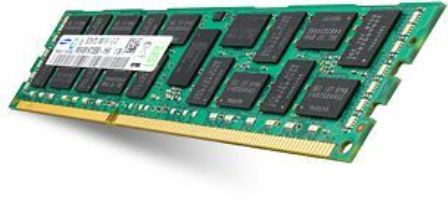
The M393B1K70CH0-YH9Q5 is a server-grade DDR3 RDIMM designed for virtualization and memory-intensive database workloads where data integrity is paramount. Its registered signal type and dual-rank x4 organization ensure stable multi-DIMM operation and enhanced interleaving performance, while 1.35 V low-voltage operation and ECC error correction deliver energy efficiency without compromising reliability in 24/7 enterprise environments.
1. ECC error correction actively detects and repairs single-bit data faults, preserving transactional integrity for databases and financial services running non-stop.
2. Registered signal buffering stabilizes command and address lines across fully loaded memory channels, essential for maintaining uptime in dense rack servers.
3. Dual Rank x4 organization interleaves data accesses across two internal ranks, maximizing sustained throughput under heavy virtualization and container orchestration.
4. 1333MHz speed provides a balanced bandwidth envelope, smoothing data flow for concurrent enterprise workloads without introducing excessive power overhead.
5. 8GB capacity per module allows cost-effective scaling of in-memory caches and moderate virtual machine density in entry-level server infrastructure.
As a DDR3 1333MHz Registered DIMM with ECC, the Samsung M393B1K70CH0-YH9Q5 is purpose‑built for enterprise servers and data centers where operational continuity is non‑negotiable. Its 1.35V low‑voltage design directly cuts power draw and thermal load across dense rack deployments—meaning your cloud hosting or virtualized cluster reduces cooling expenditure and extends hardware longevity.
Error‑Correcting Code provides far more than a technical checkbox. In an in‑memory database like Redis or a transactional SQL server, a single bit flip from background radiation silently corrupts customer records or financial calculations. ECC automatically detects and corrects these errors, transforming a potential integrity crisis into a non‑event. The Registered signal buffer stabilizes high‑capacity configurations, allowing you to populate all 24 DIMM slots without stressing the memory controller. This is critical when you are hosting 50 virtual machines per node: every VM’s memory footprint stays perfectly isolated, preventing cascading failures. Meanwhile, the Dual Rank x4 organization leverages rank interleaving to overlap read and write commands, raising effective bandwidth. For a heavily virtualized cluster running multiple demanding applications, this architecture slashes latency during simultaneous access storms, keeping response times predictable when it matters most. That is the assurance your infrastructure demands.
General Virtualization
With 8GB RDIMMs, a typical dual-socket virtualization host benefits from balanced capacity and bandwidth. Populate at least six modules per CPU (12 modules total, 96GB) to leverage triple-channel or higher architectures, ensuring ample headroom for moderate VM densities and memory overcommitment.
In-Memory Database
In-memory databases demand maximum capacity and low latency. Deploy twelve 8GB RDIMMs per socket (192GB per host) to fully populate all memory channels, and consider scaling to 24 modules (192GB with dual-socket) for large datasets. The ECC and registered design ensures data integrity under heavy, sustained read/write loads.
High-Performance Computing
HPC clusters require high memory bandwidth for parallel workloads. Use a balanced configuration—eight or twelve modules per node (64–96GB) to saturate all memory channels with 1333MHz registered DIMMs. Matching the dual-rank x4 organization per channel optimizes throughput for throughput-sensitive simulations and data analysis tasks.
Rigorously tested, compatible with Dell PowerEdge R720, R620, HP DL380p Gen8, IBM x3650 M4, and more.
Q: Can I mix this M393B1K70CH0-YH9Q5 with other memory modules of different brands or speeds?
A: Mixing Registered ECC modules with unbuffered or non-ECC DIMMs is not supported. Even within RDIMMs, different ranks, speeds, or timings may cause instability. We recommend using identical modules for guaranteed server reliability.
Q: Is this memory compatible with my dual-socket Intel Xeon or AMD Opteron server platform?
A: This DDR3-1333 registered DIMM is compatible with Intel Xeon 5500/5600 series and AMD Opteron 6100/6200 series platforms that require 1.35V low-voltage support and 240-pin RDIMM slots. Verify your server board's qualified vendor list for definitive compatibility.
Q: What is the recommended DIMM population order for optimal performance?
A: For dual-processor servers, populate identical DIMMs in matching slots across memory channels, typically filling blue slots first per the system board manual. Maintain balanced memory configurations across CPU sockets to enable uniform interleaving and maximize bandwidth.
Q: Does this module support overclocking or XMP profiles?
A: No. This is an enterprise Registered DIMM adhering to JEDEC DDR3-1333 standards for mission-critical stability. Overclocking and XMP profiles are not supported; the module operates at 1333MHz with CL9 timings and ECC correction to prevent data corruption.
Q: What warranty and typical failure rate can I expect?
A: This Samsung memory carries a 1-year warranty covering manufacturing defects. Server-grade DDR3 RDIMMs exhibit extremely low annualized failure rates (typically less than 0.2%) when operated within specified voltage and thermal limits. We provide advance replacement for any validated failure.