











 Secure payments
Standard refund policy
Trade Assurance
Secure payments
Standard refund policy
Trade Assurance
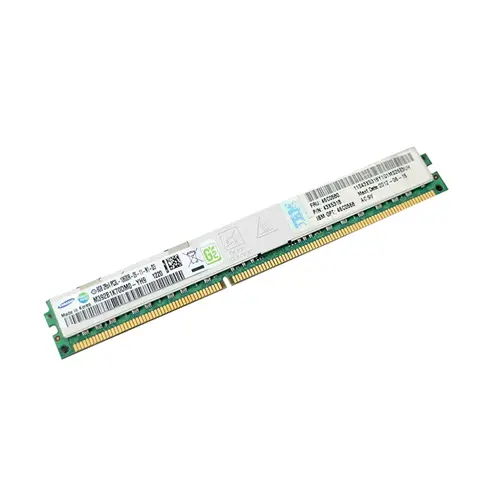
| Model | M392B1K70DM0-YH909 |
|---|---|
| Product Type | Memory Module |
| Compliance Standards | EU RoHS,FCC |
| Memory Capacity | 8 GB |
| Memory Technology | DDR3 |
| Product Voltage | 1.35V |
| RAM Speed | 1333MHz |
| RAM Standard | DDR3-1333/PC3-10600 |
| Error Identifying | ECC |
| Signal Type | Registered |
| Column Access Strobe (CAS) | CL9 |
| Rank | Dual Rank x4 |
| Quantity of Pins | 240-pin |
| RAM Genre | VLP RDIMM |
Designed for energy-efficient server deployments, this Samsung 8GB DDR3 VLP RDIMM operates at 1.35V with ECC and registered signaling to ensure data integrity in virtualized environments and memory-intensive applications like in-memory databases. Its dual-rank x4 configuration and low-profile form factor optimize signal stability and thermal clearance in dense 1U rack servers, while the 1333MHz CL9 timing delivers a balanced blend of latency and throughput for sustained enterprise workloads.
1. Registered buffer logic decouples the electrical load from the memory controller, enabling massive multi-DIMM configurations that maintain unwavering signal integrity in dense virtualization hosts.
2. End-to-end ECC protection silently detects and corrects single-bit errors in real time, safeguarding critical enterprise databases and financial transactions from silent data corruption.
3. Dual Rank x4 organization interleaves access across internal banks, maximizing sustained channel utilization and delivering predictable low-latency throughput for heavy virtual machine consolidation.
4. Very low profile form factor reduces the module height to fit ultra-dense 1U and blade server sleds, optimizing front-to-back airflow and allowing more compute nodes per rack unit.
5. Low-voltage operation significantly cuts power consumption per DIMM, which directly translates into reduced cooling overhead and lower operational expenditure in scale-out data centers.
The M392B1K70DM0-YH909 is unmistakably a server memory module, a VLP Registered DIMM with ECC, purpose-built for data centers where reliability and runtime efficiency are non-negotiable. Its four defining characteristics directly address the most painful realities of enterprise workloads. First, ECC error correction is the frontline defense against silent bit-flips caused by background radiation or electrical noise. In a virtualization cluster running dozens of VMs on a single host, an uncorrected memory error can cascade into corrupted databases or unexplained hypervisor crashes, turning a minor hardware event into a multi-tenant outage. Second, the registered buffer enables stable, high-capacity memory configurations by re-driving address and command signals. This eliminates signal degradation when all DIMM slots are populated, which is essential for memory-hungry hypervisors that require 128 GB or more of RAM without sacrificing stability. Third, the dual-rank x4 organization leverages rank interleaving to boost effective bandwidth. For an in-memory database like SAP HANA or a busy Redis cluster, this architecture reduces access latency and prevents bank conflicts, unlocking faster query responses during peak transaction loads. Finally, the 1.35 V low-voltage operation dramatically cuts power draw and waste heat. When deployed across a fleet of 1U blade servers, the cumulative savings on energy and cooling are substantial, while the VLP form factor ensures it fits seamlessly into dense chassis, improving airflow and long-term reliability. Together, these features mean your virtualized infrastructure stays up, your real-time analytics run faster, and your operational overhead stays down.
The provided module (Samsung M392B1K70DM0-YH909) is server-class memory: a DDR3-1333 Registered ECC VLP RDIMM with 8 GB capacity. Below is capacity planning guidance for typical server workloads.
General Virtualization
Balanced capacity and bandwidth are essential. Start with a minimum of six identical 8 GB modules (48 GB) across the memory channels in a dual-socket server, aiming for one DIMM per channel to preserve the full 1333 MHz speed. Scale to 12 modules (96 GB) to comfortably host dozens of virtual machines, relying on registered ECC to safeguard uptime.
In-Memory Database
These workloads demand maximum capacity and resilience. Fully populate all DIMM slots, taking advantage of the registered design; a 24‑slot server yields 192 GB using these VLP modules, which fits easily into 1U chassis without thermal restriction. Always install matched sets across channels to maintain consistent ECC protection and uniform latency.
High-Performance Computing (HPC)
Peak memory bandwidth is the priority. Install one DIMM per channel (e.g., eight modules in an 8‑channel dual‑processor node for 64 GB) to sustain the rated DDR3-1333 frequency without rank‑related downclocking. The VLP form factor reduces airflow blockage in dense racks, and populating every channel identically with these dual‑rank x4 RDIMMs maximizes throughput per core.
Rigorously tested for servers; compatible with Dell PowerEdge R720, HP DL380p Gen8, Lenovo x3650 M4, Supermicro X9.
Q: Can I mix this M392B1K70DM0-YH909 with other memory modules of different brands or speeds?
A: Mixing different brands or speeds with this registered ECC RDIMM is strongly discouraged. It may cause system instability or boot failures. Always use identical modules for guaranteed compatibility and reliability.
Q: Is this memory compatible with my system?
A: This DDR3-1333 Registered ECC VLP RDIMM is designed for server platforms like Intel Xeon E5/E3 or AMD Opteron. Please verify your server board's QVL for 240-pin RDIMM support to ensure proper compatibility.
Q: What is the recommended DIMM population order for optimal performance?
A: Follow your server board’s manual, typically populating the farthest slot from the CPU per channel first. Balance identical DIMMs across all memory channels for optimal interleaving and maximum throughput.
Q: Does this module support overclocking or XMP profiles?
A: No. As a server Registered ECC module, it adheres strictly to JEDEC DDR3-1333 CL9 standards. Overclocking and XMP are disabled to guarantee data integrity and long-term stability in enterprise environments.
Q: What warranty and typical failure rate can I expect?
A: This Samsung module comes with a 1-year warranty. Enterprise-grade ECC memory has an extremely low AFR, typically well below 0.3%, ensuring high reliability for 24/7 server operations.