











 Secure payments
Standard refund policy
Trade Assurance
Secure payments
Standard refund policy
Trade Assurance
| Model | M393B1K70CH0-CH9Q |
|---|---|
| Product Type | Memory Module |
| Compliance Standards | EU RoHS,FCC |
| Memory Capacity | 8 GB |
| Memory Technology | DDR3 |
| Product Voltage | 1.5V |
| RAM Speed | 1333MHz |
| RAM Standard | DDR3-1333/PC3-10600 |
| Error Identifying | ECC |
| Signal Type | Registered |
| Column Access Strobe (CAS) | CL9 |
| Rank | Dual Rank x4 |
| Quantity of Pins | 240-pin |
| RAM Genre | RDIMM |
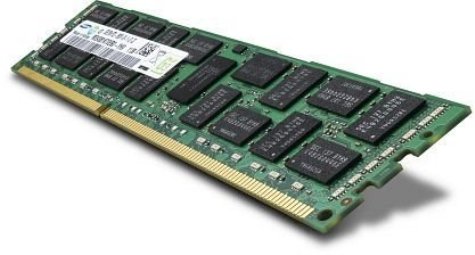
Designed specifically for server-class platforms, this Samsung 8GB DDR3-1333 Registered DIMM with ECC ensures data integrity and system stability for virtualization, in-memory databases, and mission-critical enterprise workloads. Its dual-rank x4 organization enhances memory bandwidth utilization in multi-DIMM configurations, while the CL9 latency and registered signal buffering maintain reliable operation under heavy, sustained load.
1. Registered signal buffering reduces electrical loading on the memory bus, enabling a server to populate all DIMM slots densely and sustain stable operation across large virtualized clusters.
2. ECC protection silently corrects single-bit errors in real time, preserving data integrity for financial transactions and preventing silent corruption in long-running database instances.
3. Dual Rank x4 organization keeps bank groups busy in parallel, delivering consistent memory bandwidth when multiple virtual machines compete for I/O under heavy consolidation.
4. An 8GB module provides a moderate capacity building block that simplifies right-sizing memory for entry-to-midrange servers and avoids stranded resources in balanced configurations.
5. The 1333MHz clock rate supplies dependable, validated throughput for legacy enterprise platforms, ensuring stable multi-DIMM synchronization without introducing timing marginalities.
The Samsung M393B1K70CH0-CH9Q is a registered DDR3 server memory module engineered for mission-critical enterprise environments, where unplanned downtime is not an option. Its defining feature is ECC (Error-Correcting Code), which actively detects and corrects single-bit memory errors caused by background radiation or electrical noise. In a dense virtualization cluster hosting dozens of VMs, this means a flipped bit will not silently corrupt a financial transaction or crash a critical application overnight—data integrity remains absolute. The Registered (RDIMM) architecture with an onboard register buffers command and address signals, dramatically stabilizing signal integrity when you populate all 24 DIMM slots in a high-capacity server. This allows you to scale up to massive memory footprints for in-memory databases like SAP HANA without sacrificing reliability. Furthermore, the dual-rank x4 organization enables rank interleaving, effectively overlapping data accesses to improve sustained bandwidth under heavy, multi-threaded workloads. Running at a validated 1.5V and 1333MHz with CL9 timings, this module delivers predictable, power-efficient performance. For your legacy platform refresh or capacity expansion, it is not just an upgrade—it is an insurance policy against silent data corruption and performance degradation that directly impact your bottom line.
Based on the DDR3, ECC, Registered 240-pin RDIMM specs, this is server memory. The 8GB modules operate at 1333MHz CL9 dual-rank. Below is capacity planning for typical workloads.
General Virtualization
Maximize VM density with generous capacity. Populate all memory channels with 8GB modules to reach at least 128GB (e.g., 16 sticks on a dual-socket server). This prevents swapping and the ECC ensures multi-tenant stability.
In-Memory Database
In-memory databases require the largest possible memory footprint. Fill every DIMM slot and use two modules per channel if allowed, accepting potential frequency reduction. A 256GB configuration (32 x 8GB) keeps entire datasets in RAM, dramatically reducing storage I/O.
High Performance Computing (HPC)
Bandwidth and latency are critical. Install only one 8GB DIMM per channel to retain the full 1333MHz speed and eliminate rank contention. For a dual-socket platform with four memory channels per CPU, eight modules deliver 64GB of high-bandwidth capacity ideal for parallel simulations and scientific computing.
Validated for servers: rigorously tested, compatible with Dell PowerEdge R720/R620, HP ProLiant DL380p Gen8, Lenovo ThinkServer RD630, and more.
Q: Can I mix this M393B1K70CH0-CH9Q with other memory modules of different brands or speeds?
A: Mixing is not recommended for server environments. Mismatched RDIMMs may cause instability or fallback to the lowest common speed. For guaranteed reliability and data integrity, maintain identical part numbers across all channels.
Q: Is this memory compatible with my Intel Xeon or AMD EPYC server platform?
A: This DDR3 registered ECC module is designed for Intel Xeon E5-2600/E5-2400 v1/v2 series and equivalent AMD G34/C32 platforms. Verify your motherboard’s qualified vendor list supports 8GB RDIMMs at 1333MHz for seamless operation.
Q: What is the recommended DIMM population order for optimal performance?
A: Populate identical DIMMs per memory channel, starting with the farthest slot from the CPU. For dual-processor boards, balance modules equally across both CPU memory risers, and always match capacity and rank per channel for maximum throughput.
Q: Does this module support overclocking or XMP profiles?
A: No. This JEDEC-compliant server RDIMM does not support overclocking or XMP. It is engineered for fixed 1333MHz operation at CL9 with strict signal integrity for enterprise-class stability and error-free 24/7 mission-critical workloads.
Q: What warranty and typical failure rate can I expect?
A: This module carries a one-year warranty. Enterprise-grade ECC RDIMMs exhibit an annualized failure rate well below 0.5% under normal server operating conditions, offering exceptional long-term reliability for data centers and professional systems.