











 Secure payments
Standard refund policy
Trade Assurance
Secure payments
Standard refund policy
Trade Assurance
| Model | M392B1G73BH0-YH9 |
|---|---|
| Product Type | Memory Module |
| Compliance Standards | EU RoHS,FCC |
| Memory Capacity | 8 GB |
| Memory Technology | DDR3 |
| Product Voltage | 1.35V |
| RAM Speed | 1333MHz |
| RAM Standard | DDR3-1333/PC3-10600 |
| Error Identifying | ECC |
| Signal Type | Registered |
| Column Access Strobe (CAS) | CL9 |
| Rank | Dual Rank x8 |
| Quantity of Pins | 240-pin |
| RAM Genre | VLP RDIMM |
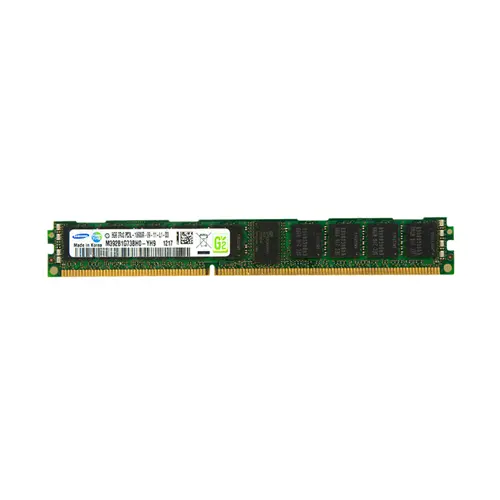
Ideal for virtualization and in-memory database workloads, this Samsung M392B1G73BH0-YH9 DDR3 VLP RDIMM leverages registered signal buffering and ECC to ensure robust signal integrity and data reliability in high-density server environments. Its dual-rank x8 organization at 1.35V low voltage and CL9 latency balances performance with energy efficiency, making it perfectly suited for space-constrained 2U/1U rack servers running memory-intensive enterprise applications.
1. The integrated ECC engine detects and corrects single-bit errors in real time, safeguarding financial and database transactions from silent data corruption that could disrupt 24/7 operations.
2. Registered signal buffering decouples chip loading from the memory controller, allowing fully populated 3DPC configurations without signal degradation on high-core-count virtualization hosts.
3. The Very Low Profile RDIMM form factor sits just 18.75mm tall, significantly improving front-to-back airflow in dense 1U/2U chassis and reducing fan power needed to cool the rack.
4. 1.35-volt low-power operation slashes overall power draw across multi-node data center deployments, yielding a lower PUE and prolonged service life through reduced thermals.
5. Dual Rank x8 organization leverages rank interleaving to hide precharge and refresh gaps, nearly saturating channel bandwidth so numerous guest VMs feel equally responsive under consolidation.
The M392B1G73BH0-YH9 is engineered as a server-class 8GB DDR3 VLP RDIMM, and its four defining characteristics directly address the most critical pain points in modern data centers. First, ECC protection continuously scrubs and corrects single-bit errors, which is non-negotiable in virtualized clusters where silent data corruption can ripple across dozens of tenant workloads; in a memory-centric database like SAP HANA, this ensures transactional accuracy without costly query retries. Second, the Registered buffer redistributes clock signals cleanly, enabling you to populate all channels without signal degradation—this means a single host can confidently scale to hundreds of virtual machines under VMware or KVM without random DIMM dropouts. Third, 1.35V low-voltage operation cuts thermal load substantially across a fully populated rack, translating directly into lower power bills and less throttling in dense blade deployments. Finally, the dual-rank x8 organization leverages rank interleaving to enhance achievable bandwidth for in-memory caching platforms, while the Very Low Profile form factor slips seamlessly into 1U pizza-box servers, maximizing cooling clearance. Together, these elements turn a simple memory module into a strategic asset for uptime, density, and total cost of ownership.
Server Memory Type Identified
The module M392B1G73BH0-YH9 is a DDR3-1333 Registered ECC VLP RDIMM with 8 GB capacity, 1.35V low voltage, and dual-rank x8 organization. It is exclusively a server-grade memory module.
General Virtualization
Deploy multiple identical 8 GB modules to populate all memory channels evenly—commonly four or six modules per host for 32–48 GB total. This balanced configuration maximizes memory bandwidth for hypervisor overhead and mixed VM workloads, while Registered ECC safeguards data integrity across numerous virtual machines.
In-Memory Database
Maximize capacity per server by installing all available DIMM slots with these 8 GB RDIMMs, often reaching 128 GB or more in dual-socket systems. Large, low-latency memory pools keep entire datasets resident, and ECC protection is critical for transactional consistency. Pay attention to dual-rank loading limits to avoid frequency downgrades under heavy slot population.
High-Performance Computing
Populate one DIMM per channel to sustain 1333 MHz speed and leverage dual-rank interleaving for near-peak throughput per core. Typical HPC nodes use eight or sixteen modules for 64–128 GB, balancing capacity against memory bandwidth demands of MPI-parallel simulations. The 1.35V VLP form factor also reduces power and thermal strain in dense rack deployments.
Rigorously tested server memory, compatible with Dell PowerEdge R720, HP ProLiant DL380p Gen8, and Lenovo ThinkServer RD630.
Q: Can I mix this M392B1G73BH0-YH9 with other memory modules of different brands or speeds?
A: Mixing is strongly discouraged. For server platforms, all installed RDIMMs should share identical rank, timing, and ECC characteristics. Mixed modules will operate at the lowest common speed, often compromising stability.
Q: Is this memory compatible with my system?
A: Compatibility requires a server motherboard with 240-pin DDR3 slots that explicitly supports Registered ECC RDIMMs. Please verify against the system’s qualified vendor list (QVL) for Intel or AMD DDR3 server platforms.
Q: What is the recommended DIMM population order for optimal performance?
A: Populate identical modules per channel, typically filling blue or primary slots first. Always consult the server motherboard manual for specific rules to leverage multi-channel interleaving and maintain signal integrity.
Q: Does this module support overclocking or XMP profiles?
A: No, this is a server-grade Registered ECC module. It complies strictly with JEDEC DDR3-1333 standards and does not support overclocking or Intel XMP profiles to ensure data integrity and 24/7 stability.
Q: What warranty and typical failure rate can I expect?
A: This module includes a 1-year warranty. Engineered for mission-critical environments, it delivers a very low annualized failure rate (AFR) when operated within specified voltage and thermal parameters.