











 Secure payments
Standard refund policy
Trade Assurance
Secure payments
Standard refund policy
Trade Assurance
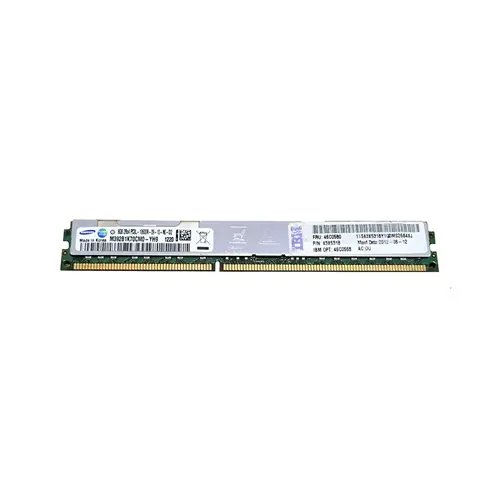
| Model | M392B1K70CM0-YH9 |
|---|---|
| Product Type | Memory Module |
| Compliance Standards | EU RoHS,FCC |
| Memory Capacity | 8 GB |
| Memory Technology | DDR3 |
| Product Voltage | 1.35V |
| RAM Speed | 1333MHz |
| RAM Standard | DDR3-1333/PC3-10600 |
| Error Identifying | ECC |
| Signal Type | Registered |
| Column Access Strobe (CAS) | CL9 |
| Rank | Dual Rank x4 |
| Quantity of Pins | 240-pin |
| RAM Genre | VLP RDIMM |
Designed as a very low-profile registered DIMM with ECC, this DDR3-1333 module is ideal for dense server and virtualization platforms where space constraints demand VLP form factors and data integrity is non-negotiable. Its dual-rank x4 organization improves memory interleaving for higher throughput in memory-database and consolidation workloads, while the 1.35V low-voltage operation and registered signaling ensure reliable, energy-efficient scaling across multiple ranks per channel.
1. Registered signal type buffers the command and address lines, allowing multiple DIMMs per channel without signal degradation so servers can scale memory capacity for large in-memory databases and virtualization hosts.
2. ECC error correction detects and corrects single-bit memory faults in real time, shielding mission-critical workloads from silent data corruption and unplanned downtime.
3. Dual Rank x4 organization interleaves memory accesses across two internal ranks, increasing sustained bandwidth that keeps multi-tenant cloud instances responsive under heavy consolidation.
4. 1.35V low-voltage operation significantly cuts power consumption per module, which reduces overall thermal load in dense racks and extends the lifespan of surrounding server components.
5. VLP RDIMM form factor allows vertical clearance in compact 1U and blade servers, preserving unobstructed front-to-back airflow for consistent cooling across fully populated memory slots.
When you are running a dense virtualization cluster or an in-memory database where every transaction must be absolutely reliable, the Samsung M392B1K70CM0-YH9 module shifts from being a simple component to a critical safeguard. This DDR3-1333 VLP RDIMM operates at 1.35V, a low-voltage design that directly cuts thermal load in cramped server chassis, allowing you to pack more VMs into the same rack without cooling bottlenecks. The registered signal type with ECC is non-negotiable here: in a hypervisor hosting dozens of virtual machines, a single uncorrected bit-flip can silently corrupt guest data or crash critical services. ECC corrects single-bit errors on the fly, while the register buffers the command and address lines, maintaining signal integrity across fully populated 24-slot boards—essential for scaling up to hundreds of gigabytes without timing failures. Its dual-rank x4 organization further benefits database workloads by enabling interleaving, which lowers latency under simultaneous read/write streams. For a Redis or Memcached node serving millions of operations per second, that means consistent sub-millisecond response even as dataset size grows. In both virtualized infrastructure and high-speed caching layers, this memory does not just store data; it preserves the business logic, uptime, and customer trust that your architecture depends on.
General Virtualization
For a dual-socket server with quad-channel memory architecture, populate one 8 GB VLP RDIMM per channel (8 modules total) to achieve 64 GB while maintaining full 1333 MHz speed. This configuration balances cost and density, supporting 20–30 light to moderate VMs. If higher density is needed, scale to 128 GB using 16 identical modules, still respecting balanced channel population.
In-Memory Database
Maximize capacity by filling all available DIMM slots with these 8 GB registered ECC modules. A 4-channel platform with 3 DIMMs per channel yields 96 GB per socket, ideal for Redis or Memcached workloads demanding low latency and data durability. Always use identical dual-rank x4 modules to preserve signal integrity and avoid clocking down to 1066 MHz under mixed loads.
High-Performance Computing
Configure one 8 GB RDIMM per memory channel (1DPC) to guarantee full DDR3-1333 operation, delivering peak bandwidth for memory-bound MPI or simulation codes. For a dual-socket system with four channels per CPU, this gives 64 GB total; larger workloads should scale horizontally across nodes rather than exceeding 2DPC, which would force a speed drop and hurt floating-point throughput.
Validated server memory, rigorously tested. Compatible with Dell PowerEdge R720, HP ProLiant DL380p Gen8, and Supermicro X9 platforms.
Q: Can I mix this M392B1K70CM0-YH9 with other memory modules of different brands or speeds?
A: Mixing brands or speeds is not recommended for Registered DIMMs. Different modules may cause signal conflicts and instability. For mission-critical server environments, populate all channels with identical modules to ensure reliable, validated performance.
Q: Is this memory compatible with my system?
A: This DDR3-1333 Registered ECC RDIMM is designed for dual-processor platforms like Intel Xeon E5-2600 v1/v2 or AMD Opteron 6300 series. Verify your server board’s memory QVL for full compatibility and supported configurations.
Q: What is the recommended DIMM population order for optimal performance?
A: For dual-rank x4 RDIMMs, populate identical modules across memory channels for balanced interleaving. Typically, fill blue or white slots first per CPU. Always consult the server motherboard manual for specific population rules.
Q: Does this module support overclocking or XMP profiles?
A: No, this server-grade module does not support overclocking or XMP. It strictly adheres to JEDEC DDR3-1333 specifications at CL9, prioritizing data integrity and 24/7 stability over performance tuning in enterprise environments.
Q: What warranty and typical failure rate can I expect?
A: This module comes with a one-year warranty. As an enterprise-class Registered DIMM, it demonstrates a very low annualized failure rate (typically under 0.2%), ensuring reliable long-term operation in data center deployments.