











 Secure payments
Standard refund policy
Trade Assurance
Secure payments
Standard refund policy
Trade Assurance
| Product Type | Memory Module |
|---|---|
| Memory Capacity | 8 GB |
| Memory Technology | DDR3 |
| Product Voltage | 1.5 V |
| RAM Speed | 1333 MHz |
| RAM Standard | DDR3-1333/PC3-10600 |
| Error Identifying | ECC |
| Signal Type | Registered |
| Column Access Strobe (CAS) | CL9 |
| Rank | Dual Rank x4 |
| Quantity of Pins | 240-pin |
| RAM Genre | RDIMM |
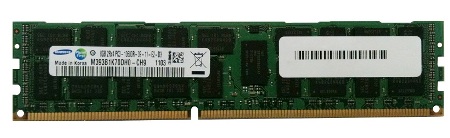
Designed as an 8GB DDR3-1333 registered ECC module with a dual-rank x4 organization, this RDIMM is built for server platforms requiring robust data integrity and moderate memory density, making it well-suited for virtualization hosts and in‑memory databases. Its registered signal architecture stabilizes high‑capacity memory controllers under concurrent load, while ECC and a CAS latency of 9 cycles mitigate single‑bit errors and reduce access latency in mission‑critical workloads.
1. ECC protection automatically corrects single-bit errors, safeguarding transactional data integrity for always-on enterprise applications.
2. Registered signal buffering enables stable operation across fully populated memory channels, ensuring reliable uptime in multi-DIMM server configurations.
3. An 8 GB capacity provides sufficient headroom for lightweight virtualization hosts or dedicated caching appliances in cost-optimized legacy data centers.
4. Dual Rank x4 organization leverages bank interleaving to boost effective memory throughput, reducing latency spikes during concurrent database queries.
5. 1333 MT/s transfer rate delivers 10.6 GB/s of peak bandwidth per channel, sustaining steady performance for moderate web and file serving workloads.
Based on the RDIMM genre and registered signal type, this is unequivocally a server memory module, designed for enterprise environments where data integrity and sustained uptime are non-negotiable. The M393B1K70DH0-CH9’s four defining characteristics—ECC error correction, registered buffering, dual-rank x4 architecture, and CL9 low latency—directly resolve critical operational pain points. In a virtualized cluster running dozens of VMs, ECC silently detects and corrects single-bit errors before they cascade into hypervisor crashes or corrupt data within a tenant; a flipped bit in a virtual switch table could otherwise bring down an entire service. Registered buffering re-drives address and command signals, ensuring clean signal integrity even when all DIMM slots are populated—allowing you to scale memory density for dense virtualization without instability. The dual-rank x4 design enables rank interleaving, which significantly increases sustained bandwidth under concurrent access patterns. When an in-memory database like Redis or SAP HANA serves thousands of queries per second, this parallel access reduces bottlenecks, while the CL9 latency shaves critical nanoseconds off each data retrieval, accelerating transaction commit times. For the data center operator, that translates directly into higher VM density, bulletproof data protection, and faster real-time analytics.
Server Memory Capacity Planning: DDR3-1333 ECC RDIMM (8GB Module)
General Virtualization
For moderate consolidation of 10–15 light to medium VMs per host, populate at least six 8 GB RDIMMs (48 GB total) evenly across all memory channels to maintain balanced interleaving and reliable ECC performance. Use identical dual-rank x4 modules to avoid clock speed downgrades and ensure stable over-subscription headroom.
In-Memory Database
In-memory workloads demand both capacity and sustained throughput. Deploy a minimum of twelve 8 GB modules (96 GB) in a balanced triple-channel configuration, leveraging the registered nature to keep signal integrity intact under full population. Scale to 128 GB or beyond if the dataset grows, always matching rank and CAS latency (CL9) to prevent latency spikes during large cache flushes.
High Performance Computing (HPC)
HPC nodes benefit from maximum bandwidth rather than extreme capacity per core. Install six or twelve 8 GB RDIMMs (48–96 GB) across all memory channels—populating one or two DIMMs per channel—to achieve peak 1333 MT/s throughput. Dual-rank x4 organization already maximizes bank-level parallelism; avoid mixing ranks or speeds, and fully utilize the 1.5 V specification for consistent power delivery under sustained floating-point loads.
Rigorously tested server memory, compatible with Dell PowerEdge R720, HPE ProLiant DL380p Gen8, Lenovo ThinkServer RD430.
Q: Can I mix this M393B1K70DH0-CH9 with other memory modules of different brands or speeds?
A: Mixing is not recommended. For server stability, all DIMMs should be identical in part number, speed, and rank. Different modules may force the system to the lowest common speed or cause boot failures.
Q: Is this memory compatible with my system?
A: This DDR3-1333 ECC Registered RDIMM is designed for Intel Xeon E5-2400 v1/v2 and select AMD Opteron platforms. Please verify that your server board supports dual-rank x4 8GB modules at 1.5V.
Q: What is the recommended DIMM population order for optimal performance?
A: Always follow your motherboard manual. Typically, populate identical DIMMs per channel, starting with the slots farthest from the CPU. Install in matched pairs to enable dual-channel operation and maximize bandwidth.
Q: Does this module support overclocking or XMP profiles?
A: No. This enterprise-grade RDIMM adheres strictly to JEDEC standards for data integrity. Overclocking and XMP profiles are not supported, ensuring reliable 24/7 operation in mission-critical environments.
Q: What warranty and typical failure rate can I expect?
A: This Samsung module carries a 1-year warranty. In properly cooled and maintained server environments, the annualized failure rate is typically below 0.1%, reflecting high reliability for enterprise deployments.