











 Secure payments
Standard refund policy
Trade Assurance
Secure payments
Standard refund policy
Trade Assurance
| Product Type | Memory Module |
|---|---|
| Memory Capacity | 8 GB |
| Memory Technology | DDR3 |
| Product Voltage | 1.5 V |
| RAM Speed | 1333 MHz |
| RAM Standard | DDR3-1333/PC3-10600 |
| Error Identifying | ECC |
| Signal Type | Registered |
| Column Access Strobe (CAS) | CL9 |
| Rank | Dual Rank x4 |
| Quantity of Pins | 240-pin |
| RAM Genre | RDIMM |
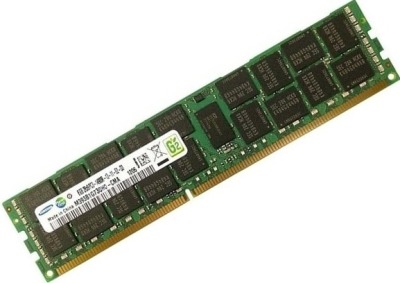
The 8GB DDR3-1333 RDIMM is engineered for server platforms, where its Registered signal buffering and ECC error correction deliver the data integrity essential for virtualization and memory-resident databases. Its dual-rank x4 configuration and CL9 latency optimize command scheduling and bandwidth, ensuring stable, efficient throughput in legacy enterprise systems operating at 1.5 V.
1. ECC memory proactively corrects single-bit errors, safeguarding transactional integrity in financial databases and long-running analytics that cannot tolerate silent data corruption.
2. Registered signal buffering strengthens command and address rails, enabling dense memory configurations across multiple channels for enterprise virtualization platforms.
3. Dual Rank x4 organization maximizes channel utilization through internal rank interleaving, delivering higher sustained bandwidth vital for hypervisors under heavy VM consolidation.
4. The capacity tier provides generous headroom per module, reducing the need for additional DIMMs and preserving precious server slots for future scaling.
5. The established DDR3 frequency guarantees consistent synchronous operation with legacy server platforms, ensuring dependable throughput for steady-state workloads.
As a Registered DDR3-1333 ECC memory module, the Samsung M393B1K70CHD-CH9 is engineered for server environments where uptime and data integrity aren’t just preferences—they’re non‑negotiable. Its ECC capability means every single‑bit error caused by background radiation or electrical noise is detected and corrected in real time. In a virtualized cluster hosting dozens of critical VMs, a silent memory flip in one guest can cascade into corrupted databases or system crashes overnight; ECC eliminates that risk entirely. The Registered signal buffer decouples the memory bus from the system controller, allowing you to populate all channels with multiple modules without signal degradation. This is vital in dense virtualization hosts and in‑memory databases like Redis or SAP HANA, where 128 GB or more must remain perfectly stable under relentless read/write pressure. The module’s Dual‑Rank x4 organization delivers tangible bandwidth gains through rank interleaving—the memory controller can pipeline commands across ranks, slashing idle latency and boosting throughput for large datasets. With a CAS latency of 9 clock cycles and a JEDEC‑standard 1.5 V operating voltage, this RDIMM balances responsive access with predictable thermal profiles, keeping your 24/7 database replicas cool and consistent without draining operational headroom. For your SQL analytics or OLTP engines, that translates to faster query execution and fewer transaction timeouts. In short, in any mission‑critical server, this module isn’t just storage—it’s insurance for your data, your uptime, and your operational reputation.
This 8GB DDR3-1333 Dual Rank x4 ECC Registered RDIMM is a server-class memory module. Use the following capacity planning guidance for typical workloads.
General Virtualization
For a dual-socket host, install at least six identical modules (one per channel) to enable balanced interleaving and provide 48 GB capacity. Scale to twelve modules (96 GB) by fully populating all channels for higher VM density without sacrificing memory bandwidth.
In-Memory Database
Maximize capacity by symmetrically filling every memory slot, for example 16 × 8 GB (128 GB). Identical dual-rank RDIMMs across all channels ensure consistent low latency, which is critical for large in-memory datasets and stable query performance.
High Performance Computing
Achieve peak memory bandwidth by placing one 8 GB module in each available channel (e.g., eight modules for an eight-channel platform). Uniform rank topology and equal DIMM population per CPU socket eliminate NUMA imbalance and sustain high floating-point throughput.
Rigorously tested server memory, compatible with Dell PowerEdge R720, HP ProLiant DL380p Gen8, and similar systems.
Q: Can I mix this M393B1K70CHD-CH9 with other memory modules of different brands or speeds?
A: Mixing modules is strongly discouraged in servers. Even with identical specs, subtle electrical differences can cause instability. For guaranteed reliability, always populate with identical, OEM-validated DIMMs like this Samsung RDIMM.
Q: Is this memory compatible with my system?
A: This DDR3-1333 ECC Registered RDIMM is designed for dual-socket Intel Xeon 5500/5600 series platforms and AMD Opteron 6100/6200 series. Verify your board requires 240-pin Registered DIMMs; it is incompatible with desktop systems.
Q: What is the recommended DIMM population order for optimal performance?
A: Populate identical DIMMs per memory channel, balancing across all CPU sockets. For servers, typically fill slots with the same white or black slot positions first, respecting channel interleaving as detailed in your system's service manual.
Q: Does this module support overclocking or XMP profiles?
A: No. This server-grade RDIMM adheres strictly to JEDEC DDR3-1333 CL9 specifications. Overclocking or XMP is not supported; it is engineered for maximum data integrity and 24/7 stability in mission-critical environments.
Q: What warranty and typical failure rate can I expect?
A: This Samsung module is covered by a 1-year warranty. For ECC RDIMMs, the AFR is exceptionally low (typically <0.2%), as they undergo rigorous screening and are designed for enterprise-level reliability.