











 Secure payments
Standard refund policy
Trade Assurance
Secure payments
Standard refund policy
Trade Assurance
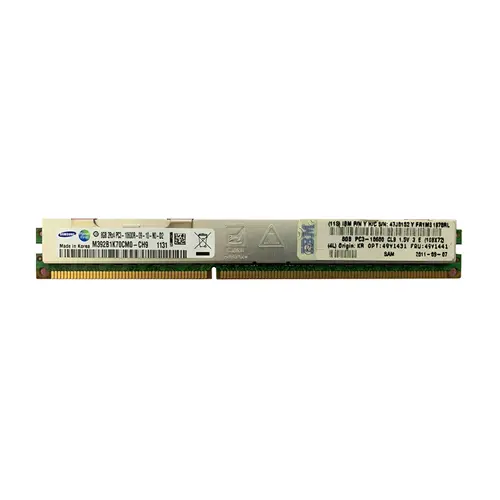
| Model | M392B1K70CM0-CH9 |
|---|---|
| Product Type | Memory Module |
| Compliance Standards | EU RoHS,FCC |
| Memory Capacity | 8 GB |
| Memory Technology | DDR3 |
| Product Voltage | 1.5V |
| RAM Speed | 1333MHz |
| RAM Standard | DDR3-1333/PC3-10600 |
| Error Identifying | ECC |
| Signal Type | Registered |
| Column Access Strobe (CAS) | CL9 |
| Rank | Dual Rank x4 |
| Quantity of Pins | 240-pin |
| RAM Genre | VLP RDIMM |
Designed specifically for server platforms, the Samsung M392B1K70CM0-CH9 is a DDR3-1333 VLP Registered DIMM with ECC, ideally suited for memory-intensive workloads such as virtualization and in-memory databases where data integrity is critical. Its registered signal type and dual-rank x4 organization enhance signal stability and memory channel efficiency, while ECC protection actively corrects single-bit errors to maintain uninterrupted system uptime in dense rack deployments.
1. Registered signal buffering stabilizes high-capacity memory arrays, enabling dense virtualization hosts to run more VMs without data integrity risks.
2. ECC protection corrects single-bit errors on the fly, preserving transaction accuracy in financial databases and critical enterprise workloads.
3. Dual Rank x4 organization maximizes bank interleaving, sustaining memory bandwidth under heavy multi-tenant database query concurrency.
4. VLP RDIMM form factor reduces module height, improving airflow through tight 1U server chassis and helping maintain consistent clock stability.
5. DDR3-1333/PC3-10600 operates at a balanced frequency-to-power sweet spot, keeping legacy server farm energy costs manageable while delivering sufficient throughput for web serving and content caching.
Designed specifically for the server environment, the Samsung M392B1K70CM0-CH9 VLP RDIMM transforms raw specifications into tangible data center reliability. Its ECC technology works silently in the background, detecting and correcting single-bit memory errors caused by cosmic radiation or electrical noise. In a memory database like SAP HANA, a single uncorrected bit flip can corrupt financial records or stop transactions dead in their tracks; ECC ensures that your in-memory ledger stays mathematically precise, preventing silent data corruption that standard memory would simply ignore.
The Registered signal buffer on this module means you can populate all 24 or 32 DIMM slots of a virtualization host without compromising signal integrity. For clusters running dozens of VMs under VMware, that stability lets you maximize RAM capacity for live migration and dense consolidation, eliminating the blue screens and random reboots that haunt unbuffered configurations under heavy load. Dual Rank x4 organization interleaves memory banks to push more bandwidth under concurrent access patterns, so virtual machines and containerized applications fetch data with lower latency, even when memory is fully allocated.
Finally, the Very Low Profile form factor is a critical enabler in 1U blade servers and high-density rack nodes. Where standard DIMMs would force a thermal bottleneck or collide with CPU coolers, this module’s reduced height improves airflow and allows vertically stacked designs, keeping your compute cluster cool and compact. From financial trading platforms to virtual desktop infrastructure, this Samsung module builds a foundation where data integrity, massive capacity, and physical fit work in perfect concert.
Capacity Planning for M392B1K70CM0-CH9
This module is a DDR3‑1333 VLP Registered ECC DIMM—a server memory type designed for stability, signal integrity, and dense deployments. Its 8GB capacity per stick, ECC error correction, and very low‑profile form factor suit multi‑socket rack servers. Use the scenarios below to plan your module population.
General Virtualization
Virtualized hosts balancing dozens of VMs need ample headroom and consistent latency. Populate all memory channels symmetrically with identical M392B1K70CM0‑CH9 modules—typically 8 to 12 sticks (64‑96GB) in a dual‑socket server—to enable channel interleaving. This configuration avoids bottlenecks during VM migration and bursts in memory demand while ECC guards against data corruption in multi‑tenant environments.
In‑Memory Database
Databases like Redis or SAP HANA demand maximum capacity and reliable throughput. Deploy a full population of 16 or more modules per node, targeting 128‑256GB total. With registered DIMMs and dual‑rank x4 organization, the memory controller can sustain high command rates, and ECC prevents silent bit‑flips in hot data. Pair motherboards supporting large‑capacity DDR3 RDIMMs and ensure all slots use identical parts for uniform latency.
High Performance Computing (HPC)
HPC workloads require peak bandwidth and low latency. Populate every available memory channel—often 8 modules per CPU in a quad‑channel architecture, increasing to 16+ for dual‑socket nodes—strictly with matched, same‑revision M392B1K70CM0‑CH9 sticks. The VLP design improves airflow in dense clusters, while consistent CAS‑9 timing and registered signaling enable stable high‑frequency interleaving critical for compute‑intensive simulations and parallel I/O patterns.
Rigorously tested server memory, compatible with Dell PowerEdge R720, HP DL380p Gen8, and more.
Q: Can I mix this M392B1K70CM0-CH9 with other memory modules of different brands or speeds?
A: Mixing brands or speeds is not recommended for this registered ECC module. It may cause system instability or fail to POST. Always use identical modules across all channels to ensure reliable server operation and data integrity.
Q: Is this memory compatible with my system?
A: This DDR3-1333 ECC Registered VLP RDIMM requires a server-class platform, such as Intel Xeon E5-2400/2600 v1/v2 series or equivalent AMD Opteron platforms. It will not work in standard desktop or laptop motherboards.
Q: What is the recommended DIMM population order for optimal performance?
A: Populate identical DIMMs per channel starting with the farthest slot from the CPU. Balance memory evenly across all channels for maximum bandwidth. Refer to your server motherboard's manual for the exact slot numbering sequence.
Q: Does this module support overclocking or XMP profiles?
A: No. This is a mission-critical server module adhering strictly to JEDEC DDR3-1333 CL9 standards for maximum stability. It does not support overclocking, XMP, or any non-standard voltage adjustments.
Q: What warranty and typical failure rate can I expect?
A: This module comes with a one-year warranty. It is an enterprise-grade component with extremely low AFR, extensively validated for 24/7 operation under rated server conditions to minimize downtime.