











 Secure payments
Standard refund policy
Trade Assurance
Secure payments
Standard refund policy
Trade Assurance
| Product Type | Memory Module |
|---|---|
| Memory Capacity | 8 GB |
| Memory Technology | DDR3 |
| Product Voltage | 1.5V |
| RAM Speed | 1333MHz |
| RAM Standard | DDR3-1333/PC3-10600 |
| Error Identifying | ECC |
| Signal Type | Registered |
| Column Access Strobe (CAS) | CL9 |
| Rank | Dual Rank x4 |
| Quantity of Pins | 240-pin |
| RAM Genre | RDIMM |
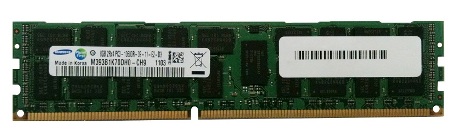
This DDR3-1333 registered ECC RDIMM is purpose-built for legacy server platforms requiring data integrity under sustained workloads. Its dual-rank x4 organization and registered signaling provide stable, high-capacity memory access ideal for virtualization and in-memory databases, where 1.5V ECC protection is critical for preventing silent data corruption in 24/7 operation.
1. Error-correcting code eliminates single-bit memory faults, preserving transactional integrity for mission-critical databases and financial processing.
2. Registered clock driver buffers signal distribution, allowing stable population of all DIMM slots across dense multi-socket server nodes.
3. Dual Rank x4 organization maximizes bank-level parallelism, sustaining high throughput for concurrent virtual machine operations under heavy consolidation.
4. Balanced memory bandwidth keeps multiple CPU cores fed during peak request bursts, ensuring consistent response times in web and application servers.
5. Standard voltage design guarantees predictable power draw and thermal behavior inside tightly packed rack enclosures, simplifying cooling and reliability management.
The Samsung M393B1K70DH0-CH9B is an enterprise-grade DDR3 Registered DIMM, engineered specifically for server platforms where data integrity and continuous uptime are absolute priorities. Its first critical feature, ECC, actively corrects single-bit errors in real time, shielding in-memory databases like SAP HANA from silent data corruption that could otherwise cascade into transactional inaccuracies or unexplained system crashes. Second, the registered buffer decouples the memory controller from heavy electrical loads, enabling fully populated 24-slot servers to operate stable, high-capacity configurations without signal degradation; this directly supports dense virtualization clusters hosting hundreds of virtual machines without memory-related blue screens. Third, the dual-rank x4 configuration leverages rank interleaving to overlap memory accesses across two internal rank groups, boosting effective bandwidth and slashing latency during intense Redis caching bursts or OLTP query storms. Finally, the fine-tuned CL9 latency at 1333MHz delivers predictable response times under mixed workloads, ensuring repetitive database lookups complete without microstalls. For infrastructure teams managing hyper-converged or virtualized environments, these four attributes translate directly into fewer undetected errors, linear scalability, and consistent application performance when every microsecond counts.
The provided module is an 8GB DDR3-1333 ECC Registered RDIMM (1.5V, CL9, dual-rank x4, 240-pin), identifying it as server memory. Capacity planning recommendations for common server workloads follow.
General Virtualization
Hypervisor hosts hosting multiple VMs quickly exhaust RAM. Equip each server with at least sixteen of these 8GB modules (128GB) distributed evenly across all memory channels to maintain balanced interleaving and NUMA performance. This provides headroom for memory overcommitment, live migration, and fault tolerance.
In-Memory Database
Platforms like SAP HANA or Redis require maximum capacity and absolute data integrity. Populate every DIMM slot with these ECC RDIMMs to achieve the highest possible footprint—a 24-slot server yields 192GB. The registered buffering and error correction ensure stability under constant, demanding access.
High-Performance Computing
HPC codes are bound by memory bandwidth. Install one dual-rank x4 module per channel to maximize peak throughput; only add a second identical module per channel if problem size demands more capacity. Keeping all channels populated symmetrically avoids imbalances that lower effective bandwidth.
Rigorously tested for servers: Dell PowerEdge R720, HP ProLiant DL380p Gen8, and more.
Q: Can I mix this M393B1K70DH0-CH9B with other memory modules of different brands or speeds?
A: Mixing is not recommended for server environments. Different speeds default to the lowest common speed, and mixing with non-ECC or unbuffered modules may cause instability. Use identical RDIMMs for guaranteed reliability.
Q: Is this memory compatible with my system?
A: This DDR3-1333 registered ECC RDIMM works with servers using Intel Xeon E5/E7 or AMD Opteron platforms that support 8GB dual-rank modules. Always verify compatibility via the QVL or manufacturer's guidelines for your specific board.
Q: What is the recommended DIMM population order for optimal performance?
A: Follow your server's manual, but generally populate whitelisted slots first (e.g., A1, B1) to balance channels. For dual-processor systems, install identical modules per memory channel to maximize throughput.
Q: Does this module support overclocking or XMP profiles?
A: No. As an enterprise-grade registered ECC DIMM, it operates at fixed JEDEC timings (1333MHz, CL9) exclusively. Stability and data integrity preclude any overclocking or XMP functionality.
Q: What warranty and typical failure rate can I expect?
A: This module includes a 1-year warranty. Typical annualized failure rates are very low, under 0.5%, reflecting rigorous screening for 24/7 server workloads.