











 Secure payments
Standard refund policy
Trade Assurance
Secure payments
Standard refund policy
Trade Assurance
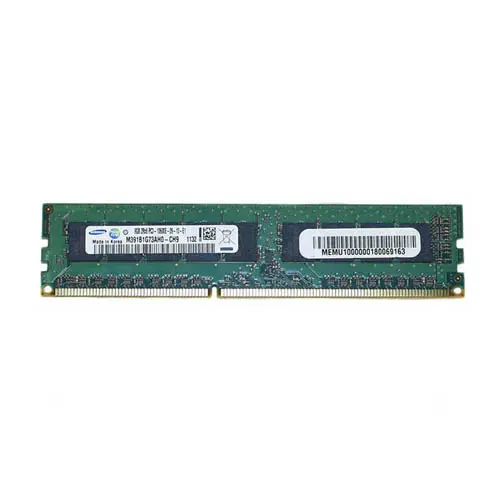
| Model | M391B1G73AH0-CH9 |
|---|---|
| Product Type | Memory Module |
| Compliance Standards | EU RoHS,FCC |
| Memory Capacity | 8 GB |
| Memory Technology | DDR3 |
| Product Voltage | 1.5V |
| RAM Speed | 1333MHz |
| RAM Standard | DDR3-1333/PC3-10600 |
| Error Identifying | ECC |
| Signal Type | Unbuffered |
| Column Access Strobe (CAS) | CL9 |
| Rank | Dual Rank x8 |
| Quantity of Pins | 240-pin |
| RAM Genre | UDIMM |
Designed for single-socket workstation and entry-level server platforms, this UDIMM combines unbuffered ECC at DDR3-1333 with a dual-rank x8 organization to deliver reliable data integrity and improved memory interleaving for modest virtualization or database workloads. Its CL9 latency and 1.5 V operation ensure stable, energy-conscious performance on motherboards requiring 240-pin ECC UDIMMs.
1. ECC protection detects and corrects single-bit memory errors on the fly, preserving data integrity for critical business applications where even a silent corruption can cascade into costly service outages.
2. Dual Rank x8 organization interleaves requests across two sets of DRAM banks, sustaining higher throughput under concurrent virtual machine and database workloads without adding latency.
3. The eight-gigabyte capacity meets the memory footprint of lightweight virtualization hosts, caching proxies, or branch-office file servers without overspending on unused DIMM slots.
4. Operating at 1333 megatransfers per second delivers balanced bandwidth that fully saturates DDR3-era server chipsets, keeping response times predictable during peak user access.
5. Unbuffered architecture eliminates the register clock delay, trimming access latency in small-scale servers where raw speed and electrical simplicity matter more than maximum capacity scaling.
When your server’s uptime isn't just a metric but a business promise, every component must earn its place. The Samsung M391B1G73AH0-CH9 is a DDR3 1333MHz 8GB UDIMM engineered with ECC (Error-Correcting Code), Dual Rank x8 organization, and a true 1.5V profile—purpose-built for entry-level servers and workstations where data integrity meets cost-conscious deployments. Unlike standard desktop memory, its ECC capability continuously detects and corrects single-bit errors in real time, a non-negotiable safeguard for virtualization clusters. Imagine an eight-VM host running diverse workloads: a silent cosmic ray flipping a single DRAM cell can corrupt a live database page or a hypervisor’s memory table, bringing down all tenants. ECC intercepts that silent corruption before it cascades into a costly outage. For in-memory databases like Redis or Memcached, where entire datasets persist solely in RAM, the Dual Rank x8 design further delivers rank interleaving, allowing the memory controller to access alternating ranks simultaneously and reduce effective latency under heavy transactional loads. With unbuffered architecture and standard 1.5V operation, this module keeps power and platform complexity low while still providing the error immunity needed for financial logging, remote replication nodes, or any scenario where you’d rather not gamble your data on electrical noise. It’s not just compliance—it’s the confidence to keep critical services running cleanly and continuously.
General Virtualization
For light to moderate consolidation, populate one 8 GB module per host to deliver 8 GB, or two modules for 16 GB dual-channel operation, which balances cost and VM density. For over 20 VMs on a single socket, install four identical M391B1G73AH0-CH9 modules (32 GB total) to avoid memory ballooning and swapping under contention.
In-Memory Database
In-memory workloads thrive on capacity and latency stability. Deploy six to eight modules (48–64 GB) to keep active datasets resident, using dual-rank x8 DIMMs to leverage rank interleaving for slight latency improvements. Avoid mixing dissimilar DIMMs; populate all channels symmetrically to maintain the rated CL9 timing and 1.5 V stability under sustained write pressure.
High-Performance Computing
HPC nodes typically favor memory bandwidth over sheer capacity. Install four or eight modules in a balanced dual-channel configuration to achieve the 21.3 GB/s theoretical peak per channel with DDR3-1333. Because these are unbuffered ECC DIMMs, limit the per-socket count to four for signal integrity, targeting 32 GB per node for mid-scale simulation or data-analysis pipelines.
Rigorously tested for servers, compatible with Dell PowerEdge R210 II, T110 II, HP MicroServer Gen8, Lenovo TS140.
Q: Can I mix this M391B1G73AH0-CH9 with other memory modules of different brands or speeds?
A: Mixing is not recommended for server environments. All modules should share identical ECC, rank, and speed to preserve data integrity and prevent system instability.
Q: Is this memory compatible with my Intel Xeon E3 or AMD Ryzen Pro server platform?
A: Yes, this UDIMM is compatible with platforms supporting DDR3 ECC Unbuffered memory, such as Intel Xeon E3-1200 series or select AMD AM3+ server boards.
Q: What is the recommended DIMM population order for optimal performance?
A: Install in identical pairs per channel, usually populating the slots furthest from the CPU first. Follow your server board's manual for exact configuration.
Q: Does this module support overclocking or XMP profiles?
A: No. As a server-grade ECC UDIMM, it operates strictly at JEDEC standard DDR3-1333 CL9 without support for overclocking or XMP.
Q: What warranty and typical failure rate can I expect?
A: This module comes with a one-year warranty. Samsung's enterprise memory typically exhibits an extremely low AFR, ideal for demanding reliable server operations.