











 Secure payments
Standard refund policy
Trade Assurance
Secure payments
Standard refund policy
Trade Assurance
| Product Type | Memory Module |
|---|---|
| Memory Capacity | 8 GB |
| Memory Technology | DDR3 |
| Product Voltage | 1.5 V |
| RAM Speed | 1333 MHz |
| RAM Standard | DDR3-1333/PC3-10600 |
| Error Identifying | ECC |
| Signal Type | Unbuffered |
| Column Access Strobe (CAS) | CL9 |
| Rank | Dual Rank x8 |
| Quantity of Pins | 240-pin |
| RAM Genre | UDIMM |
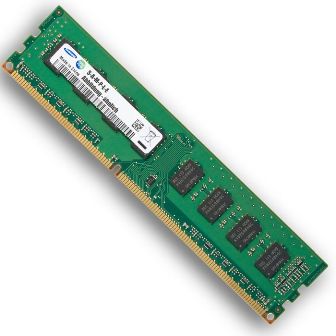
This DDR3-1333 UDIMM with ECC is ideally suited for entry-level servers and workstations requiring data integrity, where the unbuffered ECC design and dual-rank x8 configuration deliver balanced capacity and reliable error correction for light virtualization or NAS applications. Its 1.5V operating voltage and CL9 latency ensure stable, efficient performance on older platforms that demand cost-effective memory with strong fault tolerance.
1. Error Correction Code (ECC) constantly scans and repairs single-bit memory errors in real time, safeguarding transactional data integrity and virtually eliminating silent data corruption in always-on server environments.
2. An 8GB capacity per module strikes the right balance for entry-level virtualization hosts, allowing multiple lightweight VMs or containerized services to reside simultaneously without swapping to disk.
3. With a peak throughput of 10.6 GB/s per channel, the DDR3-1333 interface supplies ample bandwidth for handling concurrent file-sharing requests and moderate database workloads without creating a bottleneck.
4. The CL9 column access latency accelerates read-to-command turnaround, giving latency-sensitive server tasks such as in-memory caching and message queuing a noticeable responsiveness lift.
5. Dual Rank x8 organization keeps both internal memory banks interleaved under load, sustaining full channel utilization and delivering consistent multi-client throughput during peak operation windows.
For small business servers and entry-level workstations, the Samsung M391B1G73BH0-CH9 brings enterprise reliability into real-world operations where data integrity cannot be compromised. This 8GB DDR3-1333 UDIMM features ECC, which silently detects and corrects single-bit memory errors before they can corrupt your virtualization host or a sensitive in-memory database like Redis. Imagine running a hypervisor with several guest VMs; a random bit flip in an unprotected module could cascade into platform instability, causing hours of troubleshooting. The unbuffered architecture keeps latency low, providing the snappy response that database queries and file services demand every second. Its dual-rank x8 design interleaves memory banks, elevating effective bandwidth by up to 10% when multiple virtual machines contend for resources simultaneously, a real advantage when your accounting application and email server must coexist without lag. Operating at the industry-standard 1.5V, this module ensures rock-solid compatibility across a wide range of server boards while avoiding voltage-induced thermal headaches. This means predictable uptime and protection for the always-on workloads your business depends on.
Server Memory Identification
This 8GB DDR3-1333 ECC Unbuffered UDIMM (PC3-10600, CL9, dual-rank) is server-grade memory. Its ECC support and 1.5V operation suit single-socket servers or workstations where data integrity matters. Capacity planning must balance channel population, speed, and reliability for typical enterprise loads.
General Virtualization
Populate all memory channels identically to maximize bandwidth for hypervisor overhead. For a common 4-channel platform, install four or eight 8GB modules (32GB or 64GB total) to run a mixed workload of 10–20 light VMs. Always use identical ECC UDIMMs to avoid uncorrected errors and maintain stable memory interleaving.
In-Memory Database
Aim for the highest supported capacity using the largest practical module count. With 8GB sticks, fill all available slots—e.g., 24 slots on a dual-socket board yields 192GB—to keep entire datasets in RAM. Stick to dual-rank x8 DIMMs for optimal signal integrity, and ensure all modules share the same revision to prevent timing conflicts under sustained writes.
High-Performance Computing
Balance capacity and peak bandwidth by installing one DIMM per channel first, then adding a second matching DIMM per channel if needed. Avoid mixing single- and dual-rank kits; dual-rank 8GB modules maintain rated 1333MHz speed better than mix-matched sets. A typical 8‑slot node with 64GB (8×8GB) keeps ranks aligned and delivers consistent memory throughput for iterative simulations.
Server DDR3 ECC UDIMM rigorously validated for Dell PowerEdge R720, HPE ProLiant DL380p Gen8, Lenovo ThinkServer TS440.
Q: Can I mix this M391B1G73BH0-CH9 with other memory modules of different brands or speeds?
A: We strongly advise against mixing. For server environments, using identical modules ensures signal integrity and maximum stability. Mismatched brands, speeds, or timings may cause unpredictable memory errors and system instability under load.
Q: Is this memory compatible with my system?
A: This DDR3-1333 ECC Unbuffered UDIMM is designed for entry-level servers and workstations. It is compatible with platforms supporting ECC UDIMMs, such as Intel Xeon E3-1200 series or select AMD Opteron series. Please verify your motherboard’s QVL for confirmation.
Q: What is the recommended DIMM population order for optimal performance?
A: For dual-socket or single-socket servers, always populate identical DIMMs per channel starting with the slot furthest from the CPU. Follow the manual’s recommended sequence—typically filling blue slots first. Balanced channel loading maximizes memory bandwidth and ECC protection.
Q: Does this module support overclocking or XMP profiles?
A: No. This is a strictly JEDEC-compliant server memory module running at fixed DDR3-1333 CL9 timings. It does not support overclocking, XMP, or any dynamic frequency/voltage adjustments. Servers require deterministic, stable operation without timing variations.
Q: What warranty and typical failure rate can I expect?
A: This module is covered by a 1-year warranty. It meets enterprise-grade reliability standards with an extremely low annualized failure rate (AFR), typically well below 0.5% under normal operating conditions, ensuring robust long-term performance.